

Start tonight with five moves: go to bed and wake up at the same time daily, keep your bedroom cool, dark, and quiet, cut screens an hour before lights out, stop caffeine by early afternoon and alcohol at least three hours before bed, and skip naps after 3 p.m. That combination is the core of any sleep hygiene checklist. If you’re doing all of it and still lying awake most nights, the next step isn’t a new gadget. It’s cognitive behavioral therapy for insomnia, the treatment sleep specialists actually recommend for chronic cases.
Your Sleep Hygiene Checklist, Broken Down by Time of Day
Sleep hygiene is the set of daily habits and bedroom conditions that either support good sleep or quietly sabotage it. It’s not a cure for a diagnosed sleep disorder, but for most people dealing with restless nights, tossing, and 2 a.m. wakeups, it’s the first and most fixable lever. Harvard Health breaks these habits into environment and behavior, which is exactly how this checklist is organized: what you do all day, what you do in the hour before bed, and what happens once you’re actually under the covers.
Daytime habits that set up your night
What you do at 10 a.m. affects whether you sleep at 11 p.m. This is the part most people skip entirely, assuming sleep only matters once the lights go off.
- Wake up at the same time every day, weekends included. Your body’s internal clock resets off your wake time, not your bedtime, so this single habit does more heavy lifting than almost anything else on this list.
- Get outside within an hour of waking. Morning sunlight signals your brain to suppress melatonin and start the daytime clock, which makes falling asleep that night considerably easier.
- Exercise earlier in the day when you can. Mayo Clinic notes that intense exercise within two hours of bedtime can interfere with sleep for some people, though the effect varies person to person.
- Cut caffeine by early afternoon. Harvard’s guidance puts the cutoff at 6 to 8 hours before bed, so a 10 p.m. bedtime means your last coffee should happen by early afternoon at the latest.
- Keep naps under 30 minutes and finish them before 3 p.m. A longer, later nap eats into the sleep pressure you need to fall asleep that night.
Before bed: the wind-down that actually matters
The hour before bed is where most sleep problems get made, usually without anyone noticing. This is also the part of a bedtime routine for adults that gets skipped first when life gets busy, which is exactly backward.
- Finish eating 2 to 3 hours before bed. A full stomach keeps digestion active when your body is trying to power down, and heavy or spicy meals close to bedtime are a common, underrated cause of restless nights.
- Skip alcohol within about three hours of bed. It can make you drowsy at first, but Harvard Health points out it fragments sleep later in the night and cuts into REM sleep, which is why a nightcap often backfires.
- Set a device cutoff, ideally 30 to 60 minutes before lights out. It’s less about blue light and more about what’s on the screen: a work email or a group chat argument keeps your brain alert exactly when it should be winding down.
- Build a repeatable ritual. Reading, stretching, a warm shower, or a few pages of a journal all work. What matters is that your brain learns to associate the sequence with sleep, not the specific activity.
- Dim the lights an hour before bed. Bright overhead lighting delays the natural rise in melatonin your body needs to feel sleepy.
In bed: rules that protect the association between bed and sleep
Once you’re actually in bed, a different set of rules takes over, most of them focused on protecting your brain’s association between “bed” and “sleep.”
- Use the bed only for sleep and intimacy. Avoid wakeful activities in bed to help your brain associate bed with sleep.
- Keep the room around 65 to 68°F. A room that’s too warm is one of the most common, least discussed reasons people wake up at 3 a.m. and can’t fall back asleep.
- Block out light and sound. Blackout curtains, a white noise machine, earplugs, or a sleep mask all solve real, specific problems, so pick based on which one is actually disrupting you.
- Follow the 20-minute rule. If you’re not asleep in about 20 minutes, Mayo Clinic recommends getting out of bed, doing something relaxing in dim light, and returning only when you feel sleepy.
- Turn the clock away from you. Watching minutes tick by turns a normal wakeup into a stress spiral, and that stress is often what keeps you awake longer than the original disruption.
Pro Tip: Pick the one item on this list you’re currently doing worst, not the one that sounds most impressive. A person who fixes their caffeine cutoff often sees more improvement in a week than someone who buys blackout curtains but keeps drinking espresso at 3 p.m.
How to Actually Implement a Sleep Hygiene Routine Without Overhauling Your Life
Changing everything on the checklist at once feels productive, but it backfires. If you overhaul your bedroom, cut all caffeine, ban screens, and shift your bedtime by two hours in the same week, and your sleep improves, you’ll have no idea which change actually did it. Worse, if it doesn’t improve, you’ll have no idea what to fix. One change at a time, tracked over roughly two weeks, is a slower but far more reliable sleep hygiene routine to follow.
Here’s a simple rollout that respects how busy adult life actually works:
- Week 1: Lock in a consistent wake time, seven days a week, no exceptions. Don’t touch anything else yet.
- Week 2: Add a device cutoff, 30 to 60 minutes before your target bedtime.
- Week 3: Adjust caffeine timing, moving your last cup earlier by an hour or two.
- Week 4: Address the bedroom itself: temperature, light, and noise.
While you run this, Harvard Health recommends keeping a simple sleep diary for up to two weeks. You don’t need an app for this, though one can help if you’d rather not write things down. Track these fields each day:
- Time you got into bed and time you actually fell asleep (your best guess)
- Wake time and how many times you woke up overnight
- Caffeine amount and time of your last cup
- Alcohol, if any, and when you had it
- What time you exercised, if at all
- What time your devices went off
- A rough 1 to 5 rating of how you felt the next day
After two weeks, look for patterns rather than single bad nights. If every night you had a late coffee shows up as a rough sleep rating the next day, that’s your answer. One common measurement pitfall: wearable sleep trackers are convenient but notoriously rough at distinguishing light sleep from actual wakefulness, so treat the data as a general trend indicator, not a precise readout. A handwritten diary, oddly, often gives you a clearer signal because it forces you to actually notice your own habits instead of outsourcing that awareness to a device.
When the Checklist Isn’t Working: Quick Fixes and Red Flags
Sometimes the checklist is right but the execution is off. A few adjustments handle most of the common snags.
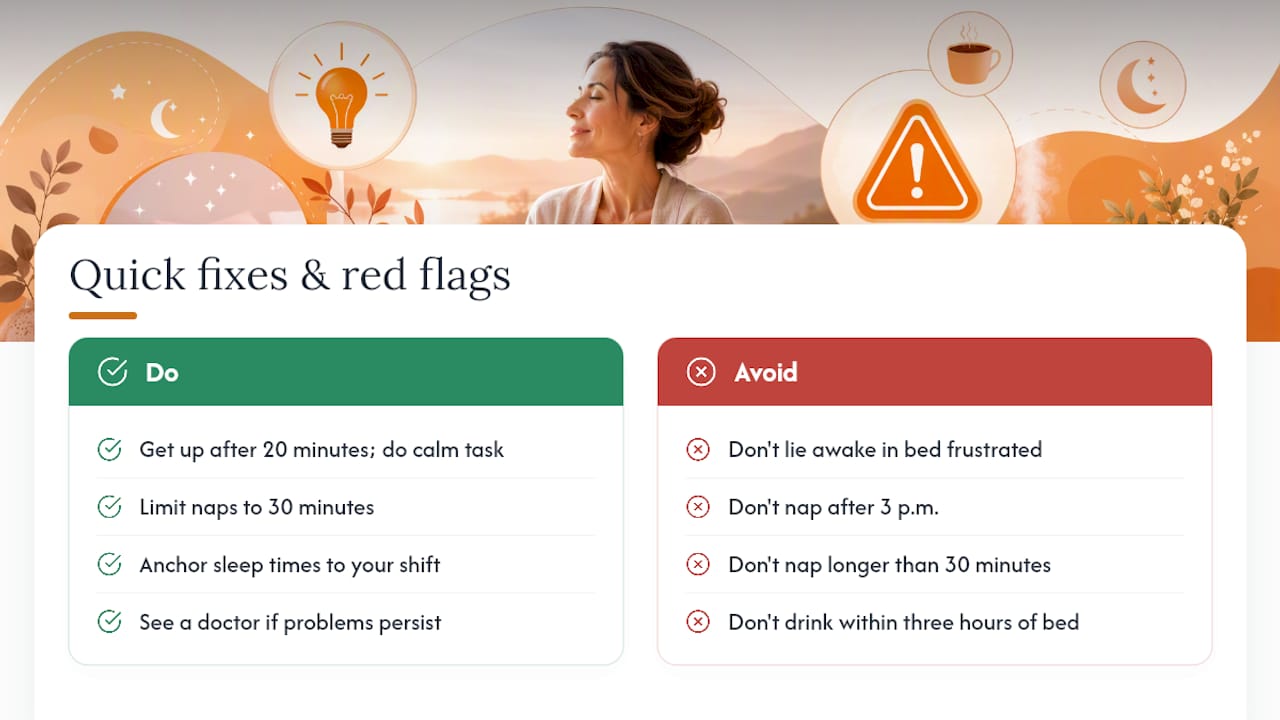
Can’t fall asleep after 20 minutes? Get up. Go to another dim room, do something boring and calm like folding laundry or reading a few pages, and return to bed only when you feel drowsy. Lying there getting frustrated trains your brain to associate bed with wakefulness, which is the exact opposite of what you’re trying to fix.
Napping wrecking your nights? Cap naps at 30 minutes and never nap after 3 p.m. A nap that feels harmless at 4:30 can quietly erode the sleep pressure you need at 10 p.m.
Still wired at bedtime despite doing everything right? Check your caffeine math again. The 6 to 8 hour cutoff applies to sensitivity, not just quantity, and some people metabolize caffeine far slower than others. Also check alcohol timing: even one drink within three hours of bed can fragment sleep later in the night.
Shift work throwing everything off? Consistency still matters, just anchored to your own schedule instead of the sun. Keep your sleep and wake times fixed relative to your shift, use blackout curtains aggressively during daytime sleep, and treat your “morning” light exposure as whatever hour you wake up, even if that’s 7 p.m.
Here’s the honest limit of this entire checklist: a clinical practice guideline from the American Academy of Sleep Medicine recommends against relying on sleep hygiene alone as a stand-alone treatment for chronic insomnia. If you’ve run the full checklist consistently for several weeks and you’re still struggling most nights, that’s the signal to talk to a doctor about CBT-I, the multicomponent behavioral therapy considered the first-line treatment for ongoing insomnia.
Stacy’s Take: What Actually Survives a Busy Week
Of everything on this list, the consistent wake time is the one that survives travel, deadlines, and a kid with a fever. It doesn’t require a dark bedroom or a special ritual, just discipline about one number. The device cutoff is the hardest to keep and the one I’ve watched slip first whenever life gets loud.
For caregiving nights or shift work, don’t aim for the ideal checklist. Aim for whichever two items are actually realistic that week, usually wake time and caffeine cutoff, and let the rest wait. Travel is its own category: a sleep mask and earplugs in a carry-on solve more problems than any app ever has.
Why the “Just Try Harder” Version of Sleep Advice Fails
Most sleep advice treats every tip as equally important, which sets people up to fail. The research is actually specific: consistent wake time and light exposure do more than any single evening ritual, and tracking behavior for two weeks beats guessing at what’s wrong.

The conventional wisdom oversells sleep hygiene as a complete fix. It’s a foundation, not a cure, and pretending otherwise leaves people with chronic insomnia stuck cycling through blackout curtains and lavender spray instead of asking their doctor about CBT-I, which actually has evidence behind it for their situation.
If you take one thing from this checklist, make it the wake time. Everything else is easier to adjust once that anchor is set, and it’s the habit most likely to survive a bad week instead of getting abandoned by Wednesday.
— Stacy Geisinger
Want More Ways to Wind Down Naturally?
This checklist covers the clinical basics, but real life adds its own wrinkles: what you eat, how you unwind, and the small rituals that make a bedtime routine feel less like a chore and more like something you look forward to. Stacyknows dives deeper into that side of things, from calming evening habits to the small lifestyle tweaks that make consistency easier to stick with.

If tonight’s checklist felt like the clinical half of the story, How to Naturally Get Better Sleep covers the other half: routines, products, and small daily shifts that make good sleep habits feel sustainable instead of like one more task on your list. Pair that with ideas from Stacyknows’s food and lifestyle coverage for evening rituals that actually make you want to put the phone down. Read it next, and start building the version of a nighttime routine that fits your actual week, not an idealized one.
Where This Checklist Comes From
This checklist draws on Harvard Health’s sleep hygiene guidance for daily habits and tracking, Mayo Clinic’s stimulus control guidance for the 20-minute rule, MedlinePlus for core checklist items, and the American Academy of Sleep Medicine’s clinical practice guideline on chronic insomnia treatment.
This article is general information, not a substitute for advice from a qualified doctor. Consult a qualified healthcare professional about your own circumstances before acting on anything here.
Sources
- Sleep hygiene: Simple practices for better rest – Harvard Health
- Combination treatment for chronic insomnia disorder in adults: an American Academy of Sleep Medicine clinical practice guideline – PMC
- Sleep: Healthy lifestyle — Mayo Clinic
- Healthy Sleep | MedlinePlus
FAQ
What is the 30-60-90 rule for sleep?
There’s no single clinically defined “30-60-90 rule” in sleep medicine; definitions vary across sources. Some use it informally to describe staged wind-down timing (30 to 60 minutes for screens off, dimming lights an hour before bed, finishing eating 2 to 3 hours before bed), but this checklist relies on the specific, sourced timing guidance above rather than that shorthand.
How long should I follow a sleep hygiene checklist before expecting results?
Give any single change about a week before judging it, and track it in a sleep diary for up to two weeks to see a real pattern rather than one good or bad night.
What if I do everything right and still can’t sleep?
That’s the point where sleep hygiene alone typically isn’t enough, and it’s worth asking a doctor about CBT-I, the first-line behavioral treatment for chronic insomnia.
Is it bad to check the clock when I can’t sleep?
Yes. Clock-watching turns a normal wakeup into anxiety about lost sleep, which makes falling back asleep harder. Turn the display away from your bed.
Can naps ruin a good sleep hygiene routine?
Long or late naps can. Keep naps under 30 minutes and finish by 3 p.m. so they don’t cut into the sleep pressure you need that night.
Recommended
- How to Naturally Get Better Sleep
- 10 Everyday Habits That Help Reduce Anxiety
- Practical Wellness Tips to Boost Health and Beauty
