

Breadcrumbing is when someone gives you just enough attention (a text, a like, a “we should hang out sometime”) to keep you interested without ever committing to an actual relationship. The name comes from the trail of tiny “crumbs” they drop so you keep following, even though there’s no meal waiting at the end. The result is chronic uncertainty, wasted emotional energy, and a slow erosion of trust in your own judgment.
What Breadcrumbing Meaning Looks Like in Real Life
Breadcrumbing rarely announces itself. It shows up as a pattern you only notice once you step back and count the weeks between “real” contact.
The clearest sign is inconsistency with intention behind it. Someone texts back after four days of silence, apologizes with something charming, then disappears again the moment you ask to make plans. Psychology Today describes this as intermittent, shallow contact, occasional messages, a stray like on your Instagram Story, a vague “we should catch up soon” that is engineered to keep hope alive without ever moving toward commitment.
Here’s what breadcrumbing actually sounds like in a message thread:
- “Sorry I’ve been MIA, work has been insane 😩 miss you though” (sent at 11:47 p.m., three weeks after the last real conversation)
- “We should do dinner sometime!” (no date, no follow-up, repeated for two months straight)
- A double-tap on your beach photo from someone who hasn’t answered your last three texts
- “You’re literally the best, I just have a lot going on right now” (with zero explanation of what “a lot” means or when it might change)
- A flirty comment on a group chat, followed by radio silence in your one-on-one thread
The pattern shows up across more than dating. It’s common with an ex who resurfaces every few months with a “thinking about you” text, a friend who only reaches out when they need something, or a boss who dangles a promotion conversation that never actually gets scheduled. Medical News Today notes that breadcrumbing appears in romantic relationships most often, but the same sporadic, low-effort contact pattern turns up in friendships, family dynamics, and professional settings too.
Dating apps make this dynamic almost effortless to sustain. A person can keep a match warm with zero investment: a quick reply here, a story reaction there, enough to stay visible in your notifications without ever booking a second date. If you’ve noticed a match who’s suspiciously active on your profile but strangely slow to reply in the actual chat, that gap between visible engagement and real conversation is worth watching, and research on dating app engagement signals suggests those visible cues (likes, views, quick reactions) often say more about algorithm behavior than genuine interest. The same low-effort tactics show up as microcheating patterns on dating apps, where someone keeps a backup option or two warm while claiming to be unavailable or “just talking to a few people.”
The through-line in every setting: the crumbs feel personal enough to keep you hoping, but never substantial enough to build anything real.
The Psychology Behind Breadcrumbing: Why People Do It
Breadcrumbing usually isn’t random. It tends to trace back to specific attachment patterns and unmet emotional needs, which is a more useful lens than assuming you did something to deserve the treatment.
People with avoidant attachment styles often crave closeness in small, controlled doses but panic at the idea of full commitment. Dropping a crumb satisfies the craving for connection while keeping enough distance to avoid vulnerability. Research summarized on Wikipedia’s breadcrumbing entry links the behavior to avoidant attachment traits and to patterns associated with narcissistic tendencies, where the goal is validation without any real reciprocity. The breadcrumber isn’t necessarily plotting against you. They’re often responding to their own discomfort with intimacy, then reaching for your attention the moment it starts to fade.
Motive matters more than most people assume. Some breadcrumbers are keeping their options open, treating you as a backup while they pursue someone else more actively. Others are chasing an ego boost, checking in just often enough to confirm you’re still interested, then vanishing once that reassurance lands. And some are genuinely conflict-avoidant: they don’t want to be the villain who ends things outright, so they let the relationship starve slowly instead of cutting it off. Medical News Today points out that therapists frequently see breadcrumbing functioning as a maladaptive coping mechanism for the breadcrumber, one rooted in their own insecurity and need for validation, not a deliberate campaign to hurt you.
One useful tell for spotting the difference between intentional manipulation and genuine (if inconsiderate) inconsistency: watch what happens when you pull back. According to Psychology Today, breadcrumbing often intensifies the moment the recipient starts to withdraw or sets a boundary. If your silence suddenly produces a flurry of attention, that reactive pattern is a strong signal the crumbs are strategic, not accidental. Curious how these patterns overlap with narcissistic traits? Spotting a narcissist in everyday behavior can help you read the room faster next time.
Why Breadcrumbing Is So Hard to Walk Away From
Here’s the part that makes breadcrumbing feel almost impossible to ignore: your brain isn’t wired to resist unpredictable rewards. It’s wired to chase them.
Psychologists call this intermittent reinforcement, and it’s the same mechanism that makes slot machines addictive. A slot machine doesn’t pay out every time you pull the lever. It pays out just often enough, and unpredictably enough, that you keep pulling anyway, always convinced the next pull might be the one. A breadcrumber’s occasional “good morning” text or surprise phone call works the same way on your nervous system.
Behavioral research shows that unpredictable reward timing produces more persistent seeking behavior than a consistent, predictable reward schedule, which helps explain why a sporadic text from a breadcrumber is genuinely harder to let go of than a flat, clear rejection would be.
That’s a strange but important truth: consistent bad news is easier to move on from than inconsistent hope. A clean breakup gives your brain a clear stopping point. Breadcrumbing gives it a puzzle to keep solving, and puzzles are exactly what the reward system is built to chase.
This is also why checking your phone becomes compulsive during a breadcrumbing cycle. Uncertainty about when the next crumb will land keeps you scanning for it, and each small hit of attention (a reply, a like, a mention) reinforces the checking behavior all over again. You’re not weak or “too invested.” You’re responding to a well-documented pattern of reward psychology that would hook nearly anyone the same way.

The Real Cost, and Your Step-by-Step Way Out
Breadcrumbing doesn’t just waste your time. It quietly reshapes how you see yourself.
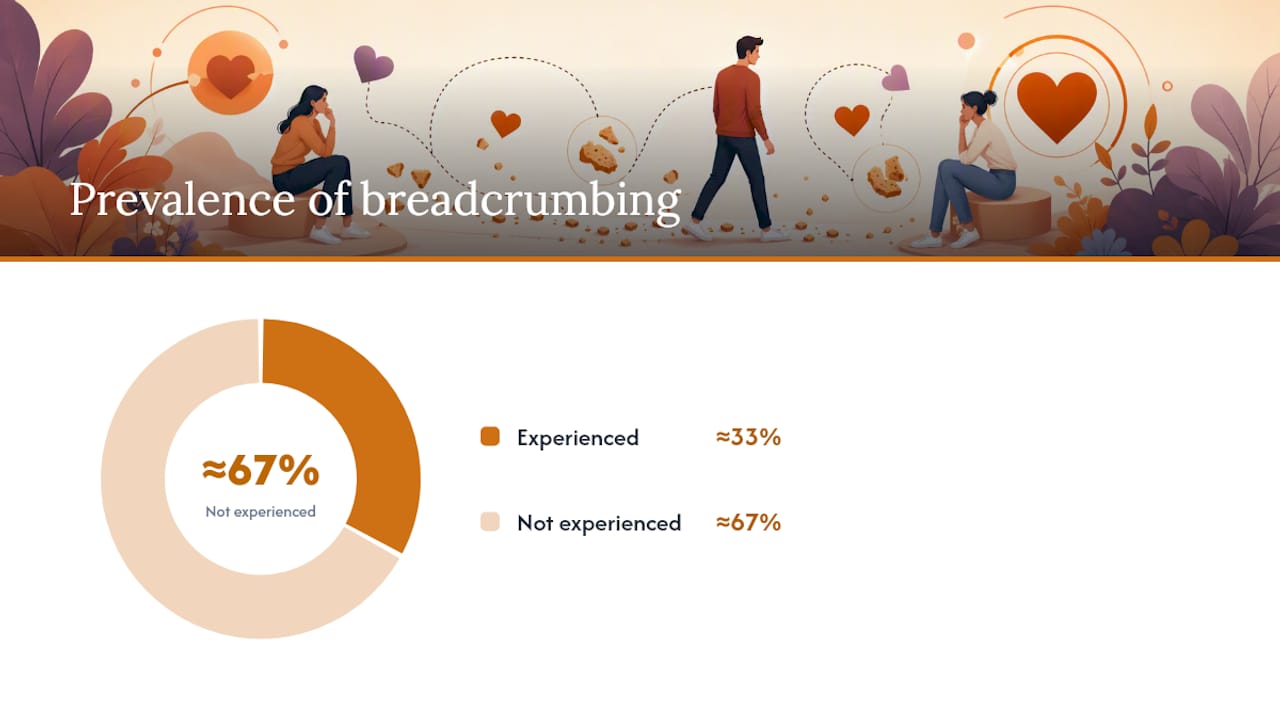
The emotional toll tends to build slowly: chronic uncertainty about where you stand, low-grade anxiety that spikes every time your phone buzzes, and a creeping erosion of self-trust because you keep second-guessing what the crumbs “really meant.” Psychology Today links this pattern to lowered self-esteem over time, since the recipient often starts blaming themselves for the other person’s inconsistency. One frequently cited study noted on Wikipedia found that about one-third of people surveyed reported having experienced breadcrumbing themselves, which suggests you’re dealing with something widespread, not a personal failing.
The way out starts with clarity, not more patience. Here’s a step-by-step plan for taking your power back:
- Name the pattern out loud. Write down the last five interactions with dates and content. If the gaps keep widening and the content stays vague, you’re not imagining it.
- Ask for something specific. Skip “are we going to hang out sometime?” and try: “I’d love to grab dinner Thursday at 7. Does that work?” Specificity forces a real answer.
- Set a response deadline for yourself, not them. Decide in advance how long you’ll wait for a real plan before you disengage. Write it down so future-you can’t talk present-you out of it.
- Use a boundary script, not a guilt trip. Try: “I enjoy talking to you, but I’m looking for someone who can commit to actual plans. Let me know if that’s something you want too.” It’s direct, non-accusatory, and it puts the decision back on them.
- Watch what happens next, then act on it. According to Psychology Today, when recipients set clear boundaries and ask for concrete plans, breadcrumbers typically either commit or fade. Either answer is useful information.
- Disengage on your timeline, not theirs. If the fade happens, don’t reopen the door when the next crumb arrives. That’s the moment intermittent reinforcement tries hardest to pull you back in.
Block or mute when a boundary gets ignored outright, especially if the crumbs escalate the moment you go quiet, since that reactive spike is one of the clearest signs of intentional manipulation. If the pattern is tangled up with a bigger relationship history, an ex, a family member, a long-term situationship, a therapist can help you untangle why the crumbs kept working on you specifically, which matters more than most people admit.
Pro Tip: Consistency is the real test, not effort. A single grand gesture doesn’t undo months of sporadic contact. Watch whether someone shows up the same way on a random Tuesday as they do after you’ve called them out. That’s the actual signal.
For more on reading mixed signals early, authentic conversation strategies can help you ask for clarity without sounding like you’re interrogating someone on date two.
Breadcrumbing vs. Ghosting, Benching, and Paperclipping
These terms get tossed around interchangeably, but they describe different behaviors, and mislabeling what’s happening to you can lead to the wrong response.
- Breadcrumbing: sporadic, low-effort contact that keeps you hopeful without any real commitment or forward movement.
- Ghosting: communication ends abruptly and completely, with no explanation and no further contact at all.
- Benching: someone keeps you as an active option “on the bench” while actively dating other people, occasionally reaching out just to keep you available.
- Paperclipping: a person who previously ghosted or faded resurfaces briefly, almost at random, before disappearing again, like a paperclip popping up on an old screen just to remind you it exists.
Healthline draws the clearest line between breadcrumbing and ghosting: ghosting is a hard stop, breadcrumbing is a slow drip that keeps you “on the hook” instead. Benching and paperclipping often overlap with breadcrumbing since all three involve keeping someone available without full investment, but the timing differs. Benching is ongoing and ranked (you’re one of several options), while paperclipping is more of a surprise callback after real silence.
Getting the label right matters because it changes your response. Ghosting calls for acceptance and moving on. Breadcrumbing and its cousins call for a direct ask for clarity, since there’s still active (if minimal) contact to respond to.
My Take on Modern Dating’s Crumb Problem
Modern dating rewards low commitment disguised as availability. Apps make it painless to keep six people warm at once, and breadcrumbing is what that ease looks like in practice. What frustrates me about a lot of advice on this topic is how much of it tells you to “just have more patience” or “give it time,” when the research points the opposite direction: patience is exactly what keeps the intermittent reinforcement cycle running.
The advice I’d prioritize first isn’t self-esteem work or moving on speeches. It’s the specific-plan script from earlier in this piece. Ask for a Thursday dinner, not a vague “sometime.” You’ll get your answer in days, not months, and that answer tells you everything about whether the crumbs were ever leading anywhere. If you want more vocabulary for what you’re seeing out there, StacyKnows has a rundown on the newest dating terms taking over social media worth bookmarking.
When Understanding Isn’t Enough
The gap most breadcrumbing advice misses is this: understanding the psychology behind the behavior doesn’t automatically make it easier to walk away. Knowing that intermittent reinforcement is hijacking your reward system helps, but knowledge alone doesn’t outrank a dopamine hit. What actually works is combining the science with a hard behavioral rule you set in advance, before the next crumb lands and your resolve gets tested. If there’s one thing I’d want every reader to take from this, it’s that clarity is a test you run once, not a conversation you keep having on repeat every time someone resurfaces with “miss you though.”
— Stacy Geisinger
Sources
- Breadcrumbing: What It Is and How to Deal — Healthline
- Breadcrumbing (Medical News Today)
- Breadcrumbing — Psychology Today
- PMC7037474 — NCBI
FAQ
What does it mean if someone is breadcrumbing you?
It means they’re giving you sporadic, low-effort attention (texts, likes, vague plans) to keep you interested while avoiding any real commitment or forward movement in the relationship.
What are the differences between paperclipping and breadcrumbing?
Paperclipping is a brief, surprise reappearance from someone who previously went quiet or ghosted, while breadcrumbing is an ongoing pattern of sporadic contact that never fully stops in the first place.
How can you tell if someone is breadcrumbing you?
Look for a repeating pattern: inconsistent replies, plans that are mentioned but never scheduled, and social-media engagement (likes, story views) that outpaces any real conversation.
What is breadcrumbing in a relationship?
It’s when one partner keeps the other hopeful with occasional, shallow attention, without ever matching that attention with consistency, availability, or a willingness to commit.
Recommended
- The New Language of Love: Ghostlighting, Banksying & the Dating Terms Taking Over Social Media
- Why Modern Dating Feels Broken (And What Actually Works Now)
- Ignite Your Online Dating Conversations: The Power of Authenticity (and a Dash of Humor)
- Are We All Quietly Cutting People Off? The Rise of “No Contact” and What It Really Means
