

If you’ve never had a “what are we?” talk and most of your plans together happen the night before, you’re probably in a situationship. Add in a feeling that you’re more anxious than secure, and the pattern is clear. Below is the full checklist, the emotional logic behind why it stings, and exactly what to say next.
The Clearest Situationship Signs to Watch For
A situationship lives in the gap between “just talking” and an actual relationship, and the Cleveland Clinic describes it as a persistent in-between state where the usual markers of commitment never quite show up. No label, no defined boundaries, no forward motion, even though the emotional or physical connection feels real. Here’s how to spot it in your own dating life.
- There’s been no label conversation. You’ve never sat down and defined what this is, and neither of you has brought it up first.
- Plans are inconsistent or last-minute. “Hey, you around tonight?” texts replace actual dates on the calendar.
- You’re not part of their world. Their friends don’t know your name, and you’ve never met family, coworkers, or anyone who matters to them.
- There’s no future talk. No mention of next month, next season, or anything beyond this weekend.
- The connection is mostly physical. Conversation stays light, and depth rarely shows up outside the bedroom.
- Exclusivity signals are mixed. They might be seeing other people, or they dodge the question when you ask.
- Cancellations happen often, with little follow-up. Plans fall through and nobody circles back to reschedule.
- They keep you off social media. No tags, no posts together, no public acknowledgment that you exist as a couple.
- You feel more anxious than secure. Confusion and low-grade worry outweigh the comfort a real partner should bring.
- They’ve said, out loud, that they don’t want anything serious. Believe that sentence. It’s usually the most honest thing they’ll tell you.
Lifestyle outlets covering this topic, including InStyle, list nearly identical patterns: stalled progression, lack of real dates, and an ongoing absence of the direct-the-relationship (DTR) conversation. When several of these signs overlap for a prolonged time, you’re not in a slow burn. You’re in a holding pattern.
Pro Tip: Time is data. If you’ve been at this for several months with zero movement on any of these ten points, that’s usually the signal to ask directly rather than keep waiting for it to evolve on its own, according to Women’s Health.
Why Situationships Feel So Confusing
The confusion makes sense once you see the mechanics. A situationship gives you real emotional or physical closeness without any of the structure that closeness usually comes with, and that mismatch is exactly what breeds anxiety, according to Cleveland Clinic Newsroom. Your nervous system reads intimacy as a signal of safety. Without a label or a future, that safety never fully lands, so you stay a little braced.
This is also where situationships and friends-with-benefits arrangements split. FWB tends to run on low emotional investment by design, both people know the deal. A situationship usually carries genuine emotional exchange without the commitment to match it, which is precisely why it messes with your head more, according to Campus Mental Health.
Left unaddressed, this pattern can chip away at more than your mood:
- Self-esteem takes a hit when you keep interpreting ambiguity as your own fault.
- Decision-making gets cloudy, because hope and evidence start pulling in opposite directions.
- Anxiety compounds when every text becomes a mood-setting event for your whole day.
What to Do Next: Define It, Set Limits, or Walk Away
You have three real options, and all three start with a conversation, or the decision to skip one entirely.
- Ask for the label, briefly. Try: “I like what we have, and I want to know if we’re building toward something real.” Or simpler: “Are we exclusive?” Short, specific language reduces the anxiety of asking, more than a long, open-ended talk does.
- Set one boundary and watch the response. Say: “I need us to make plans more than a day ahead,” or “I’m not comfortable being kept off your social media.” Their reaction tells you almost everything.
- Exit calmly if the answer disappoints you. Say your piece once: “This isn’t what I need right now, so I’m stepping back.” Then limit follow-up messages, mute if you have to, and give yourself permission to grieve something that was never fully defined in the first place.
Some behaviors don’t deserve a boundary conversation at all, they deserve an exit. Watch for manipulation, secrecy about other partners, or breadcrumbing, small, inconsistent bursts of attention meant to keep you hooked without any real investment. Therapists flag these as genuine red flags that justify leaving without further negotiation. We have a breakdown of breadcrumbing that explains what that looks like in real texts.
Pro Tip: Practice your DTR line out loud once before you say it. It sounds small, but hearing yourself say it calmly makes it far easier to hold your ground when the real conversation gets tense.
How Texting and Social Media Keep the Confusion Going
Situationships thrive in group chats and phone screens because texting lets both people stay vague. A string of flirty messages can feel like closeness without either person ever committing to plans, feelings, or exclusivity. That’s a feature of the dynamic, not an accident.
Social media adds its own layer. If they never tag you, never post you, and their Instagram gives zero indication you exist, that’s not shyness, it’s a boundary they’ve drawn without telling you. Compare that to how they treat close friends online, and the gap usually says more than any conversation would. Modern dating has even generated a vocabulary for these micro-behaviors, from breadcrumbing to “banksying,” a slow fade that erases someone from your digital life piece by piece. Our guide to the new language of dating breaks down the terms worth knowing before you find yourself living one of them.
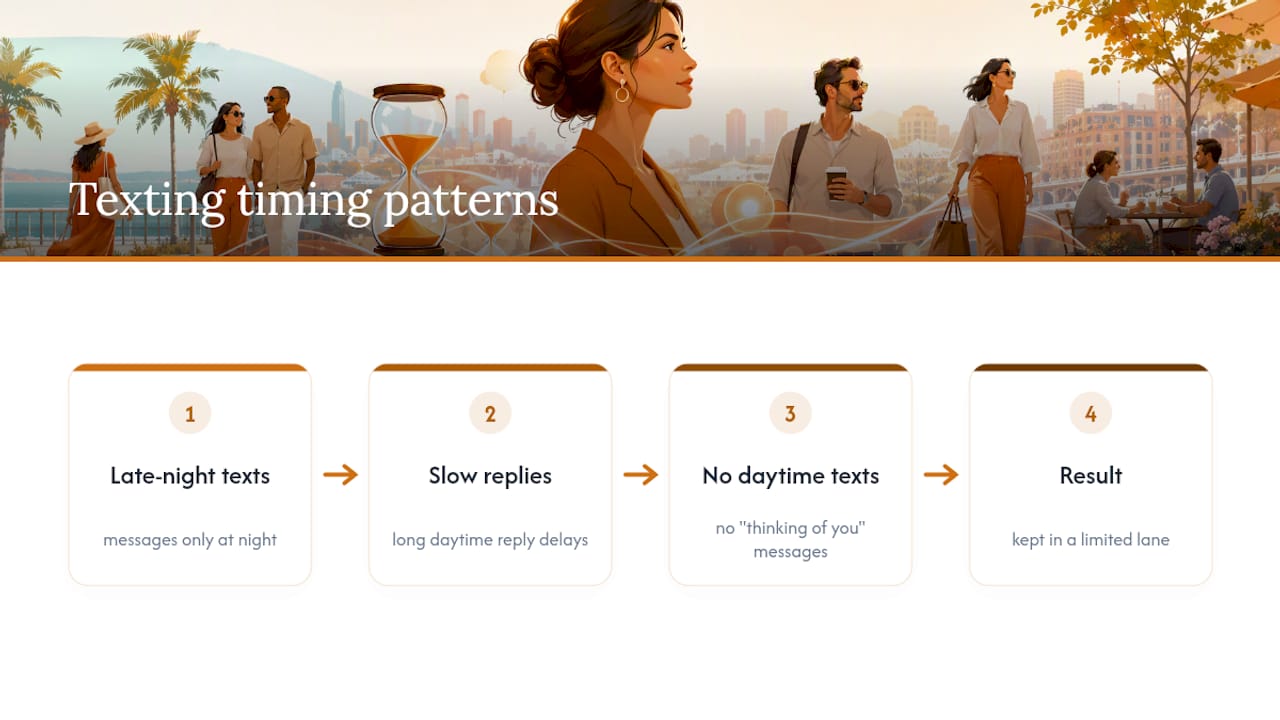
Texting patterns matter just as much as content. Late-night-only messages, slow replies during daylight hours, and a total absence of daytime “thinking of you” texts all point to someone keeping you in a specific, limited lane.
A Reality Check for Busy Daters
Between work, kids, and the general math of adult life, a situationship isn’t automatically a red flag. Sometimes it’s an honest, mutually agreed arrangement between two people who don’t have bandwidth for more right now. The trouble starts when only one person agreed to that arrangement while the other quietly hoped it would grow into something else. That’s when everyday stress and unspoken expectations start working against you instead of for you. If you’re unsure which category you’re in, our piece on figuring out if your relationship has a gap is a useful next read.
— Stacy Geisinger
Sources
- Situationship: What it Is and 5 Signs You’re In One — Cleveland Clinic
- What Is a Situationship? And 10 Signs You’re in One — InStyle
- What Is A Situationship? — Women’s Health
FAQ
How do situationships usually start?
They typically begin as casual dating or a physical connection that never gets a formal check-in, so the ambiguity just continues by default rather than by choice.
Do situationships come back after they end?
They often do, especially through late-night texts or social media likes, but a return without a real conversation about commitment usually just restarts the same unresolved pattern.
Can a situationship turn into a real relationship?
It can, but mainly when both people actively want that shift and say so; situationships that drag on for months with zero progression rarely evolve on their own, according to Women’s Health.
How can you tell if it’s just a situationship?
Check for the core pattern: no label, inconsistent plans, no integration into each other’s lives, and no future talk. If most of those apply, you likely have your answer.
Recommended
- How to Spot a Narcissist in 15 Seconds
- Throning: The New Dating Trend That’s All About Status, Not Love
- The New Language of Love: Ghostlighting, Banksying & the Dating Terms Taking Over Social Media
- Does Your Relationship Have a “Gap”?
