

If you’ve recently bought an electric vehicle or you’re seriously thinking about it, the phrase “charging level” probably came up fast. And it probably raised more questions than it answered. The types of EV charging levels, formally categorized as Level 1, Level 2, and Level 3 by the U.S. EPA, differ in speed, cost, installation requirements, and ideal use cases. Getting this wrong means either overpaying for equipment you don’t need or spending your mornings anxious about range. This guide cuts through the confusion so you can make the right call for your home, your commute, and your values.
Table of Contents
- Key takeaways
- 1. What factors should guide your charging level choice
- 2. Level 1 charging: the slow and steady option
- 3. Level 2 charging: the home and workplace workhorse
- 4. Level 3 DC fast charging: power when you need it fast
- 5. Charging level comparison: speed, cost, and connectors
- 6. How to choose the right charging mix for your lifestyle
- My take on charging smart and living greener
- Ready to take the next step with your EV journey?
- FAQ
Key takeaways
| Point | Details |
|---|---|
| Three distinct charging levels | Level 1, Level 2, and Level 3 (DC fast charging) differ in voltage, speed, and installation needs. |
| Level 1 works for light drivers | If you drive fewer than 40 miles daily, a standard outlet may be all you need. |
| Level 2 is the daily driver sweet spot | It adds 12 to 32 miles of range per hour and works for most home and workplace setups. |
| DC fast charging is for road trips | Use it for travel and emergency top-ups, not routine daily charging. |
| Connector type matters too | Confirm your vehicle’s connector standard before choosing a charger or public station. |
1. What factors should guide your charging level choice
Before you pick a charger, you need to know what your life actually looks like. Not what you imagine it might look like, but the real picture.
Ask yourself these questions:
- How far do you drive each day? A 20-mile round-trip commute is a very different situation than 80 miles of daily driving.
- Do you have a private garage or dedicated parking? Apartment dwellers and street parkers face real constraints that homeowners with garages don’t.
- What’s your home’s electrical setup? A 240-volt circuit is needed for Level 2. If your panel is older, upgrades add cost.
- What’s your budget for installation? Level 1 costs almost nothing to set up. Level 2 home installation typically runs $200 to $1,000 or more depending on your electrical panel.
- How often do you take long road trips? Frequent travelers need access to fast charging networks, not just home options.
- What connector does your vehicle use? Connector compatibility is a crucial but often overlooked detail, especially for DC fast charging.
Pro Tip: Check your vehicle’s onboard charger rating before buying Level 2 equipment. Some EVs cap AC charging at 7.2 kW regardless of what the charger can deliver, so paying for a 19.2 kW unit won’t get you faster charging.
2. Level 1 charging: the slow and steady option
Level 1 is the simplest charging option available. It uses a standard 120-volt household outlet, the same kind you plug a lamp or a phone charger into. No installation required. No electrician needed. Just plug in and wait.
The tradeoff is speed. Level 1 typically delivers 3 to 5 miles of range per hour of charging. Overnight, that’s roughly 30 to 50 miles of range restored. That’s genuinely enough for a lot of people.
Who does Level 1 work well for?
- Short-distance commuters who drive fewer than 40 miles per day
- Plug-in hybrid (PHEV) owners whose smaller batteries charge fully overnight on Level 1
- Budget-conscious drivers who want zero installation cost
- Secondary vehicle owners who don’t rely on the EV for every trip
Where it falls short:
- Drivers with longer daily commutes will wake up to a partially charged battery
- It’s not practical as the only charging option for full battery EVs with large packs (60 kWh and above)
- Weather affects efficiency, so cold climates can reduce overnight range gains
Pro Tip: If you’re on the fence about upgrading to Level 2, track your actual daily mileage for two weeks first. Many drivers discover they never exceed 35 miles a day and Level 1 is genuinely all they need.
3. Level 2 charging: the home and workplace workhorse
Level 2 charging runs on 240 volts, the same power supply used by electric dryers and ovens. It’s the most popular charging option for EV owners who want real convenience without the complexity of DC fast charging.
The speed difference over Level 1 is significant. Level 2 adds 12 to 32 miles of range per hour depending on the charger’s power output and your vehicle’s onboard charger capacity. A full charge overnight is realistic for most EVs.
Here’s what you need to know about Level 2:
- Installation is required. You’ll need a 240-volt circuit, which typically means hiring a licensed electrician.
- Equipment cost ranges from about $200 for a basic unit to $800 or more for a smart charger with scheduling and energy monitoring.
- It’s widely available publicly. Workplaces, shopping centers, hotels, and parking garages increasingly offer Level 2 EV charging stations.
- Most EVs are compatible. The J1772 connector is the North American standard for Level 2 AC charging, and virtually every non-Tesla EV uses it. Tesla vehicles use an adapter.
- Smart chargers add value. Wi-Fi connected units let you schedule charging during off-peak electricity hours, which cuts costs and reduces grid strain.
Level 2 is the daily driver sweet spot for moderate to heavy commuters and anyone who wants to wake up to a full battery without thinking about it.
4. Level 3 DC fast charging: power when you need it fast
Level 3, commonly called DC fast charging (DCFC), is a different animal entirely. Instead of alternating current (AC) like Levels 1 and 2, it delivers direct current (DC) straight to the battery at very high power levels, typically 50 kW to 350 kW or more.
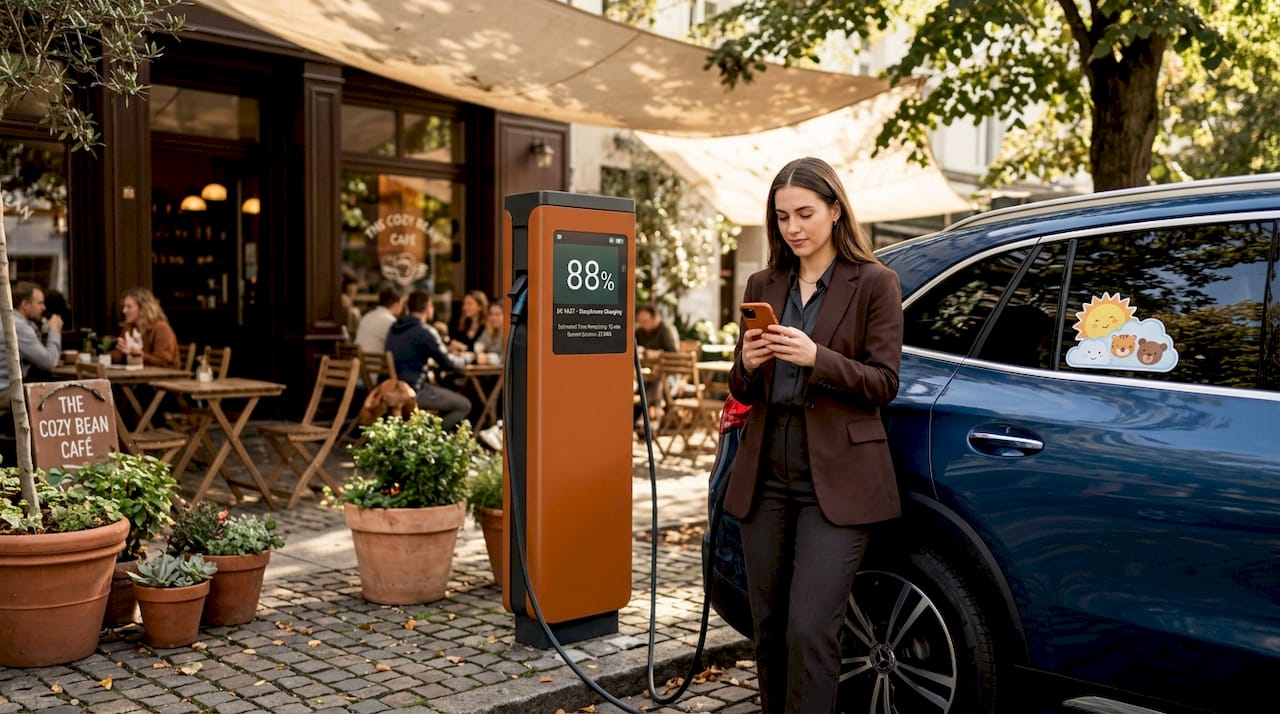
The result? 100 to 250 miles of range in 30 to 45 minutes. That’s a genuine road trip enabler.
A few things worth knowing about DC fast charging:
- It’s primarily public infrastructure. Home installation is rare and extremely expensive. You’ll find these chargers along highways, at travel plazas, and in urban fast-charging hubs.
- Charging slows near 80% battery. DC fast charging speed drops significantly as the battery approaches full capacity. Going from 80% to 100% can take as long as the first 80% did.
- It costs more per session. Pricing is typically higher than Level 1 or 2, often charged per minute or per kWh.
- Not all EVs support it. Some smaller or older EVs don’t have DC fast charging capability at all.
“DC fast charging is ideal for trips and emergency top-ups, not routine daily charging. Using it every day can add unnecessary cost and, over time, may affect battery longevity.”
The connector landscape for Level 3 is more complex. CCS (Combined Charging System) is the dominant standard in North America and Europe. NACS (North American Charging Standard), standardized by SAE in 2024, is now adopted by most major automakers. CHAdeMO, once common in Japanese vehicles, is fading from the market.
5. Charging level comparison: speed, cost, and connectors
Here’s a side-by-side look at all three levels to make the charging level comparison clear at a glance.
| Feature | Level 1 | Level 2 | Level 3 (DC Fast) |
|---|---|---|---|
| Voltage | 120V AC | 240V AC | 400–800V DC |
| Typical power output | 1.4–1.9 kW | 3.3–19.2 kW | 50–350+ kW |
| Miles added per hour | 3–5 miles | 12–32 miles | 150–500+ miles/hr equivalent |
| Typical charge time (empty to full) | 8–40+ hours | 4–12 hours | 20–60 minutes to 80% |
| Installation needed | No | Yes (240V circuit) | Yes (commercial grade) |
| Common locations | Home | Home, workplace, public | Highway, urban hubs |
| Typical connector (North America) | J1772 | J1772 / NACS | CCS / NACS / CHAdeMO |
| Relative cost per session | Lowest | Low to moderate | Highest |
The IEA classifies public chargers at or below 22 kW as slow, between 22 and 150 kW as fast, and 150 kW and above as ultra-fast. That’s a useful framework when you’re reading public charging network apps, which often use power-based labels instead of Level 1/2/3 terminology.
Pro Tip: When using a public charging app like PlugShare or ChargePoint, filter by power output (kW) rather than just “fast” or “slow.” A 7 kW Level 2 charger and a 22 kW Level 2 charger are both technically “Level 2,” but the difference in charge time is significant.
6. How to choose the right charging mix for your lifestyle
There’s no single right answer here. Choosing a charging setup is about matching your daily driving needs, home capabilities, and budget. Here’s how different driver profiles typically map to charging levels:
- Light daily drivers and PHEV owners. If you drive under 40 miles a day and have overnight parking at home, Level 1 is genuinely sufficient. Don’t let anyone talk you into an expensive upgrade you don’t need.
- Moderate commuters (40 to 80 miles daily). Level 2 at home is the move. The overnight charge keeps you topped up, and the installation cost pays off quickly in convenience and reduced range anxiety.
- Heavy commuters and multi-car EV households. Level 2 at home plus access to workplace charging is the ideal setup. Having two charging points reduces morning competition for the cable.
- Frequent road trippers. You need a vehicle with DC fast charging capability and a route plan that includes fast chargers. Apps like A Better Route Planner (ABRP) make this straightforward.
- Apartment dwellers and street parkers. This is the hardest situation. Rely on public Level 2 charging at nearby stations and use DC fast charging for longer trips. Advocate for charging in your building’s parking structure.
- Cost-conscious eco drivers. Lean on Level 1 or Level 2 at home, charge during off-peak hours, and treat DC fast charging as an occasional tool. Using Level 1 and 2 for daily needs and reserving fast charging for trips is the strategy that optimizes cost, convenience, and battery health.
Pro Tip: If you’re buying a new EV and plan to rely on public charging, check the coverage map of the manufacturer’s preferred charging network in your area before signing anything. Network density varies wildly by region.
My take on charging smart and living greener
I’ve spent a lot of time talking with EV owners, and the ones who feel most at ease with their vehicles are rarely the ones with the fastest charger. They’re the ones who figured out their actual routine and built their charging setup around it.
Here’s what I’ve come to believe: frequent DC fast charging is a bit like always taking a taxi instead of walking. It works, but it costs more and it’s not always better for the long game. Battery management research consistently points to slower, regular charging as gentler on battery longevity. And from an eco standpoint, charging slowly overnight often means drawing power when the grid is running on more renewable energy.
I’ve also seen a lot of people get talked into Level 2 installations they didn’t need. If you drive 25 miles a day, a standard outlet does the job. Save that $600 installation cost for something that actually improves your life.
That said, I’m not anti-fast-charging. It’s a genuinely useful tool for road trips, and the expanding network of EV charging stations makes long-distance EV travel more realistic every year. The key is using it with intention, not out of habit.
My honest recommendation: start with what you have, track your needs for a month, and upgrade only when the data tells you to.
— Stacy
Ready to take the next step with your EV journey?
At Stacyknows, we believe that living sustainably doesn’t mean sacrificing convenience. Whether you’re still weighing whether an EV fits your lifestyle or you’re already charging nightly and loving it, we’ve got resources that meet you where you are.

If you’re curious about the real-world costs of EV ownership, including what charging actually adds to your electricity bill, our in-depth breakdown covers everything from home installation to public charging expenses. And while you’re exploring smarter lifestyle choices, don’t miss our most-loved reads over at Stacyknows. From wellness to wheels, we’re here to help you make choices that feel good and make sense.
FAQ
What are the three types of EV charging levels?
The three charging levels are Level 1 (120V AC), Level 2 (240V AC), and Level 3 DC fast charging. Each differs in speed, cost, and typical location of use.
How long does Level 2 charging take?
Level 2 charging typically takes 4 to 12 hours for a full charge, adding 12 to 32 miles of range per hour depending on the charger and vehicle.
Is DC fast charging bad for my battery?
Occasional DC fast charging is generally fine, but using it as your primary daily charging method may affect long-term battery health. Most manufacturers recommend Level 1 or Level 2 for routine charging.
What connector do I need for Level 3 charging?
In North America, CCS and NACS are the dominant connectors for DC fast charging. CHAdeMO is still found on some older vehicles but is becoming less common. Always confirm your vehicle’s connector type before arriving at a public station.
Can I charge an EV with a regular household outlet?
Yes. Level 1 charging uses a standard 120-volt outlet with no installation required. It’s the slowest option but works well for drivers who cover fewer than 40 miles per day.
Recommended
- Is It Worth Getting an Electric Car in 2026? Pros, Cons & Costs Explained – Stacyknows
- Essential Electrical Safety Measures Every Home Should Follow – Stacyknows
- Tips for Choosing Energy-Efficient Windows – Stacyknows
- 5 Stylish Sustainable Swaps That Actually Make Sense for Real Life – Stacyknows
