

The Evolution of Telemedicine Addiction Treatment
The landscape of addiction treatment is undergoing a profound transformation, fueled by both an urgent need for support and rapid technological advancements. As we reach July 2026, telemedicine has become an indispensable tool in addressing substance use disorders, making vital care more accessible than ever before. This digital revolution allows individuals to receive expert addiction counseling remotely, fundamentally changing how we approach recovery and support.
In this comprehensive guide, we will explore the significant rise of telemedicine addiction treatment programs. We’ll specifically delve into online addiction counseling, examining the diverse educational and professional development pathways available for counselors. We will compare these programs based on their accreditation, costs, and time commitments, and clarify how they prepare professionals for state licensure and hands-on clinical practice. Furthermore, we’ll discuss modern therapeutic approaches like harm reduction and trauma-informed care, and highlight the robust career opportunities awaiting graduates in this essential field.
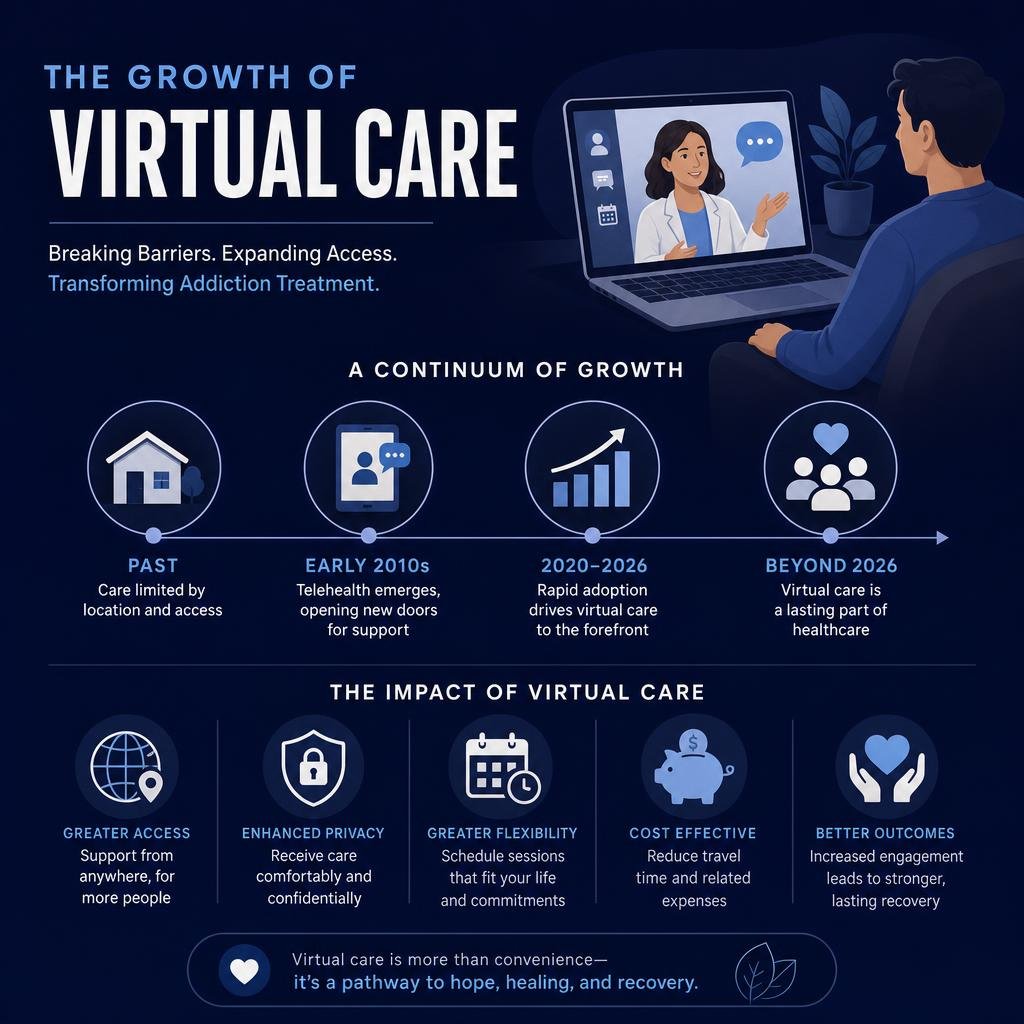
The integration of technology into healthcare has been a gradual process, but for addiction treatment, its acceleration has been nothing short of revolutionary. Historically, addiction care was often confined to physical facilities, creating significant barriers for many seeking help. These barriers included geographic distance, stigma associated with visiting a treatment center, lack of transportation, and the challenge of balancing treatment with work or family responsibilities. The advent of telemedicine has systematically dismantled many of these obstacles, ushering in an era where support is literally at one’s fingertips.
Telemedicine, in its broader sense, encompasses a wide range of services delivered remotely, from initial consultations to ongoing therapy sessions and medication management. For individuals grappling with substance use disorders, this means access to a continuum of care that is flexible, private, and often more affordable. This shift aligns with a growing understanding of addiction as a public health issue rather than a moral failing, necessitating a compassionate, accessible, and evidence-based approach to treatment. The convenience and reduced perceived stigma of receiving care from home have encouraged more individuals to seek help, leading to better engagement and retention in treatment programs. The growth of virtual care has been substantial, indicating a permanent shift in healthcare delivery.
Integrating Telemedicine Addiction Treatment into Modern Healthcare
Telehealth has become an integral component of the modern healthcare ecosystem, particularly in the realm of clinical mental health and addiction services. It’s no longer just a temporary solution but a foundational element that enhances reach and efficiency. Online platforms allow for seamless delivery of counseling sessions, group therapy, psychoeducation, and even psychiatric evaluations. This integration ensures that individuals can receive comprehensive care without the need for in-person visits, which is especially beneficial for those in remote areas or with mobility challenges.
One of the most significant advancements in telemedicine addiction treatment is the ability to provide comprehensive medication-assisted treatment (MAT) remotely. This includes the prescription and management of medications like Suboxone, which are crucial for treating opioid use disorder. The ability to access telemedicine-based Suboxone treatment through secure online platforms has expanded vital care to countless individuals who might otherwise struggle to find local providers or manage frequent in-person appointments. This blend of counseling and pharmacotherapy, delivered virtually, represents a powerful, evidence-based approach to improving patient outcomes. We are committed to ensuring that these innovative approaches are not only accessible but also maintain the highest standards of clinical excellence.
The Role of Telemedicine Addiction Treatment in Overcoming Geographic Barriers
Geographic barriers have historically presented a formidable challenge to healthcare access, particularly in rural and underserved communities. Individuals residing in these areas often face long travel times, limited public transportation, and a scarcity of specialized addiction treatment providers. Telemedicine addiction treatment directly addresses these disparities by bringing counseling services and clinical expertise directly into patients’ homes.
Digital platforms connect individuals with licensed counselors and medical professionals regardless of their physical location. This dramatically broadens the pool of available specialists, allowing patients to choose providers who best meet their needs, rather than being limited by local availability. Beyond rural healthcare, telemedicine also benefits those in urban areas who face logistical hurdles such as demanding work schedules, childcare responsibilities, or physical disabilities. By removing the need for physical travel, telemedicine reduces treatment barriers, making consistent engagement with therapy more feasible and sustainable for a wider population. This enhanced accessibility plays a critical role in fostering recovery and improving public health outcomes across diverse communities.
Comparing Online Addiction Counseling and Training Programs
As the demand for addiction counseling grows, so does the need for highly skilled and well-trained professionals. Online education has emerged as a flexible and effective pathway for individuals to enter or advance within this crucial field. These programs cater to a diverse audience, from those seeking foundational knowledge to experienced practitioners looking for professional development or specialized certifications. We see a clear distinction between academic pathways designed for licensure and non-credit courses aimed at enhancing existing skills or fulfilling continuing education requirements. Understanding these different types of programs is essential for aspiring and current counselors to choose the path that best aligns with their career goals.
Academic Degrees vs. Professional Development Certificates
The landscape of online addiction counseling education offers a spectrum of options, primarily categorized into academic degrees and professional development certificates.
Academic Degrees, predominantly master’s degrees, are typically designed to prepare individuals for state licensure as professional counselors with a specialization in addiction. These programs are comprehensive, often requiring 48 to 60 credit hours, and delve deep into theories of counseling, psychopathology, ethical practices, and advanced treatment modalities. For example, Liberty University’s online MA in Addiction Counseling is a 48-credit-hour program, while Hazelden Betty Ford’s online Master’s in Counseling is a 60-credit-hour program. Graduates of these programs are equipped with the extensive knowledge and clinical skills necessary to diagnose and treat substance use disorders and co-occurring mental health conditions.
Professional Development Certificates and Micro-courses, on the other hand, serve a different but equally vital purpose. These are generally non-credit options focused on specialized knowledge or continuing education hours (CEs) required for maintaining licensure or certification. They are ideal for current mental health professionals looking to specialize in addiction, or for addiction counselors needing to update their skills. For instance, Walden University offers an Addiction Counseling Professional Certificate (ADDC3000) that provides 80 CEs. They also offer micro-courses, which are short, focused learning modules (e.g., 5-hour workload for 5 CEs) on specific topics like adolescent addiction or psychopharmacology. These programs are often approved by bodies like NAADAC (National Association of Addiction Professionals), ensuring the credits are valid for professional development and licensing requirements. They offer flexibility, allowing professionals to earn essential CEs without the long-term commitment of a full degree program.
Accreditation, Costs, and Time Commitments
When considering an online addiction counseling program, accreditation, cost, and time commitment are critical factors. These elements vary significantly across different program types and institutions.
Accreditation is paramount, especially for academic degrees. For master’s programs leading to licensure, CACREP (Council for Accreditation of Counseling and Related Educational Programs) accreditation is the gold standard. A CACREP-accredited program ensures that the curriculum meets rigorous national standards and is widely recognized by state licensing boards. For professional development courses and certificates, look for programs offered by NAADAC Approved Education Providers to ensure that continuing education hours (CEs) are accepted for licensure renewal.
Costs can range widely. Graduate-level addiction counseling courses, such as those offered by Walden University (e.g., COUN6730), cost $2,800.00 for 5 quarter credits over 10 weeks. For full master’s degrees, tuition rates are typically calculated per credit hour. Liberty University’s online MA in Addiction Counseling, for example, charges $600/credit for full-time students and $665/credit for part-time students, totaling approximately $28,800 to $31,920 for the 48-credit program. Certificate programs are generally less expensive. TCNJ’s online Addiction Counseling Certificate is 12 credits at $740 per credit, amounting to $8,880. Professional development certificates, like Walden’s ADDC3000, are more affordable, costing $799.00 for 80 CEs.
Time commitment also varies significantly. A full master’s degree can take 2-3 years of full-time study, or longer if pursued part-time. Certificate programs, like TCNJ’s 12-credit program, can be completed in about 1 year full-time. Micro-courses are designed for quick completion, often requiring just 5 hours of work for 5 CEs. This flexibility allows individuals to choose a program that fits their current life and career stage.
To help visualize these differences, here’s a comparison:

Clinical Standards and Licensure Preparation in Online Education

The transition to online learning for addiction counseling programs has not compromised the rigorous clinical standards and thorough preparation required for state licensure. In fact, many online programs are meticulously designed to meet or exceed these benchmarks, ensuring that graduates are fully equipped for professional practice. The focus remains on developing competent, ethical, and effective counselors who can provide high-quality care, whether in person or via telehealth. This commitment to educational excellence is crucial for maintaining public trust and safeguarding patient well-being.
CACREP Accreditation and Hands-On Clinical Internships
For those pursuing a master’s degree in addiction counseling, CACREP accreditation is a critical indicator of program quality and a foundational requirement for state licensure in many jurisdictions. CACREP-accredited programs adhere to comprehensive standards for curriculum, faculty qualifications, and student outcomes, ensuring a robust educational experience. Hazelden Betty Ford Graduate School, for instance, offers a CACREP-accredited online master’s program.
A cornerstone of any quality counseling program, online or in-person, is the requirement for hands-on clinical internships. These internships provide students with invaluable real-world experience under the direct supervision of licensed professionals. Hazelden Betty Ford’s program, for example, requires 700 hours of clinical or internship experience. This extensive practical component allows students to apply theoretical knowledge, develop counseling skills, and gain exposure to diverse client populations and treatment settings.
Furthermore, many online programs incorporate on-campus residencies to complement virtual learning. These brief, intensive in-person sessions, such as the two four-day residencies required by Hazelden Betty Ford, serve multiple purposes. They facilitate face-to-face communication skills practice, allow for direct faculty interaction, and foster a strong sense of cohort connection among students. These residencies are vital for developing the interpersonal skills essential for clinical practice and for building professional networks that extend beyond the screen.
Navigating State Licensure and Certification Pathways
Graduating from an online addiction counseling program is a significant step, but the ultimate goal for most is state licensure and certification. The pathways to becoming a Licensed Addiction Counselor (LADC), Licensed Professional Counselor (LPC), or Licensed Professional Clinical Counselor (LPCC) vary considerably from state to state. It is crucial for prospective students to research the specific requirements of the state where they intend to practice.
Online programs play a vital role in preparing students for these diverse requirements. They typically align their curricula with the educational standards set by state licensing boards and national certification bodies. For example, Liberty University’s online MA in Addiction Counseling explicitly addresses the specific requirements for Certified Substance Abuse Counselor (CSAC) credentials and even notes that an additional 12 hours of coursework are needed to meet the Licensed Substance Abuse Treatment Provider (LSATP) requirements in Virginia.
Students are often guided to complete supervised post-graduate clinical hours, pass standardized credentialing examinations (such as the NCE or specific state exams), and adhere to ethical guidelines. The Hazelden Betty Ford program boasts an impressive 100% pass rate on credentialing examinations for its graduates from 2020-2024, six months post-graduation, demonstrating the effectiveness of their preparation. While online programs provide the academic foundation, it is ultimately the student’s responsibility to understand and fulfill all state-specific requirements for licensure.
Modern Therapeutic Approaches and Student Support Systems

The field of addiction counseling is dynamic, continuously evolving to incorporate new research and best practices. Online programs are at the forefront of integrating these modern therapeutic approaches, ensuring that graduates are prepared to address the complex needs of clients in July 2026 and beyond. Alongside cutting-edge curriculum, these programs also prioritize robust student support systems, recognizing that success in an online environment requires more than just academic rigor.
Trauma-Informed Care, Harm Reduction, and Co-occurring Disorders
Contemporary addiction counseling emphasizes a holistic and person-centered approach. Trauma-informed care is now recognized as fundamental, acknowledging the pervasive role of trauma in the development and maintenance of substance use disorders. Online curricula delve into strategies for recognizing, understanding, and responding to the effects of trauma in clients, ensuring that treatment is sensitive and avoids re-traumatization.
Similarly, the principles of harm reduction are increasingly integrated into training. Programs like TCNJ’s Addiction Counseling Certificate embrace a public health approach that recognizes addiction as a complex issue, not solely a criminal one. This includes exploring non-abstinence-based recovery pathways, focusing on reducing negative consequences associated with substance use, and meeting clients where they are. This contrasts with traditional abstinence-only models, offering a broader, more compassionate perspective.
A significant focus is also placed on co-occurring mental health disorders. It’s well-established that many individuals with substance use disorders also struggle with mental health conditions like depression, anxiety, or PTSD. Online programs prepare counselors to conduct differential diagnoses, understand the interplay between these conditions, and implement integrated treatment plans that address both simultaneously. Courses often cover the neuroscience of addiction and psychopharmacology, providing a scientific understanding of how substances affect the brain and the role of medication in treatment, allowing counselors to collaborate effectively with medical professionals.
Technology, Orientation, and Faculty Engagement for Student Success
Online learning environments are designed to foster student success through innovative technology, structured orientation, and active faculty engagement. Many programs utilize advanced digital learning management systems (LMS) that provide a rich, interactive educational experience. Platforms like Populi, used by Hazelden Betty Ford, offer tools for discussions, assignments, and resource sharing.
To ease the transition into online education, many institutions offer comprehensive online orientation courses. Hazelden Betty Ford, for instance, provides a one-month online orientation course divided into four weekly units, preparing students with essential skills like time management, effective communication, and leveraging technology with confidence. These orientations help students become active, engaged learners and take ownership of their educational journey.
Faculty engagement is another cornerstone of online student support. Despite the virtual setting, professors are often highly accessible through virtual office hours, email, and discussion forums. Some programs, like TCNJ’s certificate, even incorporate a weekly 90-minute synchronous learning component, utilizing interactive virtual classrooms for real-time collaboration and discussion, mirroring the richness of in-person instruction. This combination of technology, structured support, and dedicated faculty ensures that online students receive a high-quality, engaging, and successful learning experience.
Career Outlook and Job Growth in Addiction Counseling
The demand for skilled addiction counselors is experiencing robust growth, making it an incredibly promising and impactful career path. As of July 2026, the field of clinical mental health, which encompasses addiction counseling, is projected to grow by 18% between 2022 and 2032. This growth rate is significantly faster than the average for all occupations, indicating a strong and sustained need for qualified professionals.
Graduates of accredited online addiction counseling programs are well-positioned to capitalize on this demand. Data from institutions like Hazelden Betty Ford Graduate School highlights impressive student outcomes:
- A 100% pass rate on credentialing examinations (six months post-graduation) for their 2020-2024 cohorts (n=38/38).
- A 94.9% combined employment and doctoral admission rate for their 2020-2024 cohorts (n=63/67).
These statistics underscore the effectiveness of these programs in preparing students for successful careers or further academic pursuits. In 2025 alone, 45 students earned their master’s degree through one such online program, contributing to the growing workforce.
Career outcomes for addiction counselors are diverse, spanning various settings including:
- Outpatient and inpatient treatment centers
- Hospitals and medical clinics
- Community mental health centers
- Correctional facilities
- Private practice
- Schools and universities
- Government agencies
The ongoing opioid crisis, increased awareness of mental health issues, and a broader acceptance of addiction as a treatable disease all contribute to the expanding need for compassionate and competent addiction counselors. This field offers not just job security but also the profound satisfaction of helping individuals and families navigate the path to recovery.
Frequently Asked Questions about Telemedicine Addiction Treatment
What is the difference between academic credits and continuing education hours (CEs)?
Academic credits are units earned towards a formal degree, such as a master’s or doctoral degree. These credits appear on an official academic transcript and contribute to fulfilling the requirements for graduation and, subsequently, state licensure. Continuing Education Hours (CEs), on the other hand, are units earned from professional development activities, workshops, or micro-courses. They are essential for maintaining existing licenses or certifications, ensuring that professionals stay current with best practices and new research in the field. CEs do not typically count towards an academic degree but are crucial for ongoing professional competency and compliance with regulatory bodies.
How do online programs facilitate hands-on clinical experience?
Online addiction counseling programs are meticulously structured to ensure students gain essential hands-on clinical experience, even in a virtual format. This is primarily achieved through supervised internships completed at approved local clinical sites. Students work directly with clients under the guidance of a licensed supervisor, accumulating the required clinical hours (e.g., 700 hours for Hazelden Betty Ford). Many programs also incorporate face-to-face residencies—brief, intensive on-campus sessions—where students engage in simulated counseling sessions, role-playing, and direct interaction with faculty and peers to refine their clinical skills. These integrated approaches ensure that online graduates are just as clinically competent as their traditional counterparts.
Are online addiction counseling programs widely accepted for state licensure?
Yes, online addiction counseling programs are widely accepted for state licensure, provided they meet specific criteria. The most crucial factor is accreditation alignment, particularly CACREP accreditation for master’s degree programs. Programs with this accreditation are generally recognized by state licensing boards across the U.S. However, it is imperative for prospective students to research the specific state board requirements of the state where they intend to practice. Licensing regulations can vary significantly, covering educational standards, required clinical hours, and specific credentialing exams. While online programs offer the necessary academic foundation, students must ensure their chosen program, along with their post-graduate supervised experience, fully complies with their target state’s regulations to successfully achieve licensure.
Conclusion
The rise of telemedicine addiction treatment programs marks a pivotal moment in healthcare, expanding access to vital services and transforming the landscape of recovery. As we look ahead from July 2026, the digital transformation in addiction counseling is not just a temporary measure but a permanent, evolving solution. This shift necessitates a well-trained, adaptable workforce, and online addiction counseling programs are stepping up to meet this challenge.
Through rigorous academic degrees, specialized professional development, and a commitment to modern therapeutic approaches like harm reduction and trauma-informed care, these online programs are preparing the next generation of compassionate and competent counselors. By integrating robust clinical experiences, navigating complex licensure pathways, and leveraging innovative technology for student support, online education ensures that graduates are ready to make a profound difference. The promising career outlook and significant job growth in this field underscore the critical importance of developing a strong, skilled workforce dedicated to supporting individuals on their journey to recovery. We believe that by embracing these advancements, we can collectively foster a future where effective, accessible, and compassionate addiction care is available to all who need it.
