
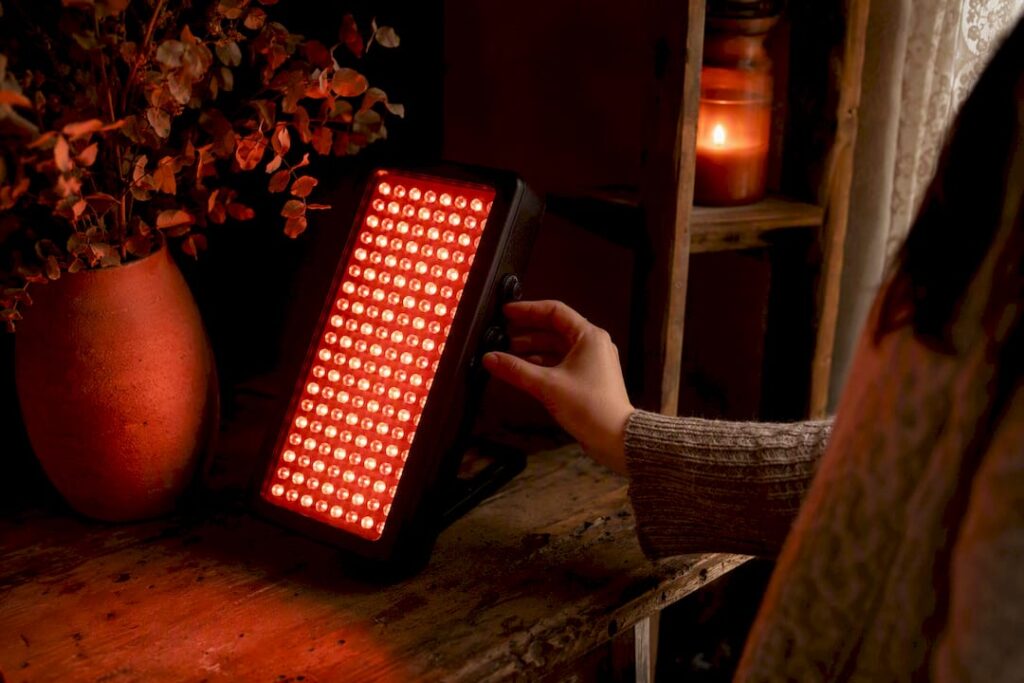
Red light therapy works, but not the way most product pages promise. A 2025 umbrella review of randomized clinical trials found moderate-certainty evidence for a short, specific list of outcomes: increased hair density in androgenetic alopecia, pain reduction in burning mouth syndrome, disability improvement in knee osteoarthritis, and fatigue reduction in fibromyalgia. Everything else researchers have tested, from acne to wrinkles to general “anti-aging,” lands somewhere between promising and unproven, with low-to-very-low certainty evidence behind it.
That gap between what’s studied and what’s marketed matters. Stanford Medicine’s review of the science notes the mechanism is biologically plausible and the hair-growth data holds up reasonably well, but device dosing across the consumer market is inconsistent. Cleveland Clinic echoes that caution, pointing out that most skin-focused studies are small and that anyone considering treatment should loop in a healthcare provider first, especially if they have an underlying skin condition.
Here’s the safety picture in brief:
- Short-term side effects are uncommon and usually mild when devices are used as directed.
- Eye protection matters. Direct exposure, especially from higher-powered clinic devices, can cause damage.
- Long-term effects from repeated home use over years haven’t been well studied.
- People on photosensitizing medications, pregnant patients, or those with a history of skin cancer should talk to a doctor before starting.
One more thing worth knowing before you spend a dollar on this: at-home masks and panels are almost never as powerful as what you’d get in a dermatology office, which changes what kind of results you can realistically expect.
What Red Light Therapy Is and How Photobiomodulation Actually Works
Red light therapy is the consumer name for what researchers call photobiomodulation, or PBM. It uses low-level red and near-infrared light, typically somewhere in the 630 to 850 nanometer range, to trigger changes inside your cells without generating enough heat to damage tissue. That’s the whole concept in one sentence, but the mechanism behind it is worth understanding because it explains both why this treatment can help and why so many devices fail to deliver.
Light at these wavelengths gets absorbed by a molecule inside your cells’ mitochondria called cytochrome c oxidase. Think of mitochondria as the power plants inside every cell, and cytochrome c oxidase as one of the machines on the factory floor. When red or near-infrared light hits it, that machine runs more efficiently, and the cell produces more ATP, the molecule your body uses as fuel for basically everything. More available energy at the cellular level appears to set off a chain reaction: modest increases in collagen production, some reduction in inflammatory signaling, and improved local blood flow through vasodilation.
A few distinctions are worth locking in early, because confusion here is common:
- It’s not UV light. Red light therapy doesn’t carry the wavelength range responsible for sunburn or the DNA damage linked to skin cancer risk.
- It’s not photodynamic therapy. PDT pairs light exposure with a photosensitizing drug applied to the skin, usually for treating precancerous lesions. Red light therapy uses no chemical agent.
- Dose is everything. Wavelength, irradiance (how much light energy hits the skin per second), and exposure time together determine whether a session does anything at all.
That last point deserves emphasis because it’s where most consumer confusion starts. Researchers talk about a “therapeutic window,” a dose range where cells respond favorably. Below it, nothing happens. Above it, some evidence suggests the light can actually suppress the very effects it’s supposed to produce. A weak LED panel held too far from your skin might be giving you a fraction of the dose used in the clinical trials that made red light therapy famous in the first place, while an overpowered device used incorrectly could theoretically backfire.
What the Clinical Evidence Shows, Condition by Condition
The umbrella review published in 2025, which pooled results from multiple meta-analyses covering thousands of patients, found no outcome reached high-certainty status. A handful reached moderate certainty. Most sat at low or very low certainty, meaning the existing trials are too small, too inconsistent in protocol, or too few in number to draw firm conclusions yet. A related overview from the same research team makes the same point: protocol heterogeneity across studies (different wavelengths, different session lengths, different devices) is the biggest obstacle to stronger conclusions.
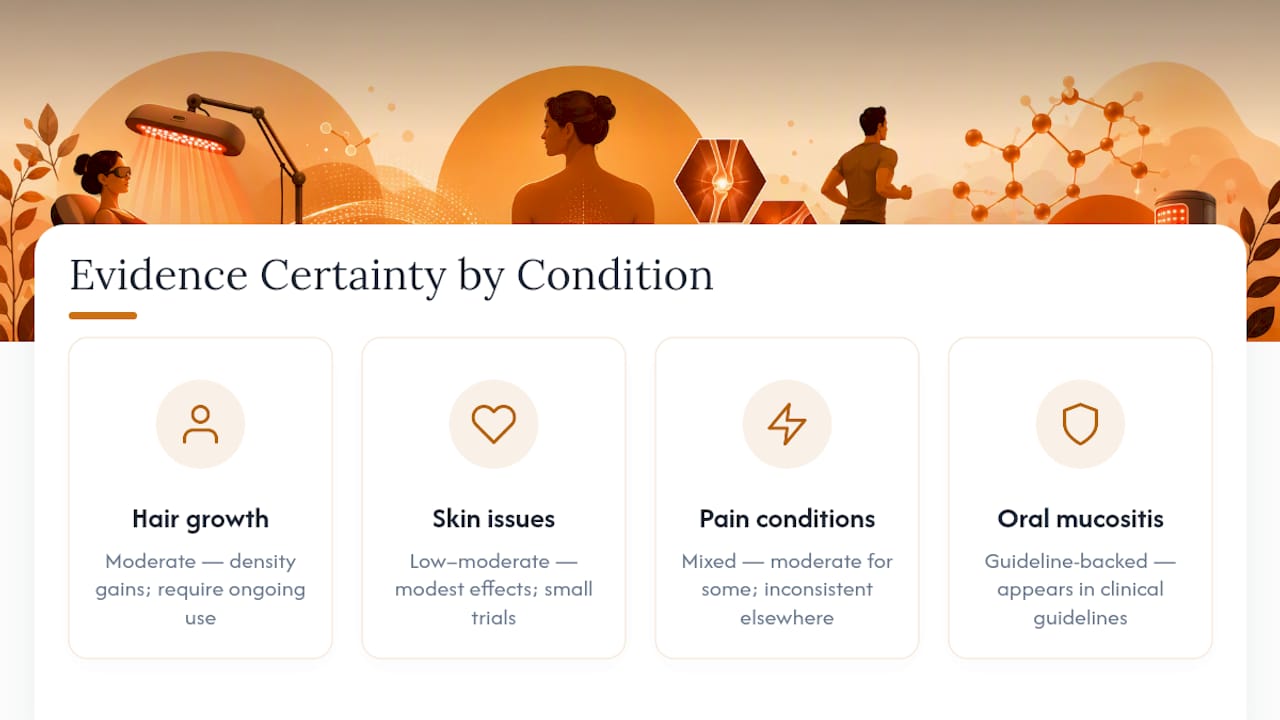
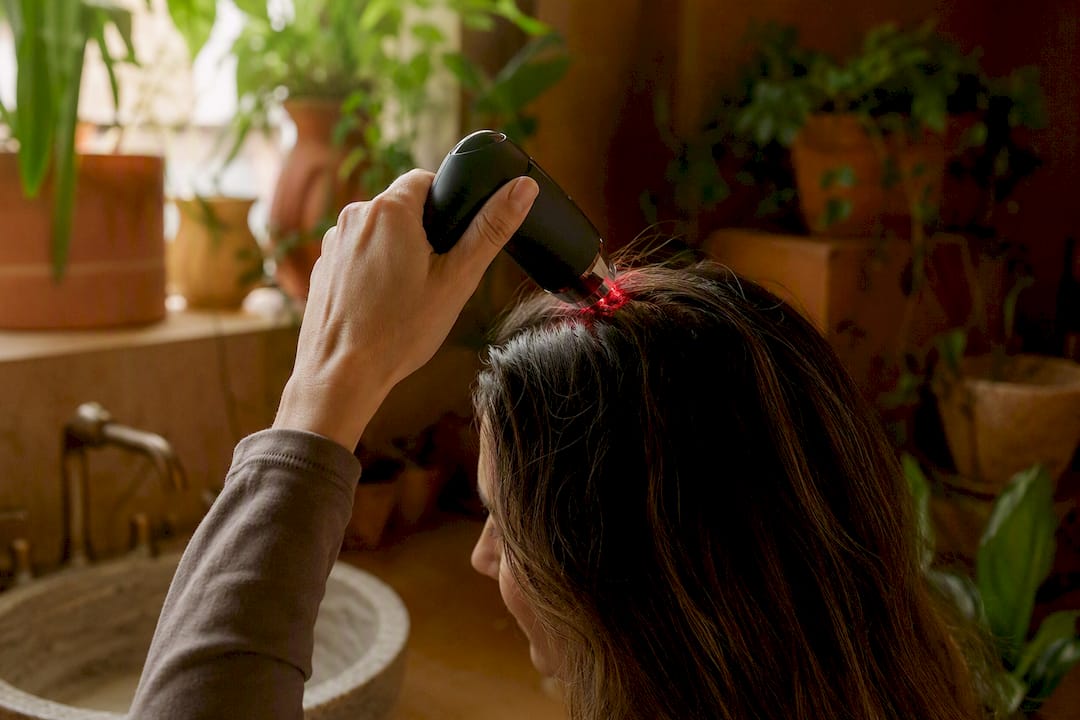
Hair growth and androgenetic alopecia has some of the sturdiest data of any use case. Multiple trials show increased hair density in people with pattern hair loss after consistent use over several months. But there’s a catch that doesn’t make it into most marketing copy: the effect appears to require ongoing treatment. Stanford dermatologist Dr. Nour Kibbi notes that gains from red light therapy tend to be temporary, and stopping treatment usually reverses them. This isn’t a one-and-done fix; it is closer to a maintenance regimen, similar in commitment to topical minoxidil.
Skin rejuvenation, wrinkles, acne, and scarring show a consistent but modest pattern across the literature. Cleveland Clinic’s patient guidance describes the evidence as promising for wrinkles, acne, and scars, while flagging that most supporting studies are small, often involving a few dozen participants over a few months. That’s not nothing, but it’s not the dramatic transformation implied by some influencer testimonials either. If you’re weighing red light against other in-office skin procedures, it helps to see where it fits among the broader menu of options for a youthful appearance rather than treating it as a standalone miracle.
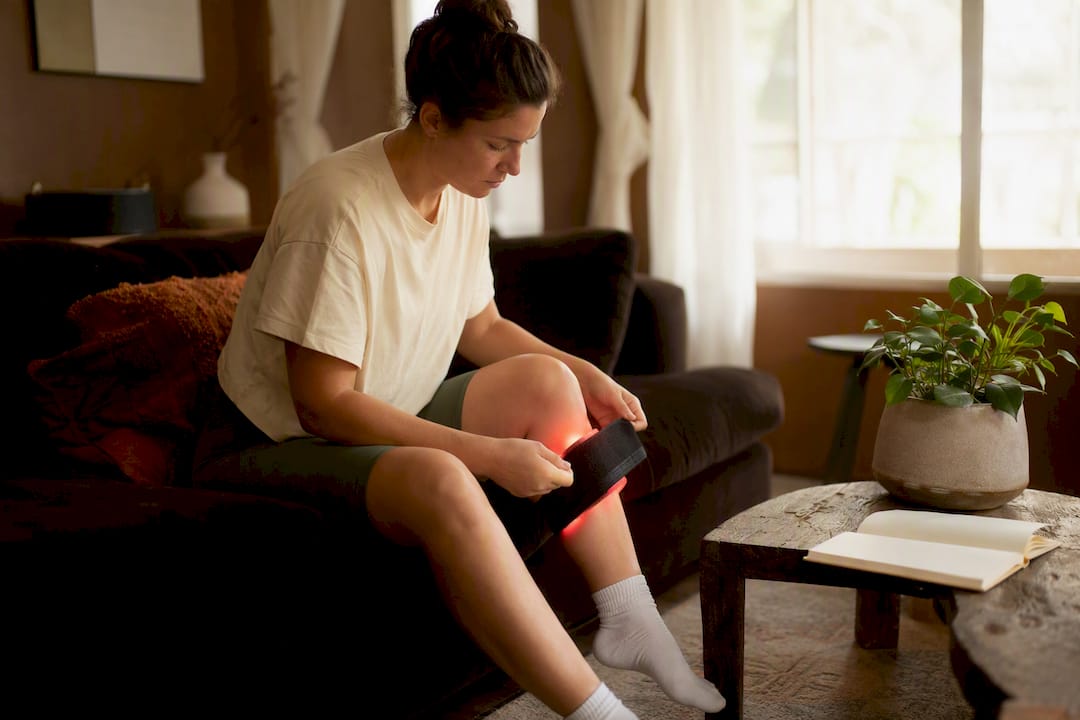
Pain conditions tell a more mixed story depending on which one you’re asking about. The umbrella review found moderate-certainty evidence specifically for disability improvement in knee osteoarthritis and fatigue reduction in fibromyalgia, along with pain relief in burning mouth syndrome. Tendinopathy and general musculoskeletal pain research is far less settled, with inconsistent results across trials that used different doses and treatment schedules. If you’re managing chronic pain and considering red light as an add-on, the honest takeaway is that it might help two or three specific conditions reasonably well, while its benefit for pain broadly remains unproven.
Oral mucositis, a painful side effect of cancer treatment affecting the mouth and throat, is one of the few areas where photobiomodulation has actually made it into clinical treatment guidelines, not just research papers. That’s a meaningfully higher bar than most of the uses discussed here.
Where the evidence runs out entirely is worth naming directly: weight loss, cellulite reduction, and claims about treating major systemic diseases have no credible clinical backing. If you see red light therapy marketed as a fat-loss tool or a treatment for a serious internal condition, that claim is running well ahead of anything in the research pool. Scientific American’s review of the science makes a similar point bluntly: genuine clinical footholds exist, particularly for wound healing and hair loss, but a lot of consumer hype has attached itself to a treatment whose evidence base is still thinner than the marketing suggests.
Safety, Side Effects, and Red Flags Worth Knowing
The short version: red light therapy has a good safety record in clinical trials, and serious adverse events are rare. That doesn’t mean it’s risk-free, and it doesn’t mean every device or provider is being straight with you.
Trial data consistently shows red light therapy is well tolerated at the doses researchers used. Mild redness or a warm sensation during treatment is the most commonly reported effect, and it typically resolves quickly. At higher intensities than trials typically use, the risk profile changes; there are documented cases of skin irritation, redness that lingers, and even blistering when devices deliver more energy than the skin can handle, particularly with extended or improperly spaced sessions.
Here’s what actually deserves your attention before you start:
- Protect your eyes. Direct exposure, especially from stronger clinic-grade panels, can affect the retina. Use the eyewear provided, and don’t assume a home device is automatically gentle enough to skip this step.
- Check your medications. Certain drugs, including some antibiotics, acne medications, and diuretics, increase photosensitivity. Combining those with light-based treatment raises the risk of an adverse skin reaction.
- Flag a cancer history. Both the American Academy of Dermatology and Cleveland Clinic recommend clinician input before starting, and that’s especially true if you have a personal or family history of skin cancer.
- Pregnancy warrants a conversation with your doctor first. The research simply hasn’t been done to rule out concerns definitively.
- Long-term, years-long use in healthy adults hasn’t been well studied. Most trials run for weeks or a few months, not years, so nobody can tell you with confidence what daily use for a decade looks like.
Pro Tip: If a product page or provider promises results across an unusually long list of conditions, wrinkles, weight loss, joint pain, mood, sleep, and hair loss all from one device, treat that as a warning sign rather than a bonus. The strongest evidence supports a short, specific list of uses. Broad, sweeping claims are usually a marketing strategy, not a reflection of the research.
The clearest tell of an overselling provider or device is the absence of specifics. A legitimate product or clinic should be able to tell you the wavelength it uses, the irradiance at the treatment surface, and point you toward published data. If you get vague language instead (“clinically proven,” “doctor recommended”) with no numbers attached, that’s a gap worth noticing.
Devices, FDA Clearance, and How to Read the Marketing
Red light therapy comes in a lot of physical forms, and the format you choose changes what results you can reasonably expect. Full-body panels used in clinics deliver higher irradiance over larger treatment areas, which is part of why professional sessions tend to outperform home devices for conditions that need deeper or broader coverage. At-home options range from full face masks to small handheld wands to wearable wraps for joints, and the tradeoff is almost always the same: more convenience and lower cost in exchange for less power.
A word that gets thrown around constantly in this space is “FDA cleared,” and it’s worth understanding exactly what that means, because it’s less reassuring than it sounds. Most red light devices go through the FDA’s 510(k) pathway, which clears a product by showing it’s substantially equivalent to an existing, already-cleared device, not by independently proving the new device works for every claim on its packaging. Clearance is primarily a safety and equivalence determination. It is not the FDA’s stamp of approval on efficacy for a specific outcome like wrinkle reduction or hair regrowth. Stacyknows has covered this distinction in more depth in a look at how the FDA authorized microneedling as a skin treatment, and the same logic applies here: clearance tells you a device meets a safety bar, not that it will deliver the specific benefit advertised on the box.
Before buying anything, check for these specs directly:
- Wavelength, ideally stated in nanometers, matching ranges used in actual clinical trials (roughly 630 to 850nm depending on the target use).
- Irradiance, measured in milliwatts per square centimeter (mW/cm²), which tells you the actual power hitting your skin, not just the device’s total wattage.
- Treatment area size, since a small handheld wand and a full-body panel are not interchangeable for full-face or full-body goals.
- Recommended treatment distance, because irradiance drops sharply the farther the device sits from skin.
- Published data specific to that product or a comparable one, rather than generic references to “photobiomodulation research” with no direct link to the device you’re buying.
Third-party testing and independently published trial data matter more in this category than in most beauty tech, precisely because dosing is so easy to get wrong and so hard for a shopper to verify on their own. If you’re generally curious about how new aesthetic treatments get vetted before they reach consumers, Stacyknows has broader coverage of innovations in medical aesthetics and wellness worth a look.
Practical Dosing: Wavelengths, Session Length, and Realistic Timelines
Clinical trials studying red light therapy have converged on some general patterns, though none of these numbers function as a universal prescription. Treat them as reference ranges for evaluating whether a product or protocol is in the right neighborhood.
- Session length: A number of published trials used sessions in the 10 to 12 minute range for a given treatment area, delivered one to three times per week depending on the condition being studied.
- Wavelength selection: Red light in the 630 to 700nm range is more commonly used for surface-level skin concerns, while near-infrared light around 800 to 850nm tends to be used when researchers want deeper tissue penetration, such as for joint pain.
- Hair growth protocols: Trials showing increased hair density generally involved multiple sessions per week sustained over several months, not a handful of one-off treatments.
- Skin rejuvenation protocols: Visible changes in fine lines or texture in published studies typically emerged after 8 to 12 weeks of consistent sessions, not immediately.
- Pain management protocols: The conditions with moderate-certainty evidence, knee osteoarthritis, fibromyalgia, and burning mouth syndrome, used regimens delivered over several weeks rather than single sessions.
The math behind “cumulative dose” explains why a cheaper, lower-power device isn’t automatically a bargain. A panel delivering half the irradiance of a clinic-grade unit would, in theory, need roughly twice the exposure time to approach a similar cumulative dose, and many home devices simply aren’t built to be used that long per session without discomfort or impracticality. WebMD’s consumer guide makes this same comparison point: in-office devices are typically more powerful, and at-home costs and results vary widely as a result.
Set your expectations around months, not days. Hair density changes and skin texture improvements documented in trials showed up over 8 to 12 weeks at minimum, with continued use required to maintain results rather than a single course that “finishes” the job.
StacyKnows’ Take on Choosing Between a Clinic and an At-Home Device
We built this guide around the actual clinical literature, the 2025 umbrella review, Stanford’s reporting, Cleveland Clinic’s patient guidance, and the AAD’s safety framework, rather than around what red light device brands say about themselves. That distinction shapes every recommendation here.
Here’s our honest read on when to see a professional versus trying an at-home option:
- See a clinician first if you’re treating a diagnosed skin condition, managing chronic pain alongside other medications, pregnant, or have a personal history of skin cancer.
- A supervised clinic session makes sense if you want the strongest possible dose and faster feedback on whether the treatment is doing anything for you at all.
- An at-home device is reasonable to try for general skin maintenance or mild hair thinning, as long as you’ve checked its wavelength and irradiance specs against what the trials actually used.
Before spending money anywhere, bring a short list of questions to a clinician or a device vendor: What wavelength and irradiance does this deliver? For those exploring wellness options, the Bright Line Eating Alternatives offer practical insights that can complement your approach. What published trial supports this specific use case? How many sessions before I should expect to see anything? What’s the maintenance schedule after that?
Pro Tip: Save the spec sheet or ask for it in writing before you buy. If a company can’t hand you a wavelength and irradiance number on request, that’s a bigger red flag than any price tag.
If you want a starting point for vetted product picks, Stacyknows keeps a running list of beauty and wellness device finds worth checking before you commit to a purchase.
Bottom Line: Who Should Try It and What to Do Next
Red light therapy earns its place as a legitimate, evidence-backed option for a specific short list: hair density in pattern hair loss, and select pain conditions including knee osteoarthritis, fibromyalgia, and burning mouth syndrome. For everything else, including most skin rejuvenation claims, it’s reasonably promising but not proven at a high level of confidence. Anyone managing a diagnosed medical condition, taking photosensitizing medication, pregnant, or with a history of skin cancer should talk to a clinician before starting, full stop.
Three things to do before you spend a dollar:
- Check the specs, not the marketing. Confirm wavelength, irradiance, and whether the product has data tied to it specifically.
- Start with supervision if you have a medical condition, or choose a well-documented device if you’re using it for general maintenance.
- Track your results over months and plan for maintenance, since most documented benefits fade if you stop treatment.
For related reading, Stacyknows covers non-pill, non-surgical approaches to hair loss and broader guidance on how lifestyle choices affect skin health if you’re building a longer-term plan rather than looking for a single fix.
Why the Hype Around Red Light Therapy Gets Ahead of the Data
The research supports a narrower claim than the internet is selling you. Hair density, a few pain conditions, some skin improvements, that’s a real and useful list, but it’s a list, not a universal cure. The conventional advice fails readers in one specific way: it treats “FDA cleared” as a synonym for “proven effective,” when clearance is mostly about safety equivalence, not efficacy for your particular goal.
What gets overlooked most is dosing. Two devices can look identical in an ad and deliver wildly different results because irradiance and session length vary so much, and almost no consumer product discloses these numbers upfront. That’s the detail worth chasing before price or brand reputation.
If you take one thing from this guide, prioritize the spec sheet over the testimonial. Ask what wavelength a device uses, what irradiance it delivers, and whether any published trial used comparable numbers. That single habit will save you more money and disappointment than any amount of research into which brand has the prettiest packaging.
— Stacy
This article is general information, not a substitute for advice from a qualified doctor. Consult a qualified healthcare professional about your own circumstances before acting on anything here.
Sources
- Effects of photobiomodulation on multiple health outcomes: an umbrella review of randomized clinical trials
- Red light therapy: What the science says – Stanford Medicine
- Red Light Therapy: Benefits, Side Effects & Uses – Cleveland Clinic
- Does red-light therapy work? What the research says | Scientific American
- Is red light therapy right for your skin? – American Academy of Dermatology (AAD)
Recommended
- Innovations in Medical Aesthetics and Wellness – Stacyknows
- FDA Legally Authorized Microneedling as a Skin Treatment – Stacyknows
- A Modern Look at Anti Aging Science in Long Island – Stacyknows
- The Science of Spongilla: A Needle-Free Approach to At-Home Microneedling – Stacyknows
