

Understanding 0W-20 Engine Oil: Properties and Viscosity Specifications
We often strive for optimal performance and longevity in all aspects of our lives, from personal well-being to the machines we rely on daily. Just as understanding our own systems is vital, comprehending the needs of our vehicles is equally important for their health and efficiency. Today, we turn our focus to a key element in modern automotive care: 0W-20 engine oil.
This advanced lubricant has become a standard for many contemporary vehicles. Its unique formulation plays a crucial role in engine protection, fuel economy, and overall operational smoothness. However, the specific properties and benefits of this oil are not always fully understood.
In this comprehensive guide, we will explore the essential characteristics of 0W-20 engine oil. We will delve into its viscosity specifications, recommended applications across different vehicle types, and its performance capabilities in extreme temperatures. Our aim is to provide clarity and valuable insights for every vehicle owner.
At its core, 0W-20 engine oil is a marvel of modern lubrication engineering, primarily a full synthetic formulation designed to meet the rigorous demands of contemporary engines. The “0W-20” designation is a critical indicator of its viscosity characteristics, as defined by the Society of Automotive Engineers (SAE) viscosity grading system.
The “0W” component refers to the oil’s cold-weather viscosity. The “W” stands for “Winter,” and the number preceding it indicates how well the oil flows at low temperatures. A “0” rating signifies exceptional fluidity in cold conditions, meaning the oil remains very thin and flows quickly even in freezing temperatures. This rapid flow ensures immediate lubrication of engine components during cold starts, significantly reducing wear and tear.
The “20” component, on the other hand, indicates the oil’s viscosity at normal operating temperatures (typically 100°C). A lower number here signifies a thinner oil at operating temperature. In the case of 0W-20, it means the oil maintains a relatively low viscosity when the engine is hot, which is crucial for minimizing internal friction and maximizing fuel efficiency.
Key Physical and Chemical Properties:
Modern 0W-20 oils are engineered with a precise balance of base oils and advanced additive packages, contributing to their superior performance. Here are some typical specifications we observe in leading 0W-20 full synthetic oils as of September 2026:
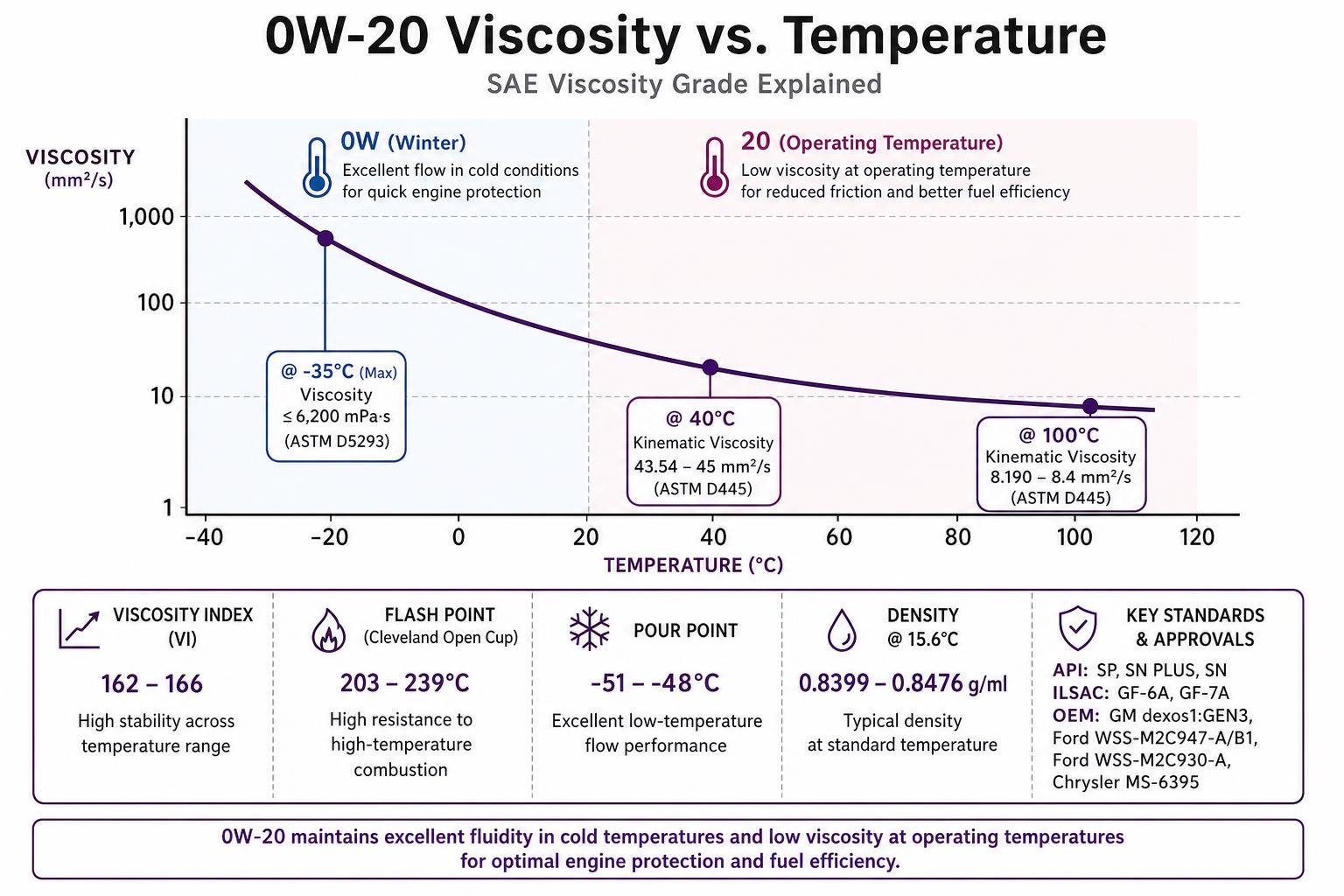
- Kinematic Viscosity @ 100°C: This measures the oil’s resistance to flow at engine operating temperature. For 0W-20, values typically range from 8.190 to 8.4 mm²/s (ASTM D445). This relatively low figure confirms its thin nature at high temperatures, which is key to its fuel-saving properties.
- Kinematic Viscosity @ 40°C: This indicates the oil’s flow characteristics at a lower, but still warm, temperature. Common values fall between 43.54 and 45 mm²/s (ASTM D445). This demonstrates its ability to thin out effectively as the engine warms up.
- Viscosity Index (VI): This measures how much an oil’s viscosity changes with temperature. A higher VI indicates better viscosity stability across a wide temperature range. 0W-20 oils often boast a high VI, typically around 162 to 166, signifying their ability to maintain optimal viscosity in both cold and hot extremes.
- Flash Point: This is the lowest temperature at which the oil’s vapors will ignite when exposed to an open flame. High flash points are desirable for safety and thermal stability. For 0W-20, flash points generally range from 203°C to 239°C (Cleveland Open Cup), indicating excellent resistance to high-temperature combustion.
- Pour Point: This is the lowest temperature at which the oil will still flow. A very low pour point is essential for cold-start performance. 0W-20 oils typically have pour points between -51°C and -48°C, ensuring the oil remains fluid even in extremely frigid conditions.
- Density @ 15.6°C: This measures the mass per unit volume of the oil at a standard temperature. Values are usually around 0.8399 to 0.8476 g/ml, reflecting the oil’s composition.
Industry Standards and Approvals:
The performance of 0W-20 engine oil is rigorously tested and certified against various industry standards and Original Equipment Manufacturer (OEM) approvals. These standards ensure the oil meets specific performance criteria for engine protection, fuel economy, and emissions control. Key certifications include:
- API (American Petroleum Institute): Modern 0W-20 oils typically meet API SP, SN PLUS, and SN classifications. API SP is particularly important as it addresses issues like Low-Speed Pre-Ignition (LSPI) and timing chain wear in downsized, turbocharged engines.
- ILSAC (International Lubricant Standardization and Approval Committee): 0W-20 oils are often certified under ILSAC GF-6A and emerging GF-7A standards. These standards emphasize fuel economy, engine cleanliness, turbocharger protection, and emissions system compatibility. They also carry a “Resource Conserving” designation, highlighting their contribution to fuel efficiency.
- OEM Approvals: Many vehicle manufacturers have their own specific oil requirements. 0W-20 oils frequently carry approvals such as GM dexos1:GEN3, Ford WSS-M2C947-A/B1, Ford WSS-M2C930-A, and Chrysler MS-6395. Adhering to these OEM specifications is crucial for maintaining vehicle warranty and optimal engine performance.
These specifications collectively define 0W-20 as a high-performance, low-viscosity lubricant engineered for the specific needs of modern engines, prioritizing both protection and efficiency.
Vehicles and Engines Recommended for 0W-20 Oil
The adoption of 0W-20 engine oil is not universal but is specifically recommended for a growing segment of the automotive market. Its unique properties are particularly beneficial for vehicles designed with tighter tolerances and advanced engine technologies.
Modern Gasoline-Powered Vehicles:
The primary candidates for 0W-20 oil are modern gasoline-powered cars, SUVs, light vans, and light trucks. Vehicle manufacturers, especially those focused on fuel efficiency and reduced emissions, have engineered their engines to operate optimally with lower viscosity oils. This includes:
- Downsized, Turbocharged, and Supercharged Engines: These engines, common in vehicles from manufacturers like GM, Ford, Chrysler, and Fiat, operate at higher temperatures and pressures. They require an oil that can provide rapid lubrication during startup and maintain stable viscosity under extreme stress. The LSPI protection offered by API SP-rated 0W-20 is vital for these engines, preventing damaging pre-ignition events.
- Hybrid Vehicles: Many hybrid models, such as the Toyota Prius, cycle frequently between engine on/off states. This stop-and-go operation demands an oil that can provide instant lubrication during numerous cold starts. The low-temperature fluidity of 0W-20 ensures that these engines are protected from the moment they kick in, contributing to both longevity and fuel economy. Field testing in a Toyota Prius taxi, for instance, has demonstrated 0W-20’s excellent resistance to oxidation over 160,000 km, even with frequent short trips.
- Japanese and Korean Vehicles: A significant number of vehicles from manufacturers like Honda, Toyota, Mazda, Subaru, Hyundai, and Kia have specified SAE 0W-20 for many years, reflecting their commitment to fuel efficiency and environmental standards.
Importance of the Owner’s Manual:
It cannot be stressed enough that the ultimate authority on which oil to use is the vehicle’s owner’s manual. While 0W-20 is widely adopted, using it in an engine not specifically designed for such low viscosity can lead to inadequate lubrication and potential damage. The manual will specify the recommended SAE viscosity grade (e.g., 0W-20, 5W-30) and the required API or ILSAC service classification, as well as any specific OEM approvals (e.g., GM dexos1, Ford WSS-M2C947-A). Always consult this document to ensure compatibility and compliance with warranty terms.
In summary, 0W-20 is the lubricant of choice for a broad range of contemporary vehicles, particularly those prioritizing fuel efficiency, advanced engine protection, and compliance with the latest emissions standards. Its application is a testament to the ongoing evolution of automotive engineering and lubrication science.

Benefits of 0W-20 Oil: Efficiency and Protection
The widespread adoption of 0W-20 engine oil in modern vehicles is driven by a compelling array of benefits, particularly when compared to higher-viscosity oils like 5W-30 or 10W-30. These advantages span from enhanced engine protection to significant improvements in fuel economy and overall operational efficiency.
Superior Fuel Economy:
One of the most significant benefits of 0W-20 oil is its contribution to improved fuel economy. Its low viscosity, especially at operating temperatures, reduces internal engine friction. When the oil is thinner, the engine components encounter less resistance as they move, requiring less energy to operate. This reduction in parasitic drag translates directly into better fuel efficiency.
- Studies and user anecdotes often report measurable improvements. For instance, a driver switching from 5W-30 to 0W-20 might observe a noticeable gain in highway fuel economy. Some reports even suggest up to a 20% improvement in fuel efficiency under specific test conditions, or real-world gains like 1.6 mpg in a Honda Accord V-6, and 1 L per 100 km reduction in a Mazda CX-5. This is why 0W-20 oils are often certified as “Resource Conserving” by ILSAC and API.
Exceptional Cold-Start Performance and Protection:
The “0W” rating is paramount for engines, particularly in colder climates. During a cold start, conventional oils can be thick and sluggish, taking longer to circulate and reach critical engine components. This delay can lead to significant wear, as most engine wear occurs within the first few seconds of startup.
- 0W-20, with its extremely low pour point (as low as -51°C), remains fluid even in severe cold. This ensures immediate oil flow to all moving parts, providing instant lubrication and drastically reducing wear during startup. This rapid circulation also lessens the load on the starter motor and battery, contributing to their longevity.
Robust High-Temperature Protection:
Despite its low viscosity, modern 0W-20 full synthetic oils offer remarkable high-temperature protection. Advanced additive packages and high-quality synthetic base oils ensure that the oil maintains its film strength and viscosity under the extreme heat and stress of engine operation.
- These oils are engineered to resist thermal breakdown and oxidation, which can lead to sludge and varnish formation. Some formulations claim up to 30 times better high-temperature protection compared to baseline standards, maintaining performance even in demanding conditions. This means they can protect vital engine parts for extended periods, with some manufacturers guaranteeing protection for up to 10,000 or even 15,000 miles, or one year.
Enhanced Engine Cleanliness and Sludge Prevention:
Full synthetic 0W-20 oils are formulated with powerful detergents and dispersants. These additives actively work to prevent the buildup of sludge, varnish, and other deposits that can clog oil passages and reduce engine efficiency.
- Mechanics often note reduced sludge buildup in engines that consistently use 0W-20, even in high-temperature climates. This cleanliness ensures optimal engine performance and extends the lifespan of critical components. Some products boast up to 99.9% contaminant reduction.
Superior Wear Resistance:
Modern 0W-20 oils are designed to meet stringent wear protection standards, including those for timing chain wear and Low-Speed Pre-Ignition (LSPI) protection. LSPI is a phenomenon that can cause severe engine damage in turbocharged direct-injection engines.
- The latest API SP and ILSAC GF-6 standards specifically address these concerns, ensuring that 0W-20 oils provide a protective barrier against metal-to-metal contact, extending engine life. Some brands even claim 1.5 times longer protection than conventional oils.
0W-20 engine oil represents a significant advancement in lubrication technology, offering a potent combination of fuel efficiency, immediate cold-start protection, and robust high-temperature performance, all while keeping engines cleaner and extending their operational life.
0W-20 Oil Performance in Extreme Temperatures
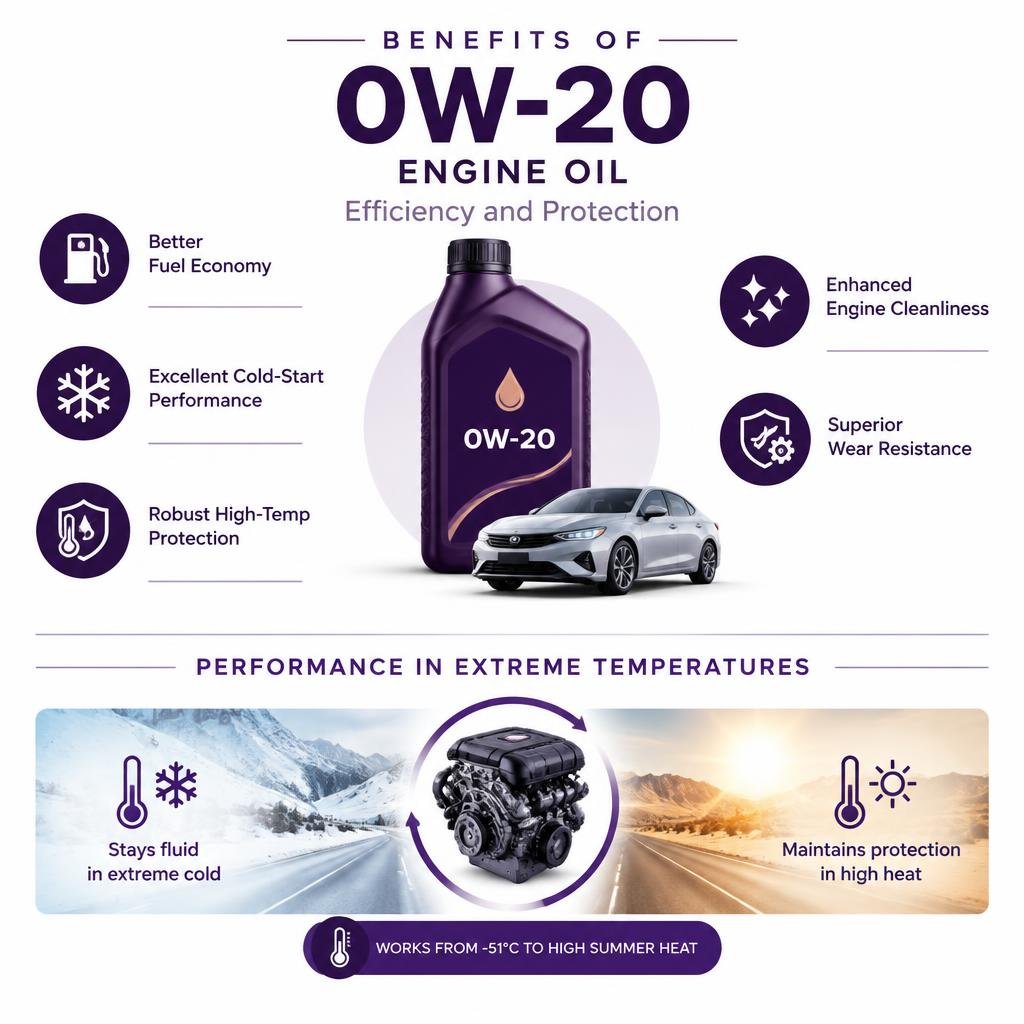
The ability of 0W-20 engine oil to perform consistently across a broad spectrum of temperatures is one of its most defining and beneficial characteristics. Its unique formulation allows it to excel in both the frigid depths of winter and the scorching heat of summer, providing unwavering engine protection.
Performance in Extreme Cold Temperatures:
The “0W” designation in 0W-20 is a testament to its exceptional cold-weather performance. The “W” stands for Winter, and the “0” indicates that the oil has a very low viscosity when cold.
- Rapid Flow and Instant Lubrication: In extremely cold conditions, traditional higher-viscosity oils can become thick and sluggish, resembling molasses. This hinders their ability to flow quickly through the engine upon startup. 0W-20, however, remains highly fluid even at temperatures as low as -51°C to -48°C (its pour point). This means it circulates almost instantly, reaching critical engine components like the camshafts, lifters, and bearings within seconds of ignition.
- Reduced Cold-Start Wear: The majority of engine wear occurs during the initial moments of a cold start, when parts are operating without adequate lubrication. By providing immediate oil film protection, 0W-20 drastically minimizes metal-on-metal friction, significantly extending engine life.
- Easier Starting: The reduced resistance from a thinner oil also makes it easier for the starter motor to turn the engine over, especially in sub-zero temperatures. This reduces strain on the battery and starting system, contributing to their longevity.
- Fuel Delivery: Quicker oil pressure buildup also helps in the efficient operation of variable valve timing systems and other oil-actuated components, which are crucial for optimal fuel delivery and engine performance from the outset.
Performance in Hot Operating Temperatures:
While its cold-weather performance is outstanding, 0W-20 oil is equally adept at protecting engines under the intense heat of normal operating conditions. The “20” in its designation refers to its viscosity at 100°C, indicating a relatively thin oil.
- Maintained Viscosity and Film Strength: Modern 0W-20 full synthetic oils are formulated with advanced polymers and base oils that resist thermal breakdown and maintain a stable viscosity even when the engine is running hot. This ensures a consistent protective oil film between moving parts, preventing metal-to-metal contact and wear.
- Thermal and Oxidation Stability: Engines generate immense heat, which can cause oils to oxidize and break down, leading to sludge formation and reduced lubrication effectiveness. 0W-20 oils are engineered with high flash points (ranging from 203°C to 239°C) and robust antioxidant packages, making them highly resistant to oxidation and thermal degradation. This stability is crucial for maintaining engine cleanliness and performance over extended drain intervals.
- Shear Stability: Historically, some low-viscosity oils faced challenges with shear stability, meaning they could thin out excessively under mechanical stress. However, modern 0W-20 formulations, particularly those meeting ILSAC GF-6 and API SP standards, have significantly improved shear stability. This ensures the oil maintains its protective viscosity and film strength even under high loads and prolonged operation.
- Effective Cooling: While lubrication is its primary role, engine oil also plays a vital role in cooling. The efficient circulation of 0W-20 helps dissipate heat from critical engine components, contributing to overall thermal management and preventing overheating.
0W-20 engine oil is a truly all-season lubricant, meticulously designed to provide superior protection and efficiency from the most extreme cold starts to the most demanding hot operating conditions. Its balanced performance across the temperature spectrum makes it an ideal choice for the sophisticated engines of today’s vehicles.
Potential Drawbacks or Limitations of Using 0W-20 Oil
While 0W-20 engine oil offers numerous benefits for modern vehicles, it’s important to acknowledge its potential drawbacks or limitations. Understanding these aspects ensures that drivers make informed decisions and use the oil appropriately for their specific vehicle.
Not Universally Compatible:
The most critical limitation of 0W-20 oil is that it is not a “one-size-fits-all” solution. It is specifically formulated for engines designed to operate with such low viscosity.
- Risk for Older Engines: Using 0W-20 in older engines that were originally designed for higher viscosity oils (e.g., 5W-30, 10W-40) can lead to insufficient lubrication. Older engines often have larger internal clearances, and a thinner oil might not provide the necessary film thickness to prevent metal-on-metal contact, potentially causing accelerated wear, increased oil consumption, and even engine damage. Always consult the vehicle’s owner’s manual for the recommended viscosity grade.
Higher Cost:
0W-20 engine oils are almost exclusively full synthetic formulations. While synthetic oils offer superior performance and protection, they typically come at a higher price point than conventional or even synthetic-blend oils.
- Initial Investment: The cost per quart or liter for 0W-20 can be a deterrent for some consumers, despite the long-term benefits in fuel economy and engine longevity. However, the extended drain intervals often associated with synthetic oils can sometimes offset the higher upfront cost over the vehicle’s lifetime. Some “budget-friendly” full synthetic options are emerging, but they generally remain more expensive than non-synthetic alternatives.
Misconceptions and Resistance to Change:
A common misconception among some drivers and even older mechanics is that “thicker oil is better” for engine protection, especially in high-mileage or older vehicles. This belief stems from a time when engine tolerances were looser and oil technology was less advanced.
- Educational Gap: Overcoming this ingrained belief can be a challenge. For modern engines, however, using an oil thicker than recommended can actually be detrimental, leading to increased friction, reduced fuel economy, and potential issues with variable valve timing systems or other oil-actuated components designed for specific flow rates.
Environmental Impact Considerations:
While modern synthetic oils like 0W-20 allow for extended drain intervals, which can reduce the overall volume of waste oil over time, the disposal of synthetic oil still poses environmental concerns.
- Recycling Infrastructure: Ensuring proper recycling and disposal infrastructure is crucial. Furthermore, the manufacturing process for synthetic oils can be more energy-intensive than for conventional oils, though the overall life-cycle benefits often outweigh this.
Not Suitable for All Engine Types:
0W-20 is designed primarily for modern gasoline-powered passenger vehicles.
- Specific Exclusions: It should generally not be used in 2-cycle engines, diesel engines (unless specifically approved by the manufacturer and meeting relevant diesel specifications like ACEA C5/C6), or aviation engines, unless the manufacturer explicitly states otherwise. Using the wrong oil type in these specialized engines can lead to severe damage.
In conclusion, while 0W-20 engine oil is a highly advanced and beneficial lubricant for the vehicles it’s designed for, its application requires careful consideration of vehicle compatibility, cost, and adherence to manufacturer recommendations. It is not a universal solution, and understanding its limitations is as important as recognizing its advantages.
Best Practices for 0W-20 Engine Oil Usage
To maximize the benefits of 0W-20 engine oil and ensure optimal engine health, adhering to a set of best practices is essential. These guidelines, informed by industry standards and manufacturer recommendations, help drivers maintain performance, longevity, and warranty compliance for their vehicles.
1. Always Consult Your Owner’s Manual:
This is the single most important step. Your vehicle’s owner’s manual is the definitive source for recommended oil viscosity, API service classification, and any specific OEM approvals (e.g., GM dexos1, Ford WSS-M2C947-A/B1).
- Why it matters: Using the incorrect oil can lead to engine damage, reduced fuel economy, and void your vehicle’s warranty. The manual specifies the exact oil type your engine was designed to operate with for optimal performance and protection.
2. Adhere to Manufacturer-Approved Oil Change Intervals:
Modern 0W-20 full synthetic oils are designed for extended drain intervals, often ranging from 5,000 to 15,000 miles or one year, whichever comes first.
- Why it matters: Following these intervals, rather than arbitrary shorter ones, ensures you benefit from the oil’s full protective life while avoiding unnecessary waste and cost. However, consider severe driving conditions (e.g., frequent short trips, extreme temperatures, heavy towing, dusty environments) which might necessitate more frequent changes. Monitoring oil condition regularly, especially in high-stress applications like stop-and-go traffic, can also be beneficial.
3. Monitor Oil Level Regularly:
Even with advanced synthetic oils, it’s crucial to check your oil level periodically, especially before long trips or in extreme temperatures.
- Why it matters: Engines can consume small amounts of oil naturally, and maintaining the correct oil level is vital for proper lubrication and cooling. Low oil levels can lead to increased wear and potential engine damage.
4. Ensure OEM Approvals for Warranty Compliance:
If your vehicle is still under warranty, using an oil that meets the specific OEM approvals (ee.g., GM dexos1, Ford WSS-M2C947) is critical.
- Why it matters: Many manufacturers require specific certifications for their engines. Failure to use an approved oil could potentially void your powertrain warranty if an engine issue arises that can be attributed to improper lubrication.
5. Store Oil Properly:
Unused engine oil should be stored in a cool, dry place, away from direct sunlight and extreme temperature fluctuations. Always keep the container tightly sealed.
- Why it matters: Proper storage helps maintain the oil’s chemical integrity and viscosity characteristics, ensuring it performs as intended when you use it.
6. Consider Synthetic-Blend Options (Where Appropriate):
While full synthetic 0W-20 is generally recommended for optimal performance, some vehicles might be compatible with 0W-20 synthetic-blend oils. These can offer a cost-effective middle ground between conventional and full synthetic options.
- Why it matters: Synthetic blends combine conventional and premium synthetic base oils, often providing enhanced protection and cleanliness compared to conventional oils, but at a lower price point than full synthetics. Always verify compatibility with your owner’s manual.
7. Understand the “Resource Conserving” Designation:
Many 0W-20 oils carry the “Resource Conserving” label, indicating their contribution to fuel efficiency and emissions reduction.
- Why it matters: Choosing such oils aligns with environmental goals and can lead to tangible fuel savings over time, contributing to a more sustainable driving experience.
By diligently following these best practices, vehicle owners can fully harness the advanced capabilities of 0W-20 engine oil, ensuring their engines run efficiently, are well-protected, and deliver reliable performance for years to come.
Conclusion: The Future of Engine Lubrication
As we have explored, 0W-20 engine oil stands as a cornerstone of modern automotive maintenance, a testament to the continuous innovation in lubrication technology. From its precise viscosity specifications, ensuring rapid cold-start protection and efficient hot-temperature performance, to its role in enhancing fuel economy and safeguarding advanced engine designs against issues like LSPI, its benefits are clear and substantial.
We’ve seen how 0W-20 is meticulously engineered to meet the stringent demands of contemporary vehicles, particularly those with turbocharged, supercharged, and hybrid powertrains. Its ability to maintain engine cleanliness, resist thermal breakdown, and extend drain intervals underscores its value in promoting engine longevity and reliability. However, we also recognize the importance of using this specialized lubricant only where recommended by the vehicle manufacturer, understanding that it is not a universal solution for all engines.
Just as we strive for optimal performance and longevity in our vehicles through precise care and the right lubricants, we also recognize the importance of personal well-being and self-care in our daily lives. For those interested in exploring resources for holistic self-care, including high-quality intimate wellness products, there are many valuable options available to support comfort and overall health.
The informed choice of engine oil, guided by manufacturer specifications and an understanding of advanced lubrication science, empowers us to make proactive health decisions for our vehicles. The journey of 0W-20 engine oil continues to evolve, promising even greater efficiencies and protection for the engines of tomorrow, ensuring that our machines, much like ourselves, are well-cared for and ready for the road ahead.
