
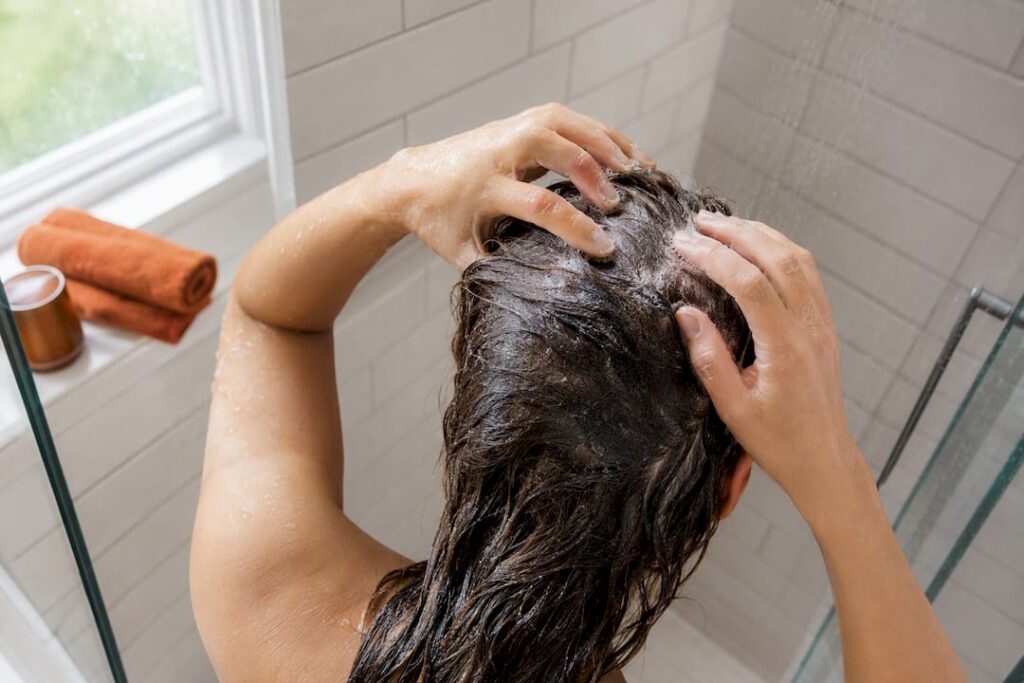
The best scalp care routine is simple: wash based on how oily your scalp actually gets, keep conditioner off your roots, clarify once a month, and reach for a medicated shampoo only when symptoms show up. This works because it protects three things your scalp needs to stay balanced: its oil supply, its barrier, and the microbes living on it. Strip all of that away with daily deep cleans and you create the exact flaking and irritation you were trying to prevent.
What Does a Healthy Scalp Actually Look Like?
A healthy scalp isn’t a blank slate. It produces sebum, hosts a community of microorganisms (yes, on purpose), and acts as the skin barrier for every hair follicle underneath it. When that system works, you barely think about your scalp. When it doesn’t, you think about nothing else.
Here’s how to tell the difference:
- Healthy: minimal itch, occasional light flaking after a few days without washing, no soreness when you run fingers through hair
- Worth watching: persistent itch that returns within a day of washing, visible flakes on dark clothing, tenderness at the crown or hairline
- Red flag: intense itching, thick scaling patches, soreness, or a sudden increase in shedding you can see in the shower drain
The instinct when things feel off is to scrub harder or wash more. That usually backfires. Stripping natural oil signals your sebaceous glands to overproduce, and it disrupts the balance of scalp and hair hygiene that keeps irritation and infection risk low. Gentle and consistent beats aggressive and occasional almost every time.
Building a Weekly Scalp Care Routine You’ll Actually Keep
Think of your routine in three layers: what you do on wash days, what you do once a month, and what you add only when something’s wrong.
Wash-day checklist:
- Brush through dry hair first to loosen surface debris and distribute natural oils.
- Wet thoroughly with warm (not hot) water.
- Apply shampoo directly to the scalp, not the ends, and massage with fingertips for 30 to 60 seconds.
- Rinse completely before applying conditioner.
- Apply conditioner from mid-length to ends only, never at the roots.
- Rinse with cooler water to help seal the hair cuticle.
- Air dry or use low heat, avoiding a hot dryer pointed directly at the scalp.
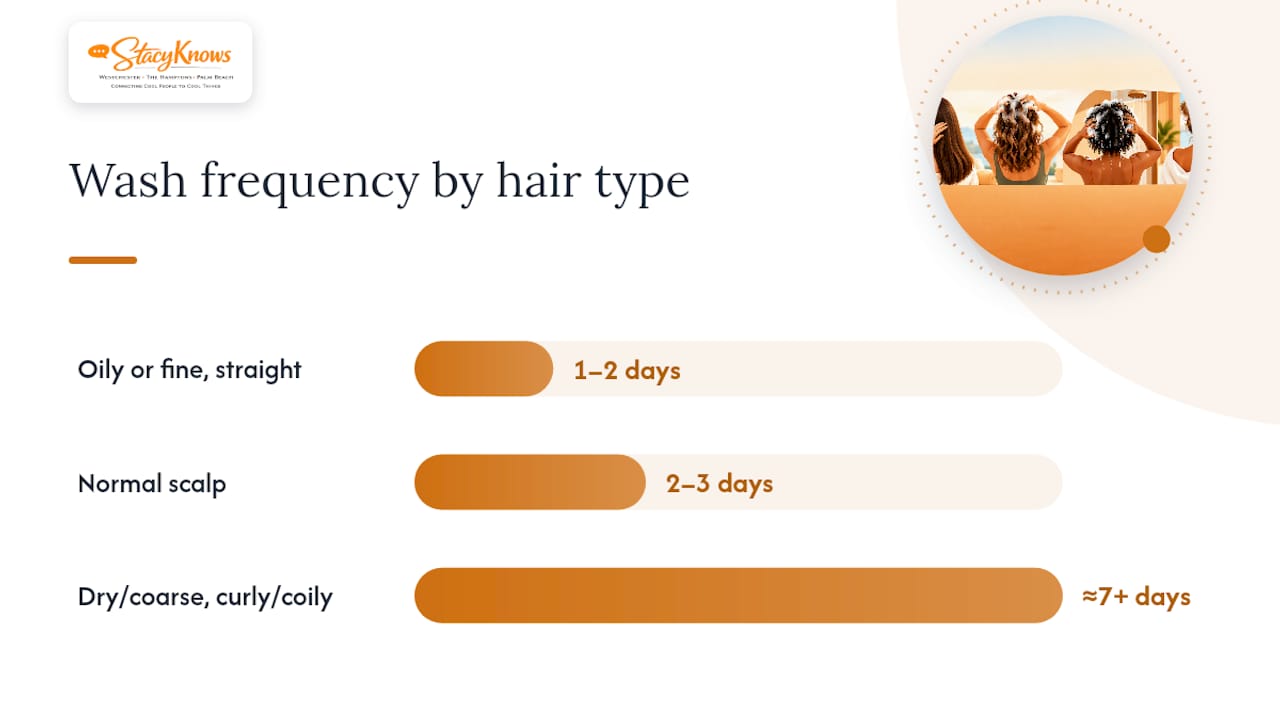
Wash frequency depends on your oil production and texture, which the next section breaks down in detail. As a starting frame: oily or fine, straight hair often means washing every one to two days, normal scalps land around every two to three days, and dry or coarse, curly, or coily hair can stretch to once a week or beyond.
Layer a monthly clarifying wash on top of your regular rhythm to clear product buildup and dead skin your usual shampoo can’t fully lift. If dandruff, itching, or flaking shows up, add a medicated shampoo two to three times a week, following the label’s directions rather than guessing.
A sample week for a normal to slightly oily scalp: gentle shampoo on Monday and Thursday, medicated shampoo on Sunday if flaking appears, monthly clarifying treatment on the first Sunday of the month.
Pro Tip: Keep a small travel bottle of your regular shampoo in your bag or car. Missing a wash day because your usual product is at home is one of the most common ways routines fall apart.
How Often Should You Wash, and Which Shampoo Actually Works?
Wash frequency isn’t one-size-fits-all, and neither is shampoo selection. Both come down to how much oil your scalp produces and what’s actually causing your symptoms.
Frequency by scalp type:
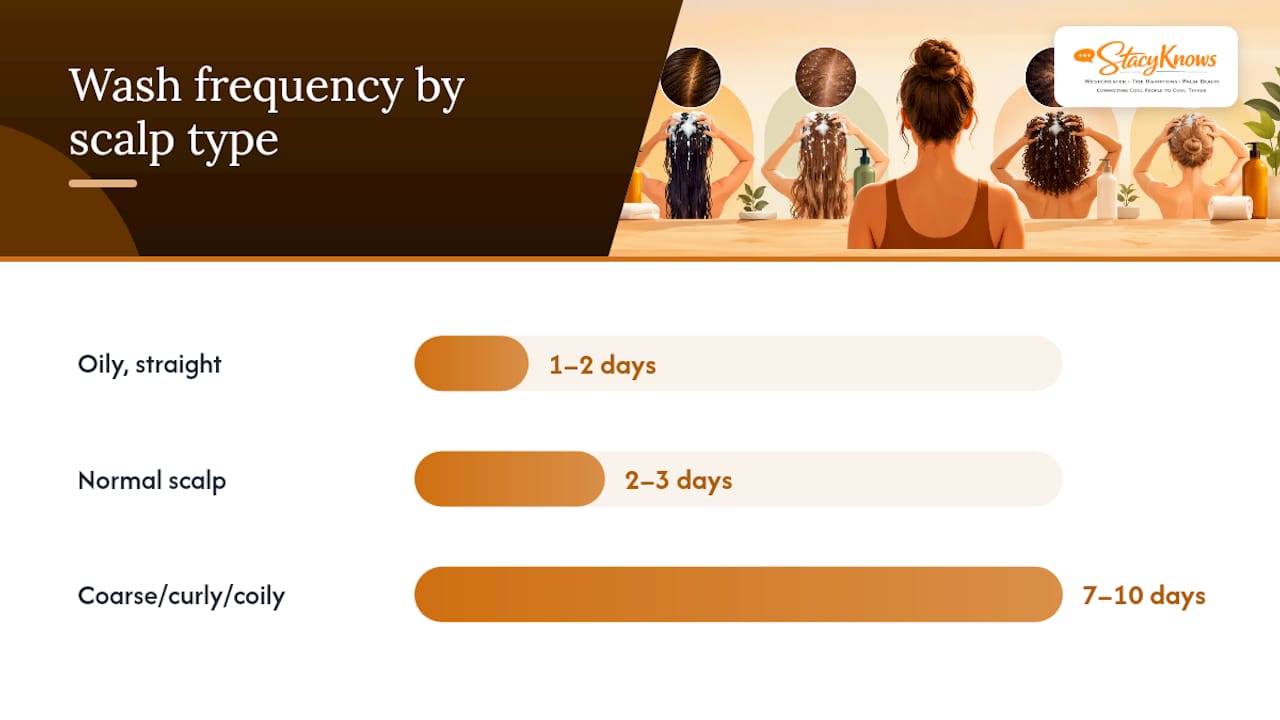
- Oily and straight hair tends to show grease fastest, so daily or every-other-day washing usually feels right.
- Normal scalps do well on a two-to-three-day rhythm.
- Coarse, curly, or coily hair produces oil more slowly and loses moisture faster, so stretching washes to once a week or even every ten days often looks and feels better.
Once you’ve settled on frequency, the active ingredient in your shampoo matters more than the brand on the bottle. The FDA’s OTC monograph for dandruff, seborrheic dermatitis, and psoriasis products covers key ingredients commonly used:
- Zinc pyrithione: an antimicrobial that targets the yeast linked to flaking
- Ketoconazole: an antifungal that addresses the same yeast
- Selenium sulfide: slows skin cell turnover and reduces flaking
- Salicylic acid: a keratolytic that loosens and lifts scale
- Coal tar: slows cell turnover for psoriasis-related scaling
The monograph’s labeling directions call for using antidandruff shampoos regularly or as directed on the package, and it requires warnings like “for external use only” and “avoid contact with eyes.” Follow those directions literally. Leave-on time matters. Mayo Clinic notes that many medicated shampoos need to sit on the scalp for several minutes before rinsing to actually work, and applying the product only to the scalp (not the hair shaft) keeps strands from drying out unnecessarily.
If one active stops working after a few weeks, don’t add a second on top of it. Switch instead, and reserve stacking for situations a dermatologist has specifically recommended.
When and How Should You Exfoliate Your Scalp?
Clarifying and exfoliating solve different problems, and mixing them up is where a lot of routines go wrong.
Clarifying uses a deep-cleansing shampoo or diluted acid rinse to dissolve oil, product residue, and mineral buildup from hard water. Exfoliating physically or chemically removes dead skin cells from the scalp’s surface, either with a soft-bristled scalp brush or a scalp scrub containing salicylic acid.
- Clarify or exfoliate once a month as a baseline for most scalp types.
- Use fingertips or a silicone scalp brush, never fingernails, to avoid micro-tears in the skin.
- Work in warm, not hot, water to avoid over-stripping natural oil.
- Follow immediately with a gentle shampoo and conditioner on the lengths.
Overuse shows up fast: tightness, redness, or a sudden increase in flaking a day or two after exfoliating usually means you’ve gone too far. If that happens, drop back to every six to eight weeks and let your barrier recover before trying again.
Treating Dandruff, Seborrheic Dermatitis, and Psoriasis
Most flaking falls into one of three categories, and the fix usually starts at the drugstore, not the dermatologist’s office.
Dandruff generally responds to over-the-counter shampoos containing zinc pyrithione, ketoconazole, or selenium sulfide used consistently. Dermatologists at the American Academy of Dermatology recommend starting with a gentle regular shampoo, adding a medicated one if flaking persists, and rotating actives if a product that used to work suddenly stops.
Seborrheic dermatitis, a more inflamed cousin of dandruff, often needs the same antifungal actives paired with an anti-inflammatory step. A 2023 to 2024 international expert consensus reviewing many published studies concluded that topical antifungals and anti-inflammatories remain the mainstay treatment, while noting that better options are still needed for moderate to severe cases that don’t respond to the basics.
Psoriasis on the scalp tends to need thicker, plaque-focused treatment, often salicylic acid or coal tar formulas, and frequently benefits from a dermatologist’s input from the start given how much more stubborn plaques can be.
Persistent flaking, ongoing itch, or unexplained shedding that doesn’t improve after two to four weeks of consistent OTC treatment is the signal to book a dermatology appointment rather than trying yet another shampoo.
For cases that don’t respond to OTC actives, dermatologists may prescribe ciclopirox, topical corticosteroids for flare-ups, or newer targeted agents. Here’s what typically prompts that referral conversation:
- Flaking or itch that hasn’t improved after a full month of consistent care
- Visible redness, soreness, or crusting beyond normal flaking
- Hair shedding that seems disproportionate to your usual pattern
- Symptoms that spread beyond the scalp to eyebrows, ears, or the hairline
Adjusting Your Routine for Curly, Coily, or Color-Treated Hair
Texture changes the math on almost every step above. Curlier hair holds moisture differently, and color treatments add another layer of sensitivity to consider.
- Apply medicated shampoo to the scalp only, working it in with fingertips, then let it rinse down through the hair rather than re-lathering the lengths.
- Save conditioner and hydrating masks for mid-lengths and ends, since curly and coily strands dry out faster than straight hair.
- On color-treated hair, choose a gentler cleanser for the lengths and keep stronger actives, like salicylic acid, targeted strictly at the scalp to protect color from fading early.
- If you wear protective styles, plan a clarifying wash before installation and another right after removal to catch buildup from styling products.
Why Most Scalp Routines Stall Out
The biggest routine killer isn’t laziness. It’s impatience layered on top of overcorrection.
- Exfoliating more than once a month “to speed things up”
- Stacking two or three medicated actives at once instead of rotating them
- Letting conditioner touch the roots, which weighs down fine or oily hair
- Switching products every one to two weeks before giving any of them a fair trial
Expect scalp symptoms like itch and flaking to shift within three to four weeks of a consistent routine. Hair density changes take much longer, often six months to a year, since hair growth cycles move slowly no matter what’s in the bottle. If you’ve been consistent for a month with no improvement, that’s the moment to stop adding products and get a professional opinion instead.
Pro Tip: Write down what you’re using and when for two weeks. Most people are shocked to realize they’re already stacking three “gentle” products that add up to a harsh routine.
Stacy’s Take: Keep It Simple, Especially After 35
Here’s what I’ve noticed watching friends chase the “perfect” scalp routine: the ones who stick with it are the ones who kept it boring. Pack a travel-size version of your regular shampoo for trips, skip the hotel-bathroom shampoo, and don’t panic if your scalp acts differently after a long flight, since dry cabin air affects your scalp barrier too.
Consistency beats complexity every time, especially once you’re busy enough that a ten-step routine simply won’t survive contact with a Tuesday. And if something’s been off for more than a month, a dermatologist will solve it faster than another round of Google searches ever will.
— Stacy Geisinger
Want More Routines Like This One?
There are beauty coverage options focused on routines you’ll actually keep, not aspirational ten-step regimens that collapse the first busy week. That’s the real advantage here. Instead of sorting through conflicting advice from a dozen different brands, some sources curate what’s actually worth trying, plus travel-friendly and time-saving tweaks that make sense once life gets full.

If scalp health is on your radar, it’s probably not the only thing on your beauty to-do list this year. Head over to Stacyknows to browse more beauty routines and sign up for the newsletter, so the next practical, no-nonsense guide lands in your inbox instead of getting buried in a search results page.
Where This Advice Comes From
- FDA OTC Monograph M032: the federal standard for active ingredients and labeling in dandruff and psoriasis shampoos
- American Academy of Dermatology: dermatologist-backed home treatment and rotation guidance
- Mayo Clinic: application technique and when to escalate care
- International expert consensus on seborrheic dermatitis: peer-reviewed treatment algorithms for more stubborn cases
This article is general information, not a substitute for advice from a qualified doctor. Consult a qualified healthcare professional about your own circumstances before acting on anything here.
Sources
- FDA OTC Monograph M032: Drug products for the control of dandruff, seborrheic dermatitis, and psoriasis
- How to treat dandruff — American Academy of Dermatology
- Dandruff — Mayo Clinic (Diagnosis and treatment)
- International expert consensus on management of seborrheic dermatitis (PubMed)
FAQ
What Is the Best Scalp Care Routine?
The best routine matches your wash frequency to your natural oil level, keeps conditioner off the roots, and adds a monthly clarifying treatment to clear buildup. Medicated shampoo only comes into play if flaking, itching, or soreness shows up, and even then it should follow the label’s directions rather than daily use.
How Do I Know If I Have Dandruff or Seborrheic Dermatitis?
Dandruff usually shows up as light, dry flakes with mild itch, while seborrheic dermatitis tends to bring redness, greasy-looking scale, and more persistent itching. If OTC treatment hasn’t helped after two to four weeks, a dermatologist can confirm which one you’re dealing with.
How Often Should I Exfoliate My Scalp?
Once a month works as a baseline for most scalp types, using a soft brush or a salicylic acid scrub rather than fingernails. Watch for tightness or new redness after exfoliating, since that usually means you need to scale back to every six to eight weeks.
Can I Use Too Many Scalp Serums or Treatments at Once?
Yes, and stacking multiple active ingredients is one of the most common reasons routines backfire instead of helping. Rotate between one or two actives at a time and give each one several weeks before deciding it isn’t working.
When Should I See a Dermatologist About My Scalp?
See a dermatologist if flaking, itching, or shedding hasn’t improved after two to four weeks of consistent OTC care, or sooner if you notice soreness, crusting, or spreading symptoms. Persistent seborrheic dermatitis or psoriasis often needs prescription options that a dermatologist-guided consensus outlines beyond what shampoo alone can fix.
Recommended
- Nobody Warned Me That Aging Would Change My Hair Too
- Hair Loss Solutions That Don’t Involve Pills or Plugs
- Quiet Silver Blending Softens Roots: Gray Hair Transition for Women 35+
