

The real rule of dating texting etiquette has nothing to do with waiting three days or playing it cool. It comes down to reciprocity, clarity, and momentum toward an actual plan. If the date went well, text something warm and specific within 24 hours that nudges toward a next step. That’s it. Everything else is noise.
How Often to Text: Matching Energy and Reciprocity
Forget the idea that there’s a magic number of texts per day that signals the “right” amount of interest. There isn’t one. What matters is whether both people are putting in roughly equal effort, and whether the texting is actually moving things somewhere. Psychology Today notes that effective texting is less about volume and more about sustaining connection and getting the next date on the calendar, not treating your phone like a surveillance device.
That said, pacing does shift depending on where you are:
- Before the first date: Keep it fairly frequent, almost daily, to build anticipation and confirm the plan is still on.
- Between dates once you’re seeing each other: Enough contact to check in and coordinate the next hangout, without needing a play-by-play of each other’s days.
- Early rhythm, a few dates in: Let a natural pattern emerge instead of forcing one. Some couples text all day; others check in twice and save the rest for in person. Both are fine if they match.
The one thing to avoid at every stage is engineered silence, the strategy of waiting longer on purpose to seem less interested. Wisp’s stage-by-stage breakdown makes the case that these old “rules” are outdated because they optimize for looking desirable instead of actually connecting. Consistency beats intensity every time. Someone who texts you reliably twice a day is showing more real interest than someone who sends a flurry of messages and then vanishes for 48 hours.
Pro Tip: If you’re naturally the more enthusiastic texter, don’t dial yourself down to match a slower partner. Being the “warmer” one early on doesn’t cost you anything, and it often speeds up the whole thing.
What to Text After a First Date (And When)
Texting within a day after the date is the standard move if you had a good time. Psychology Today’s guidance on post-date follow-up points to a simple formula: acknowledge you had fun, then propose something specific. Vague follow-ups just create more back-and-forth than necessary.
Here’s how the timing and wording usually break down:
- Same night, if the vibe was easy and fun: “That was a great time, glad we did this.” Short, warm, no pressure.
- Next morning, if you want to sound a little more composed: “Had a really good time last night. Free Thursday for round two?” This version does double duty, showing interest and floating a plan at once.
- A polite pass, if you’re not feeling it: “Really nice meeting you, but I didn’t feel a romantic connection. Wishing you luck out there.” Clear, kind, and final.
Specificity is what actually kills ambiguity here. A message that names a day beats a generic “we should hang again” every time, because it forces a real answer instead of a maybe.
Texting Dos and Don’ts: Tone, Emoji, and Double-Texting
One purposeful follow-up text is completely normal. If your first message got buried or ignored, a second message that adds context, like “no worries if you’re busy, just wanted to say hi again,” is a reasonable nudge. Business Insider’s reporting on double-texting backs this up: the old three-strikes rule is largely dead, and what actually turns people off is stacking multiple unanswered texts on top of each other.
A few more guardrails worth keeping in your back pocket:
- Match the other person’s emoji and punctuation style rather than escalating past it. If they text in full sentences, don’t reply in all lowercase fragments.
- Keep messages easy to respond to. A wall of text about your day is harder to engage with than a question or a light observation.
- Mirror energy, but don’t play games with it. Waiting hours to reply just to seem busy reads as exactly what it is.
- Save heavy topics, past relationships, family drama, deep insecurities, for a call or in person. Text is a terrible medium for nuance.
Pro Tip: If you catch yourself drafting and redrafting a text for ten minutes, that’s usually a sign the topic belongs in a phone call instead.
Texting Red Flags: Breadcrumbing, Ghosting, and Low Effort
Not every slow reply means something is wrong. But patterns matter more than any single delayed text. Psychology Today’s piece on texting and emotional intimacy warns against reading too much into one late reply, especially from someone with an anxious communication style. Look at the trend over a week or two, not one bad afternoon.
Three patterns worth naming:
- Breadcrumbing: Occasional, low-effort texts (a random “hey stranger” weeks apart) that keep you interested without ever leading to a plan.
- Slow-fading: Replies get shorter, later, and less warm over time, with no actual conversation about what’s going on.
- Ghosting: Contact stops entirely with no explanation.
The real test isn’t whether someone is busy. Busy people still confirm plans and follow through. If someone consistently cancels, rarely initiates, or never actually locks in a date, that’s low effort, not a packed schedule. A simple boundary text works fine here: “Feels like our timing’s off, I’m going to step back. Take care.” No need for a paragraph.
When to Move From Texting to a Call or a Real Date
Texting is coordination, not the relationship itself. PsychAlive’s research on technology and dating makes the case that texting maintains momentum well but is weak at resolving anything emotionally meaningful, which is exactly why it shouldn’t be the whole show for long.
A few signals it’s time to switch channels:
- The conversation has stalled into short, low-energy replies with nothing new to say.
- You want to hear tone of voice, a text thread can’t tell you if someone’s being sarcastic or sincere.
- Interest is clearly mutual and the texting has done its job of building comfort.
A low-pressure script works best here: “I feel like this would be more fun over a call, you free tonight?” Or skip straight to a plan: “Want to grab dinner Friday?” StacyKnows has a running list of easy date night ideas if you need a low-effort suggestion ready to go.
Pro Tip: Moving to a call, even a short one, tends to reveal real chemistry faster than another week of texting ever will.
How to Start Texting After Matching or Getting a Number
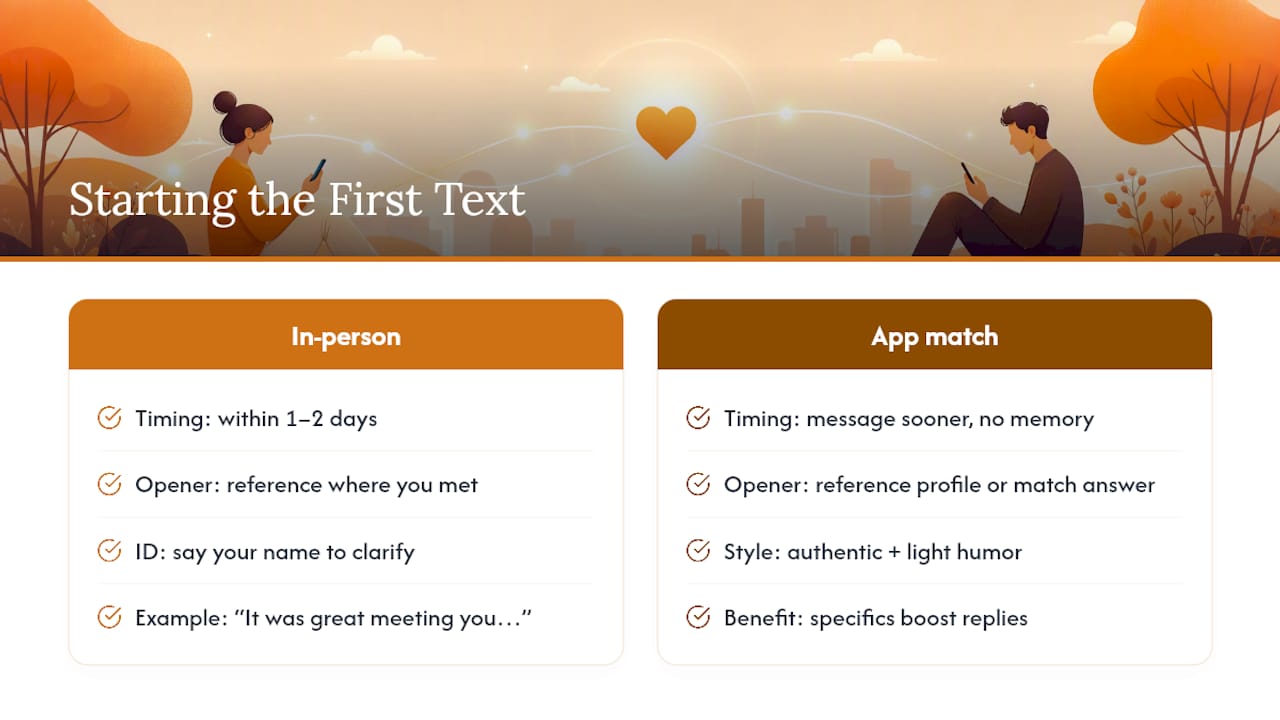
The opener matters less than people think, but it still has a job to do: reference something specific and make it easy to respond to. “Hey” gets ignored for a reason, it gives the other person nothing to work with. Pull something from their profile, a shared match answer, or the conversation you had when you exchanged numbers, and turn it into a light question or observation.
If you just got a number in person, texting within a day or two while the memory of meeting you is still fresh works better than waiting a week. Something like “It was great meeting you at [place], this is [your name]” removes any confusion about who’s texting and why.
If you matched on an app, the opener carries more weight since there’s no shared memory yet. StacyKnows’ guide to online dating conversations makes the case for authenticity and a little humor over generic compliments, since specific, slightly playful openers tend to get better response rates than “you’re cute.” A well-built profile also helps here. DoubleMyMatches’ advice on profile optimization points out that small, concrete details in a profile give matches more to reference, which makes that first message easier to write on both ends.
Either way, keep the first few exchanges light. Save the getting-to-know-you deep dive for the actual date.
Managing Expectations During the Texting Phase
Texting before you’ve met in person, or in the early days after a first date, tends to create a distorted sense of closeness. Long message threads can feel like intimacy, but they’re often just familiarity with someone’s typing style. It helps to remember that a great texter and a great match aren’t always the same person.
Keep your expectations tied to actions, not just words. Does the texting lead to actual plans? Does the person follow through on what they say? Someone who texts beautifully but consistently cancels or stalls on scheduling is telling you something more accurate than their message content ever will.
It also helps to pace your own emotional investment to match the actual stage you’re in. A few good text exchanges don’t make someone your partner, and it’s fair to keep talking to other people or keeping your calendar open until there’s a mutual, stated interest in being exclusive. Texting is a preview, not a commitment.
Handling Misunderstandings and Conflict Over Text
Text strips out tone, timing, and facial expression, which makes it a terrible tool for resolving anything emotionally loaded. A joke can read as an insult. A short reply can read as anger when it was really just someone driving. Before assuming the worst, consider that you might be missing context, not that the other person is suddenly a different person.
If a misunderstanding happens over text, resist the urge to fix it with more text. A long explanatory message rarely lands the way it’s intended, and it can spiral into a back-and-forth that leaves both people more frustrated. Instead, try: “I think that came across wrong, can we hop on a call?” This signals you want to resolve things, not escalate them, and it moves the conversation to a medium where tone actually comes through.
If the issue is small, a quick clarifying text is fine: “Wait, did you mean X or Y? Just want to make sure I’m reading that right.” But anything involving hurt feelings, mixed signals about interest, or a real disagreement deserves a voice, not a thumb.
Balancing Texting With Social Media and In-Person Time
Texting, social media, and face-to-face time all serve different purposes, and confusing them is where a lot of modern dating goes sideways. Liking someone’s Instagram stories constantly while barely texting sends a mixed signal. So does have an incredible text rapport that never translates into an actual date.
Treat texting as the scaffolding, useful for coordination and light banter, but not the whole structure. Social media can be a fun, low-stakes way to show you’re paying attention (commenting on a story, reacting to a post), but it shouldn’t replace direct conversation. If someone only engages with you through likes and views and never actually texts to make plans, that’s a pattern worth noticing.
In-person time is where you actually learn whether the chemistry from your texts holds up. Some of the funniest, most charming texters are flat in person, and some people who text sparingly turn out to be wonderful company. Prioritize getting to a real date reasonably quickly rather than building an entire relationship inside a chat thread.
Privacy and Safety When Texting Someone New
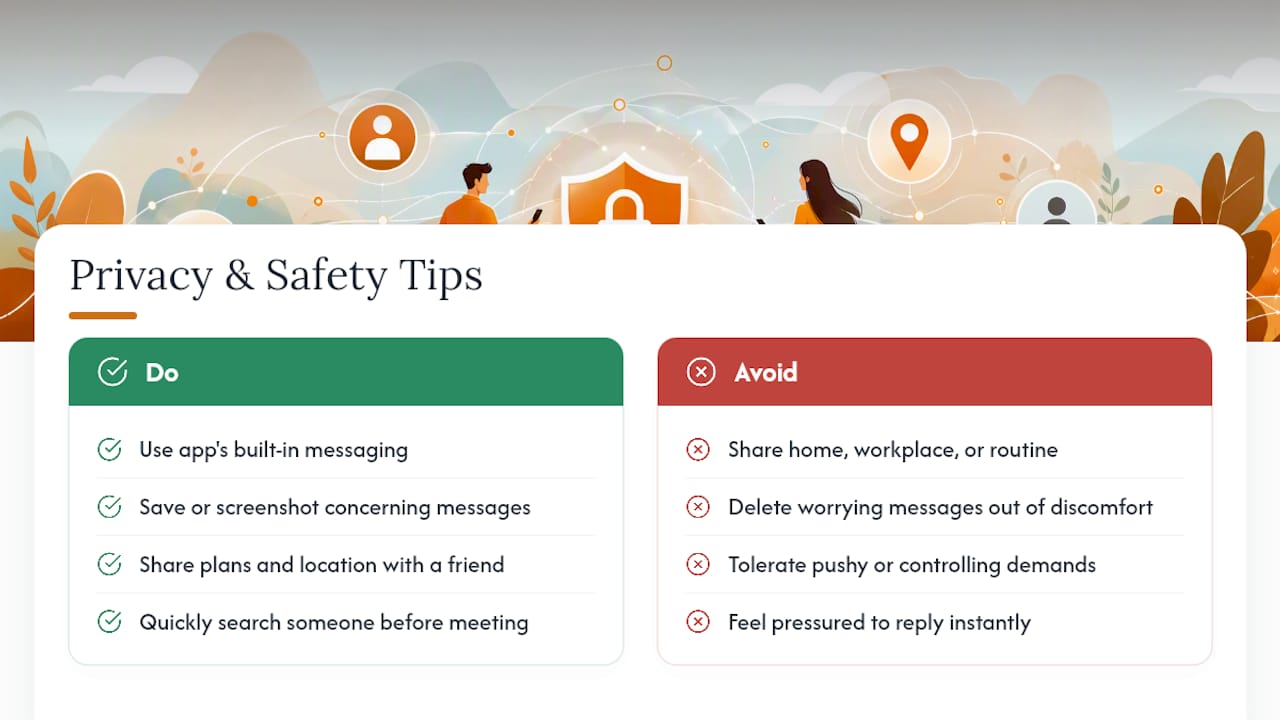
A few practical habits protect you without making the early texting phase feel paranoid. Keep your number private a bit longer by using an app’s built-in messaging feature until you feel comfortable, most major dating platforms offer this. Avoid sharing your home address, workplace, or daily routine details in early texts, even casually, since that information adds up faster than people realize.
Screenshot or save concerning messages rather than deleting them out of discomfort. If something feels off, whether it’s pushy behavior, inconsistent stories, or aggressive language, you’ll want a record. Trust your gut if someone gets upset that you’re not replying instantly or demands to know why you took a few hours to respond. That impatience over text is often a preview of controlling behavior in person.
It’s also fine to do a quick search on someone before meeting, or to share your plans and location with a friend for a first date. None of this is overkill, it’s just sensible groundwork for meeting a stranger, which is technically what a first date is, no matter how good the texting has been.
Publisher Perspective: A One-Week Texting Experiment Worth Trying
Stacy has watched enough friends spiral over a slow reply to know the fix is usually simpler than it feels. This week, try one habit: after any date or good conversation, send one warm, specific check-in and one concrete plan suggestion, nothing more. Notice whether the other person matches that energy back. That single data point tells you more than three days of second-guessing a text thread ever will.
— Stacy Geisinger
Turning Good Texts Into Actual Dates
Great texting is only useful if it leads somewhere fun. Once you’ve landed on a plan, the next challenge is picking a place that actually works, not another generic dinner-and-a-movie default. That’s where having a shortlist of go-to ideas pays off.

Stacyknows keeps a running collection of low-effort, high-payoff date night ideas built for exactly this moment, when the texting has done its job and it’s time to make an actual reservation. Instead of spending another 20 minutes texting back and forth about “where should we go,” check the Stacyknows date night guide for something specific to suggest. Pair that with a coordination resource like Mate’s Table’s guide to planning date nights if scheduling around a busy calendar is part of your challenge. Pick a spot, name a day, and send the text. That’s the whole move.
Sources
- In-depth: How often should you text someone you’re dating? — Wisp (2026)
- How technology is changing dating — PsychAlive
FAQ
What is the 3-6-9 rule in dating?
The 3-6-9 rule suggests waiting three days for a first date, six weeks before something more serious, and nine months before deeper commitment steps. It’s a loose framework some daters reference, but reciprocity and how well things are actually going matter far more than hitting specific day counts.
What is the 3-3-3 rule of dating?
Definitions of the 3-3-3 rule vary depending on the source, and there’s no single agreed-upon version. Rather than chasing a numbered rule, focus on whether texting is leading to real plans and matched effort.
What is the 3 text rule?
The 3 text rule generally refers to the outdated idea that you shouldn’t send more than three unanswered texts in a row before hearing back. Most current dating advice, including Business Insider’s reporting, treats this as far less rigid than it used to be, with one purposeful follow-up being perfectly normal.
What are some red flags when texting before a first date?
Watch for inconsistent effort, canceling plans without rescheduling, vague or evasive answers about basic details, and pressure to move too fast or share personal information early. A pattern of low effort matters more than any single slow reply.
How soon should I text after a first date if I liked them?
Texting within 24 hours is the standard recommendation, ideally with something specific like naming a day for the next date rather than a vague “we should hang out again.”
Recommended
- The New Language of Love: Ghostlighting, Banksying & the Dating Terms Taking Over Social Media
- Ignite Your Online Dating Conversations: The Power of Authenticity (and a Dash of Humor)
- Why Modern Dating Feels Broken (And What Actually Works Now)
