

EV lifecycle emissions are the total greenhouse gases released across an electric vehicle’s entire lifespan, from mining raw materials to recycling the battery at the end of its life. This is the standard industry measure known as a lifecycle assessment, or LCA, and it covers far more than what comes out of a tailpipe. Organizations like the International Council on Clean Transportation (ICCT) and the U.S. Environmental Protection Agency (EPA) use LCA frameworks to give a complete picture of a vehicle’s environmental impact. If you care about sustainability, understanding this number matters more than any single metric you’ll find on a window sticker.
What phases are included in EV lifecycle emissions?
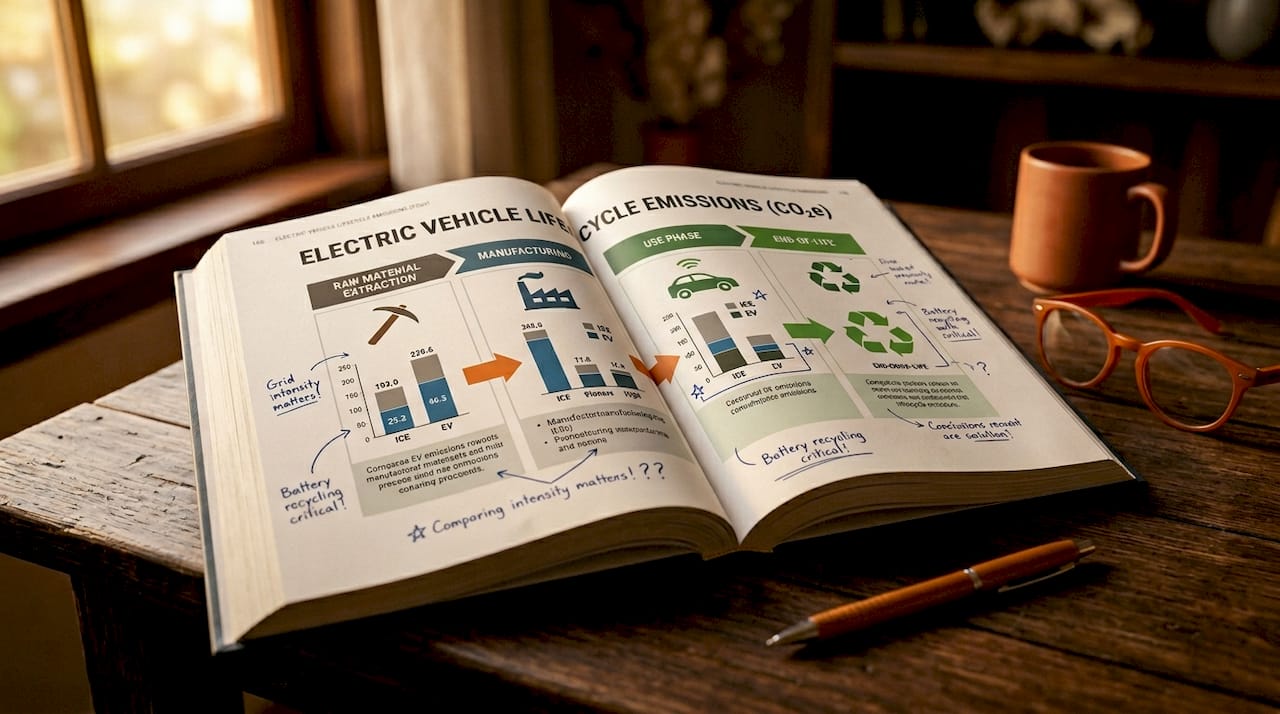
EV lifecycle emissions include all greenhouse gas impacts across four distinct phases: raw material sourcing, manufacturing, use, and end-of-life. Each phase contributes differently, and none can be ignored if you want the full story.
Here is what each phase actually involves:
- Raw material extraction. Mining lithium, cobalt, and nickel for battery cells generates significant emissions. The location of the mine, the energy source powering it, and the ore grade all affect how carbon-intensive this step is.
- Vehicle and battery manufacturing. Assembling the vehicle and producing the battery pack requires large amounts of industrial energy. Battery production alone accounts for around 60% of total production-phase emissions in a battery electric vehicle (BEV).
- Use phase. This is where EVs earn back their carbon investment. The use phase breaks into two parts: well-to-tank (the emissions from generating and delivering electricity to your charger) and tank-to-wheel (the emissions from actually driving). Two EVs driven the same miles can have very different lifecycle emissions depending on where they charge and how clean that region’s electricity grid is.
- End-of-life. Recycling battery materials like lithium, cobalt, and nickel reduces the need for fresh mining in future vehicles. However, polymer-rich components are harder to recover, so recycling benefits are real but not unlimited.
The two most common system boundaries you will see in LCA studies are “cradle-to-grave,” which covers everything from raw material extraction through final disposal, and “well-to-wheel,” which focuses on the energy chain from fuel or electricity production through vehicle operation. Cradle-to-grave is the broader and more complete measure.
Pro Tip: When you read an EV emissions study, check whether it uses cradle-to-grave boundaries. Studies that stop at the tailpipe or exclude battery manufacturing will report much lower emissions and give you an incomplete picture.
How do EV emissions compare to gasoline and hybrid vehicles?
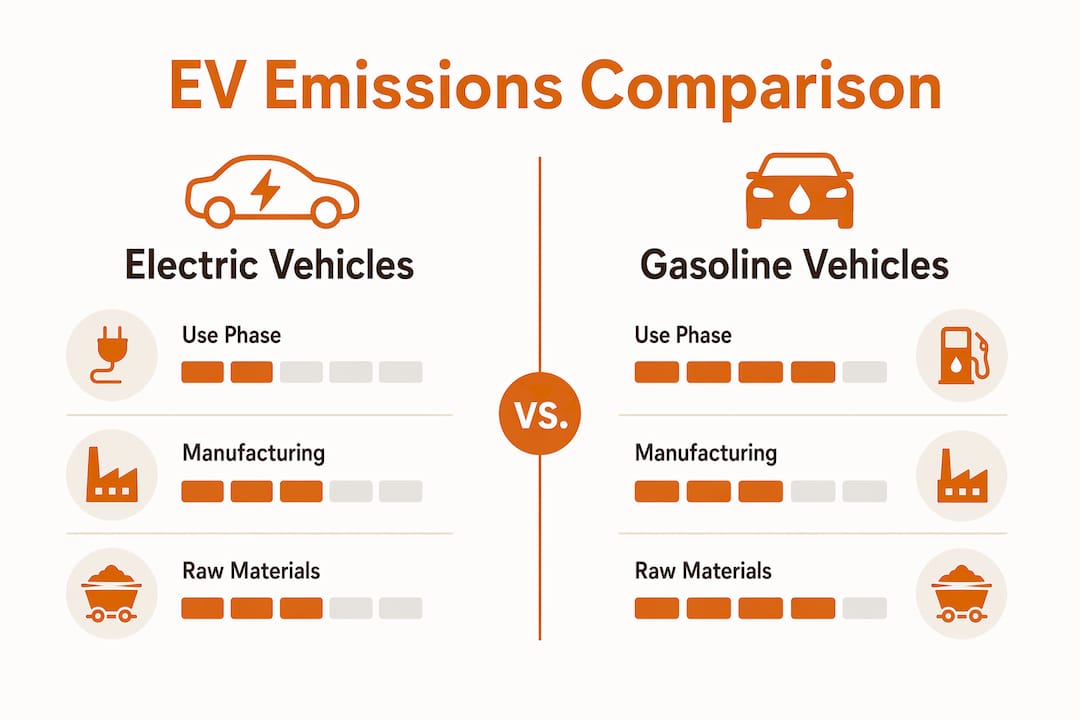
The comparison is clearer than many people expect, and the numbers favor EVs decisively.
| Vehicle type | Average lifecycle emissions (g CO2e/km) |
|---|---|
| Battery electric vehicle (BEV) in Europe | 63 |
| Plug-in hybrid electric vehicle (PHEV) | ~105 |
| Conventional hybrid (HEV) | ~130 |
| Gasoline internal combustion engine (ICEV) | 235 |
According to ICCT’s 2025 analysis, BEVs emit roughly 73% less lifecycle greenhouse gas than gasoline cars in Europe when battery manufacturing is fully included. That is not a marginal improvement. It is a structural shift in how much carbon a personal vehicle puts into the atmosphere over its lifetime.
The one area where gasoline cars genuinely win upfront is manufacturing. BEV production emissions are about 40% higher than those of a comparable gasoline vehicle, almost entirely because of battery production. This creates what researchers call a “carbon debt.” The good news is that EVs repay that debt quickly. In Europe, the break-even point arrives at around 17,000 km of driving, after which every kilometer driven in an EV is cleaner than the gasoline alternative.
Hybrids and plug-in hybrids do reduce emissions compared to conventional gasoline cars, but the gap between a hybrid and a full BEV is substantial. If your goal is minimizing total lifecycle carbon, a full battery electric vehicle on a reasonably clean grid is the stronger choice. The difference between EVs and hybrids in real-world emissions is larger than most buyers realize when they are standing in a showroom.
What key factors influence electric vehicle lifecycle emissions?
Not all EVs carry the same carbon footprint, even if they are the same model. Several variables shift the number significantly.
- Electricity grid carbon intensity. This is the single largest driver of variability in EV lifecycle emissions. Charging a BEV in Norway, where the grid runs on nearly 100% hydropower, produces far fewer emissions than charging the same car in a coal-heavy grid. Grid decarbonization alone reduces EV lifecycle emissions by roughly 30%, which is a bigger lever than any improvement in battery chemistry.
- Battery manufacturing location and energy source. A battery built in a factory powered by renewable energy carries a much lighter carbon footprint than one built with coal-fired electricity. As battery manufacturing and electricity use are deeply interlinked, decarbonizing the grid benefits both the car you drive and the car being built.
- Battery recycling rates. Metal recycling reduces upstream emissions by 15 to 20%, but the benefit depends on how much material is actually recovered. Lithium and cobalt recovery rates are improving, but they are not yet at the level needed to fully offset production impacts.
- Vehicle size and weight. Larger EVs require bigger battery packs, which increases manufacturing emissions and raises energy consumption during the use phase. A compact BEV will almost always have a lower lifecycle footprint than a large electric SUV.
- Future grid trends. An EV bought today will be driven for 10 to 15 years. As electricity grids get cleaner over that period, the car’s effective lifecycle emissions drop automatically without any change to the vehicle itself.
Pro Tip: Check your local utility’s energy mix before assuming your EV is as clean as it could be. In states like West Virginia or Wyoming, where coal still dominates, the use-phase emissions advantage shrinks. In states like Washington or California, it is enormous. The EPA’s emissions calculator lets you estimate your specific footprint by zip code.
How is EV lifecycle carbon footprint calculated, and why do estimates vary?
Lifecycle assessment is a standardized methodology governed by the ISO 14040 series of international standards. The core idea is to account for every input and output of greenhouse gas across a defined system boundary. In practice, though, the results can vary widely between studies, and understanding why helps you read the numbers critically.
The main sources of variation include:
- System boundary choices. A study using cradle-to-grave boundaries will report higher total emissions than one using only well-to-wheel, because it includes raw material extraction and end-of-life disposal. Clear disclosure of system boundaries is the first thing to look for when comparing two studies.
- Recycling credit assumptions. Some studies allocate a credit for the emissions avoided by recycling battery materials at end-of-life. Others do not. This single assumption can shift reported lifecycle emissions by 15% or more.
- Electricity modeling. Studies differ on whether they use the current grid mix, a projected future grid, or a regional average. Since the electricity carbon intensity during charging significantly impacts total lifecycle emissions, this choice has an outsized effect on the final number.
- Vehicle lifetime assumptions. A study assuming 150,000 km of total driving will report lower per-kilometer emissions than one assuming 100,000 km, because the fixed manufacturing burden is spread over more use.
The practical takeaway is that no single lifecycle emissions number is universally correct. What matters is consistency in methodology when you are comparing vehicles. The ICCT and EPA both publish transparent LCA frameworks that make their assumptions explicit, which is why their figures are widely cited and trusted.
Pro Tip: When two studies report different lifecycle emissions for the same EV model, look at the electricity source assumed and whether recycling credits are included before deciding which number to trust.
Key takeaways
EV lifecycle emissions are substantially lower than gasoline vehicle emissions across the full cradle-to-grave lifecycle, and the gap widens as electricity grids get cleaner.
| Point | Details |
|---|---|
| Full lifecycle scope | EV emissions cover raw materials, manufacturing, use phase, and end-of-life recycling, not just driving. |
| 73% lower than gasoline | ICCT data shows BEVs emit 63 g CO2e/km vs. 235 g CO2e/km for gasoline cars in Europe. |
| Carbon debt repaid at 17,000 km | Higher manufacturing emissions are offset after roughly 17,000 km of driving in Europe. |
| Grid mix is the biggest variable | Cleaner electricity reduces EV lifecycle emissions by up to 30%, more than any other single factor. |
| Study assumptions matter | Always check system boundaries and recycling credit assumptions before comparing lifecycle emissions figures. |
Why the full picture changes how I think about EVs
Here is something I have come to believe after spending a lot of time with this research: the tailpipe-versus-no-tailpipe framing is the wrong lens entirely. It makes EVs look like a simple win and gasoline cars look like a simple loss, and neither is fully accurate.
The more honest framing is that EVs carry a heavier carbon burden upfront and a much lighter one over time. That shift happens faster than most people expect, and it accelerates as grids get cleaner. An EV bought today in a state moving toward renewable energy is not just clean now. It gets cleaner every year without the owner doing anything at all. That is a genuinely unusual property for a consumer product to have.
What I find underappreciated is the manufacturing side. The push for responsible battery supply chains, from where lithium is mined to how cobalt is sourced, is not just an ethical issue. It is a direct emissions issue. A battery built with dirty energy in a poorly regulated supply chain carries a heavier carbon debt that takes longer to repay. Panasonic’s work on next-generation Tesla battery prototypes is one example of how manufacturing innovation and supply chain choices intersect with lifecycle outcomes.
My honest read is this: if you are sustainability-minded and considering an electric car in 2026, the lifecycle emissions case is strong and getting stronger. The caveats are real but they are shrinking. The direction of travel is clear.
— Stacy
Explore more sustainable living insights on Stacyknows
Stacyknows covers the topics that matter to people who want to live thoughtfully, from understanding the environmental impact of EVs to making smarter everyday choices.

If this article sparked your curiosity, Stacyknows has more to offer. The 5 sustainability tips guide is a practical starting point for reducing your personal carbon footprint beyond the driveway. And if you are drawn to eco-conscious lifestyle products, the Stacyknows Beauty Secret Finds collection includes curated picks with sustainability in mind. The EPA’s Greenhouse Gas Emissions Calculator is also worth bookmarking for anyone who wants to run the numbers on their own charging habits.
FAQ
What is the definition of EV lifecycle emissions?
EV lifecycle emissions are the total greenhouse gases released across all phases of an electric vehicle’s life, including raw material extraction, manufacturing, use, and end-of-life recycling. The standard industry term for this measurement is a lifecycle assessment, or LCA.
Are EVs really cleaner than gasoline cars when you include manufacturing?
Yes. Despite manufacturing emissions being about 40% higher for BEVs due to battery production, EVs emit roughly 73% less lifecycle greenhouse gas than gasoline cars over their full lifespan in Europe.
How does the electricity grid affect EV emissions?
The carbon intensity of your local electricity grid directly determines how clean your EV’s use phase is. Grid decarbonization reduces EV lifecycle emissions by roughly 30%, making it the single most powerful lever for improving EV sustainability.
What does cradle-to-grave mean in EV emissions studies?
Cradle-to-grave is a lifecycle system boundary that covers every emission from raw material extraction through final vehicle disposal. It is the most complete measure and the one used by organizations like the ICCT and EPA for vehicle comparisons.
Does battery recycling significantly reduce EV lifecycle emissions?
Battery recycling reduces upstream emissions by 15 to 20% by recovering metals like lithium and cobalt for reuse. It is a meaningful reduction, but it does not fully offset the emissions from initial battery manufacturing.
Recommended
- 5 Sustainability Tips for Your Everyday Life
- Is It Worth Getting an Electric Car in 2026? Pros, Cons & Costs Explained – Stacyknows
- How Hybrid and Electric Cars Are Changing the Driving Experience – Stacyknows
- Types of EV Charging Levels: What Every Driver Should Know – Stacyknows
