
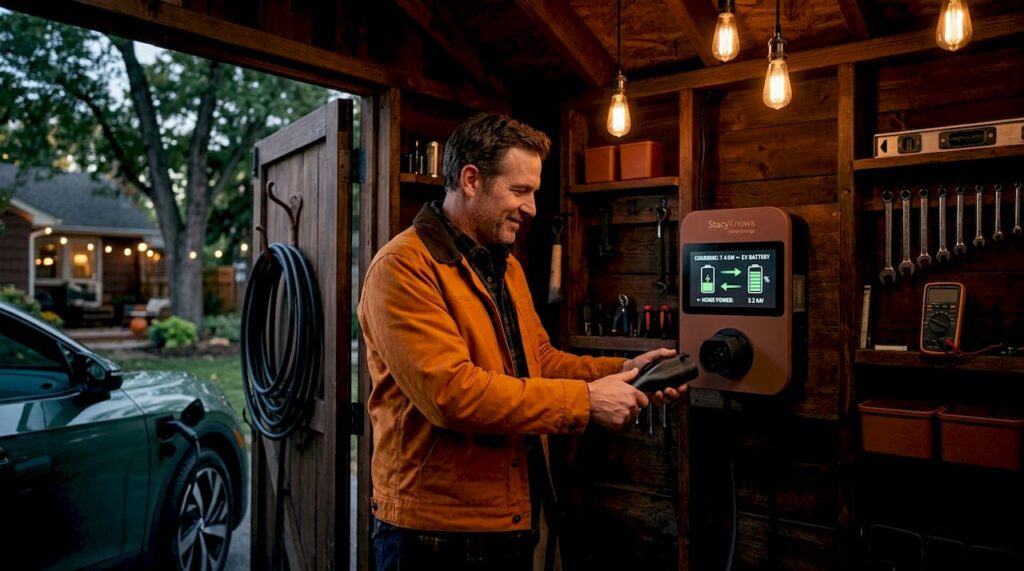
Bidirectional charging is defined as a technology that allows energy to flow both into and out of an electric vehicle’s battery, turning your EV into a mobile power source. Most people think of charging as a one-way street. You plug in, the car fills up, and that’s it. But bidirectional electric vehicle charging breaks that model entirely. Your car can power your home during an outage, feed electricity back to the grid during peak demand, or run a job site tool from the trunk. This article walks you through how it works, what you can do with it, and what stands between you and using it today.
How does bidirectional charging work in electric vehicles?
Bidirectional charging allows energy to flow both into and out of EV batteries, enabling vehicle-to-home (V2H) and vehicle-to-grid (V2G) applications. The key to understanding this is in the hardware. A standard EV charger only converts AC power from the grid into DC power that the battery stores. A bidirectional EV supply equipment (EVSE) unit does the reverse too. It converts DC from the battery back into AC that your home or the grid can use.
The EV itself also needs to support this capability. Not every electric vehicle on the road today is compatible. The Nissan Leaf, Ford F-150 Lightning, and Hyundai Ioniq 5 are among the models that currently support bidirectional output. The charger and the car must speak the same communication protocol, typically CHAdeMO or the emerging ISO 15118 standard, for the system to work safely.
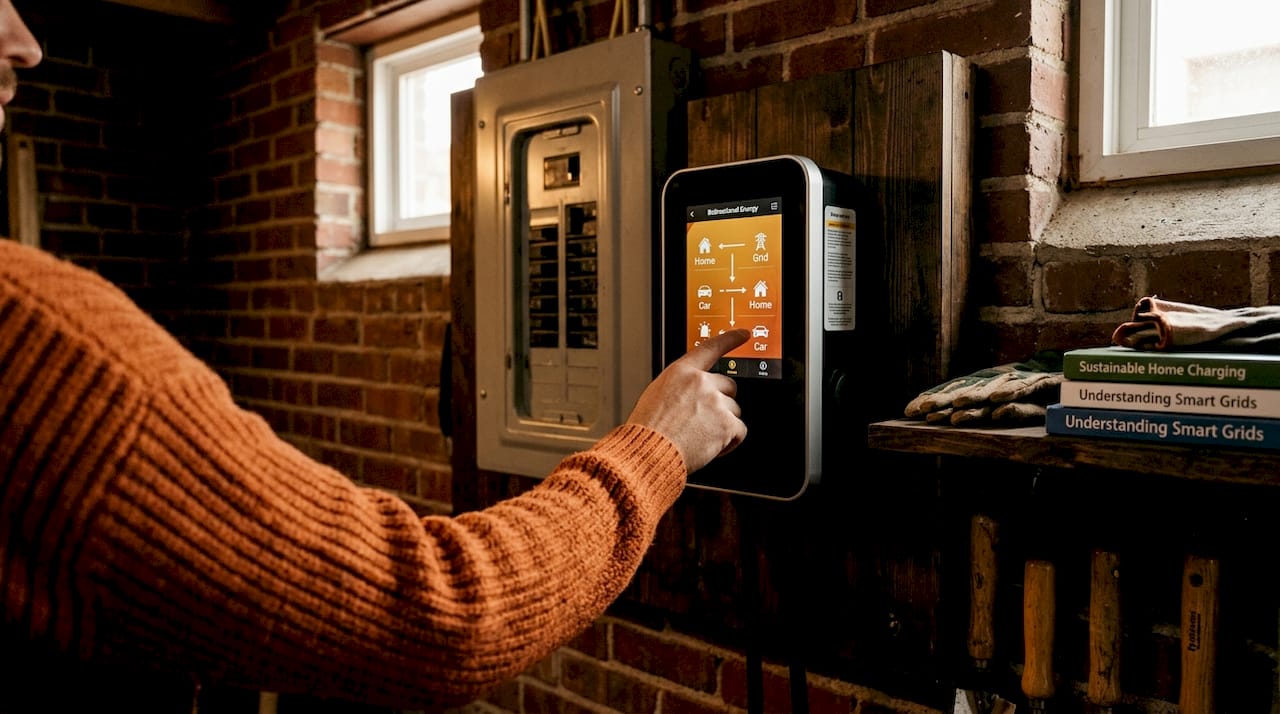
Your home’s electrical setup matters just as much. Safe home isolation requires a microgrid interconnection device (MID), which switches your home to backup mode and prevents electricity from flowing back into the utility lines during an outage. This protects utility workers from unexpected live wires. A dark start battery (DSB) is also often required to initialize the system when grid power is absent.
Pro Tip: Before investing in a bidirectional charger, check your EV’s owner manual for V2H or V2G compatibility. Not all models with large batteries support two-way energy flow.
Here is a quick comparison of what separates unidirectional from bidirectional charging:
| Feature | Unidirectional charging | Bidirectional charging |
|---|---|---|
| Energy flow direction | Grid to vehicle only | Grid to vehicle and vehicle to grid/home |
| Hardware complexity | Standard EVSE | Specialized bidirectional EVSE + MID |
| EV compatibility | All EVs | Select models only |
| Use cases | Charging only | Backup power, grid services, device power |
| Typical upfront cost | $500 to $2,000 | Often above $10,000 |
What are the main types and use cases of bidirectional charging?
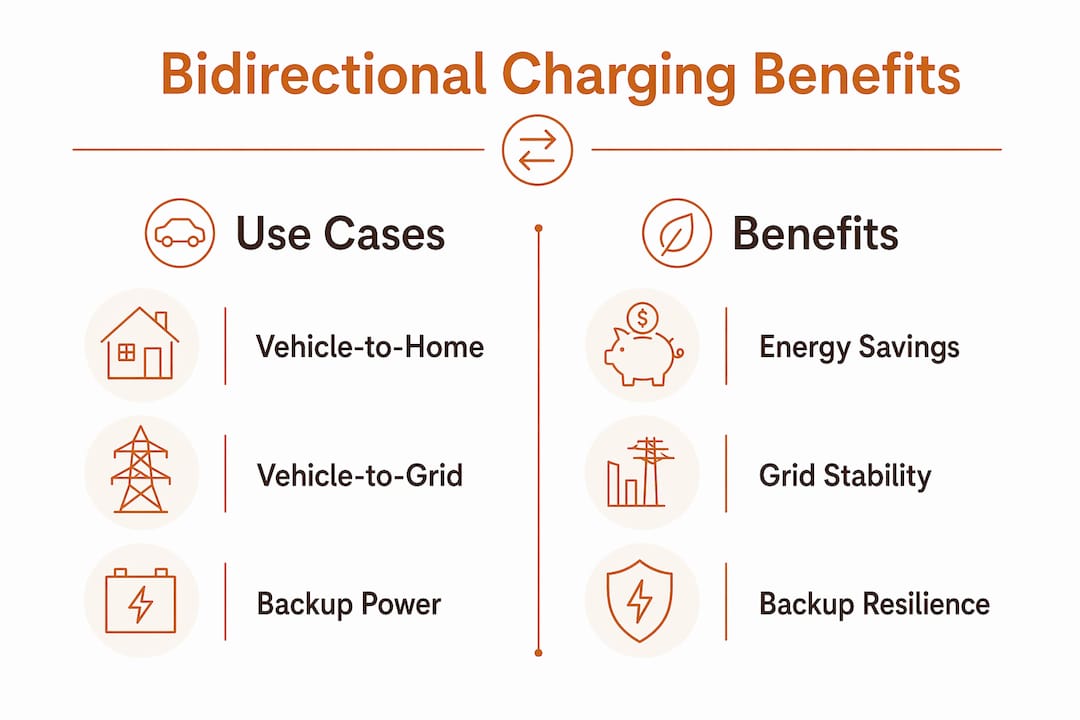
The industry groups bidirectional charging applications into three main categories, each with a distinct purpose and technical profile.
- Vehicle-to-Home (V2H): Your EV powers designated circuits in your house during a grid outage or during peak rate hours. This is the most practical entry point for most homeowners. The Ford F-150 Lightning, for example, can supply up to 9.6 kW of continuous power, enough to run a refrigerator, lights, and a window AC unit simultaneously.
- Vehicle-to-Grid (V2G): Your EV discharges electricity back to the utility grid during periods of high demand. The utility compensates you, or offsets your bill, for the energy you contribute. Understanding vehicle-to-grid technology means recognizing that your car becomes a distributed energy asset, not just a transportation tool.
- Vehicle-to-Load (V2L): Your EV powers external devices directly through an outlet built into the car or charger. The Hyundai Ioniq 5 and Kia EV6 both offer V2L capability, letting you run power tools, camping equipment, or emergency appliances without any home installation.
Real-world deployments are already proving the concept. PG&E ran a V2G pilot that demonstrated the technology works at scale. The 72% participation rate in that program, with dispatch durations of one to four hours, showed that EV owners will engage with grid services when the setup is simple and the incentives are clear.
Non-export V2H is also gaining traction as a simpler starting point. Non-export V2H sidesteps interconnection and compensation barriers by powering the home without sending electricity back to the grid, simplifying regulatory compliance considerably. If you want backup power without the paperwork, this is the path of least resistance right now.
What are the benefits and potential savings of bidirectional charging?
The financial case for bidirectional charging is getting harder to ignore. The California Energy Commission (CEC) projects that widespread adoption could deliver up to 5 GW in peak grid load reductions in California alone by 2030, assuming 4.5 million EVs on the road. That is enough capacity to replace several large natural gas peaker plants.
For individual EV owners, the numbers are equally compelling:
- Bill savings: The CEC projects average summer savings between $262 and $321 per EV, achieved through peak shaving and backup power without requiring any driver behavior change beyond plugging in.
- Grid value: The PG&E pilot found V2G capacity costs $165 per kW-year, compared to $195 per kW-year for utility-scale batteries and $280 per kW-year for peaker plants. EVs are cheaper grid assets than purpose-built infrastructure.
- Resilience: A fully charged F-150 Lightning with the extended range battery can power an average American home for three to four days during an outage.
- Environmental impact: Bidirectional charging allows excess solar energy stored in your EV to flow back to the grid at night, reducing reliance on fossil fuel generation during evening demand peaks.
The CEC’s modeling also shows that bidirectional charging offers roughly three times the grid flexibility value compared to unidirectional charging. That multiplier matters for utilities planning infrastructure investments and for policymakers deciding where to direct incentives.
What challenges does bidirectional charging still face?
The technology works. The barriers are mostly economic, regulatory, and logistical. Here is where things get complicated:
- Interoperability gaps. Most bidirectional charging solutions today are vertically integrated, meaning the charger, the car, and the software all need to come from compatible ecosystems. A Nissan Leaf with a CHAdeMO port cannot use a Ford-specific bidirectional charger.
- High upfront costs. Installation regularly exceeds $10,000 when you factor in the bidirectional EVSE, the MID, electrical panel upgrades, and labor. That price point puts the technology out of reach for many households today.
- Utility interconnection rules. Sending power back to the grid requires approval from your utility, compliance with IEEE 1547 interconnection standards, and in many states, a separate meter. The process can take months.
- Compensation gaps. Most utilities do not yet have formal programs to pay EV owners for V2G services. Without a financial return, the grid-export use case loses much of its appeal.
- Battery wear concerns. Repeated deep discharge cycles can accelerate battery degradation. Manufacturers like Nissan and Ford have begun offering warranties that account for V2H use, but this remains an open question for many models.
Pro Tip: If you are exploring home installation, check out EV charger installation considerations before committing to a bidirectional setup. Understanding panel capacity and permit requirements early saves significant time and money.
The good news is that standards bodies and regulators are moving. ISO 15118-20, which enables plug-and-charge bidirectional communication, is being adopted by more manufacturers. California, Texas, and several European markets are piloting compensation frameworks for V2G participants. The infrastructure is catching up, just not as fast as the technology itself.
How does bidirectional charging pair with solar energy systems?
Combining solar panels with a bidirectional EV creates a genuinely self-sustaining home energy loop. During the day, your solar array charges the car. At night, or during a grid outage, the car powers the house. The grid becomes a backup rather than a dependency.
The efficiency of this setup depends heavily on control strategy. Research published in Scientific Reports found that bidirectional EV charging systems integrated with solar PV and controlled by artificial neural network (ANN) controllers achieve greater than 90% efficiency and stable operation under varying conditions. Traditional controllers struggle with the rapid fluctuations in solar output. ANN controllers use battery current feedback to regulate power flow dynamically, which outperforms fixed-rule approaches significantly.
| System configuration | Efficiency | Stability under variable solar | Control method |
|---|---|---|---|
| Solar PV + standard charger | ~85% | Moderate | Fixed rule-based |
| Solar PV + bidirectional EVSE + ANN | >90% | High | Adaptive neural network |
The practical takeaway is that pairing bidirectional charging with solar is not just about plugging things together. The control technologies managing power flow between the panels, the battery, and the home determine whether the system runs smoothly or wastes energy through instability. If you are building a solar-plus-EV setup, ask your installer specifically about smart energy management systems that support bidirectional coordination.
Key takeaways
Bidirectional charging transforms electric vehicles from passive energy consumers into active grid assets, delivering measurable savings, resilience, and environmental benefits when properly integrated.
| Point | Details |
|---|---|
| Core definition | Bidirectional charging allows energy to flow both into and out of an EV battery. |
| Key use cases | V2H, V2G, and V2L each serve distinct needs from home backup to grid services. |
| Financial upside | CEC projects $262 to $321 in average summer savings per EV with no behavior change required. |
| Main barrier | Upfront costs above $10,000 and fragmented interoperability slow widespread adoption. |
| Solar synergy | ANN-controlled systems achieve over 90% efficiency when pairing solar PV with bidirectional EVs. |
Why bidirectional charging is closer than most people think
I have followed EV technology for years, and bidirectional charging is the development that genuinely shifts the conversation. Most EV coverage focuses on range anxiety and charging speed. Those are real concerns. But they miss the bigger picture. An EV sitting in your garage for 22 hours a day is an underutilized energy asset. Bidirectional charging is what finally puts that asset to work.
What I find most telling is the PG&E pilot data. A 72% participation rate is not a niche result. That is mainstream behavior. Real-world V2G value depends on participation rates and dispatch scheduling, not just battery size. The technology does not need perfect conditions. It needs willing participants and a clear incentive structure.
The piece most people overlook is the non-export V2H path. You do not need utility approval, a new meter, or a complex interconnection agreement to power your home from your car during an outage. You need a compatible EV, a bidirectional charger, and a microgrid interconnection device. That is a solvable installation problem, not a regulatory maze. If you are already thinking about backup power options, a bidirectional EV setup deserves a serious spot on your comparison list.
The cost barrier is real but shrinking. As ISO 15118-20 adoption spreads and more automakers build bidirectional capability into base models, the hardware premium will fall. My honest read is that by 2028, bidirectional charging will be a standard talking point in any EV purchase conversation, the same way range and charging speed are today.
— Stacy
Explore more with Stacyknows

Stacyknows covers the full picture of modern living, from the technology reshaping how we power our homes to the lifestyle choices that make everyday life a little better. If this deep look at bidirectional EV charging sparked your curiosity, there is plenty more to explore. Whether you are weighing electric car ownership in 2026 or looking for inspiration across sustainable living, wellness, and smart home choices, Stacyknows has you covered. Check out our beauty secret finds for the same thoughtful, research-backed approach applied to your personal care routine. Living well and living smart go hand in hand.
FAQ
What is bidirectional charging in simple terms?
Bidirectional charging is a technology that lets an electric vehicle both receive and send electricity. Instead of only charging the battery, the system can push power back to your home, the grid, or external devices.
Which EVs support bidirectional charging today?
The Nissan Leaf (CHAdeMO), Ford F-150 Lightning, and Hyundai Ioniq 5 are among the most widely available models with bidirectional capability. Compatibility depends on both the vehicle’s onboard hardware and the charger’s communication protocol.
How much can I save with V2H or V2G charging?
The California Energy Commission projects average summer savings of $262 to $321 per EV through peak shaving and backup power, with no required change in driving behavior beyond plugging in regularly.
Does bidirectional charging damage the EV battery?
Repeated deep discharge cycles can accelerate wear, but manufacturers like Ford and Nissan have begun offering warranties that account for V2H use. Keeping discharge levels moderate and using smart charge management reduces the risk significantly.
What is the difference between V2H and V2G?
V2H (vehicle-to-home) powers your house directly from the EV battery, typically during outages or peak rate hours. V2G (vehicle-to-grid) sends electricity back to the utility grid, where you may receive compensation or bill credits for the energy contributed.
Recommended
- Types of EV Charging Levels: What Every Driver Should Know – Stacyknows
- How to Install a Home EV Charger in 2026 – Stacyknows
