
Defining Custom Bespoke Fashion: Beyond the Label
In an era where personal expression defines style, the quest for garments that truly reflect our individuality has never been more prominent. We often find ourselves settling for off-the-rack options that merely “fit,” rather than truly flatter. But what if your wardrobe could be an extension of your unique identity, tailored precisely to your form and preferences?
This is the promise of custom bespoke fashion. The term “bespoke” itself originated in the 16th-century practice in which a customer “bespoke” (spoke for) a specific piece of cloth to be made into a garment. This tradition found its iconic home on London’s Savile Row, becoming synonymous with unparalleled craftsmanship. In April 2026, as the fashion landscape continues to prioritize personalization and unique narratives, bespoke tailoring is experiencing a renaissance.
The desire for items that truly reflect who we are is growing. This pursuit of individuality extends beyond clothing. It shapes everything we choose, from a perfectly tailored suit to bespoke fashion and men’s rings that tell a personal story.
In this extensive guide, we will delve into the art of bespoke craftsmanship. We will explore its precise definition and distinguish it from made-to-measure and ready-to-wear options. We will also uncover the intricate process of commissioning a bespoke garment, the benefits of such an investment, and how this age-old art is evolving with modern demands. Join us as we celebrate the artistry behind creations designed exclusively for you.
The world of custom clothing can often seem like a labyrinth of terms, but understanding the distinctions between ready-to-wear, made-to-measure, and bespoke is fundamental to appreciating the true value of personalized fashion.
At the pinnacle sits bespoke tailoring. Derived from the historical practice of “speaking for” a specific fabric, bespoke signifies a garment crafted entirely from scratch for a single individual. This means that a unique paper pattern is meticulously drafted based on an extensive array of measurements—often 20 to 30 points—and, crucially, an assessment of the client’s unique anatomical nuances, posture, and muscle tone. Unlike other options, bespoke accounts for the way you naturally stand, walk, and move, ensuring a fit that is not just comfortable but also perfectly balanced and flattering. The garment is handcrafted, embodying an exclusivity truly unparalleled.
Made-to-measure (MTM) garments offer a step up from off-the-rack by adapting a pre-existing standard pattern to a client’s basic measurements. While it allows for some customization in fabric choice and styling details, the core pattern remains a fixed starting point. The alterations are primarily focused on length and circumference, rather than fundamentally reshaping the garment to the wearer’s unique physique. The process involves fewer fittings and generally less handwork than bespoke.
Finally, ready-to-wear (RTW), or off-the-rack clothing, refers to garments produced in standard sizes and sold directly to consumers. These items are designed to fit a generalized body type and often require further alterations by a local tailor to achieve an acceptable fit. While convenient and accessible, RTW rarely offers the comfort, drape, or personal expression found in custom options.
The essence of bespoke lies in this complete individualization—from the initial design concept to the final stitch. It’s a collaborative journey with a tailor, resulting in a garment that is truly a second skin. This artisan skill is what elevates a simple piece of clothing into a work of art, designed to highlight your best features and provide unparalleled comfort and confidence. For those seeking the ultimate in personalized attire, particularly for significant pieces like custom bespoke suits, understanding this distinction is key.
Here’s a quick comparison:
Feature Ready-to-Wear (RTW) Made-to-Measure (MTM) Bespoke Tailoring Pattern Standardized sizes Modified standard pattern Unique pattern drafted from scratch Measurements Basic size selection Basic measurements taken Extensive (20-30+) measurements, posture analysis Fit Generalized, often needs alterations Improved fit, limited customization Perfect, personalized fit accounting for nuances Construction Machine-made, mass-produced Mix of machine and some handwork Predominantly hand-constructed, high handwork Customization Minimal, styling fixed Fabric, limited styling options Full design control, fabric, details, construction Fittings None (alterations separate) 1-2 fittings 2-3+ fittings, often with a muslin prototype Timeline Immediate purchase 4-8 weeks 2-6 months Price Lowest Mid-range Highest. 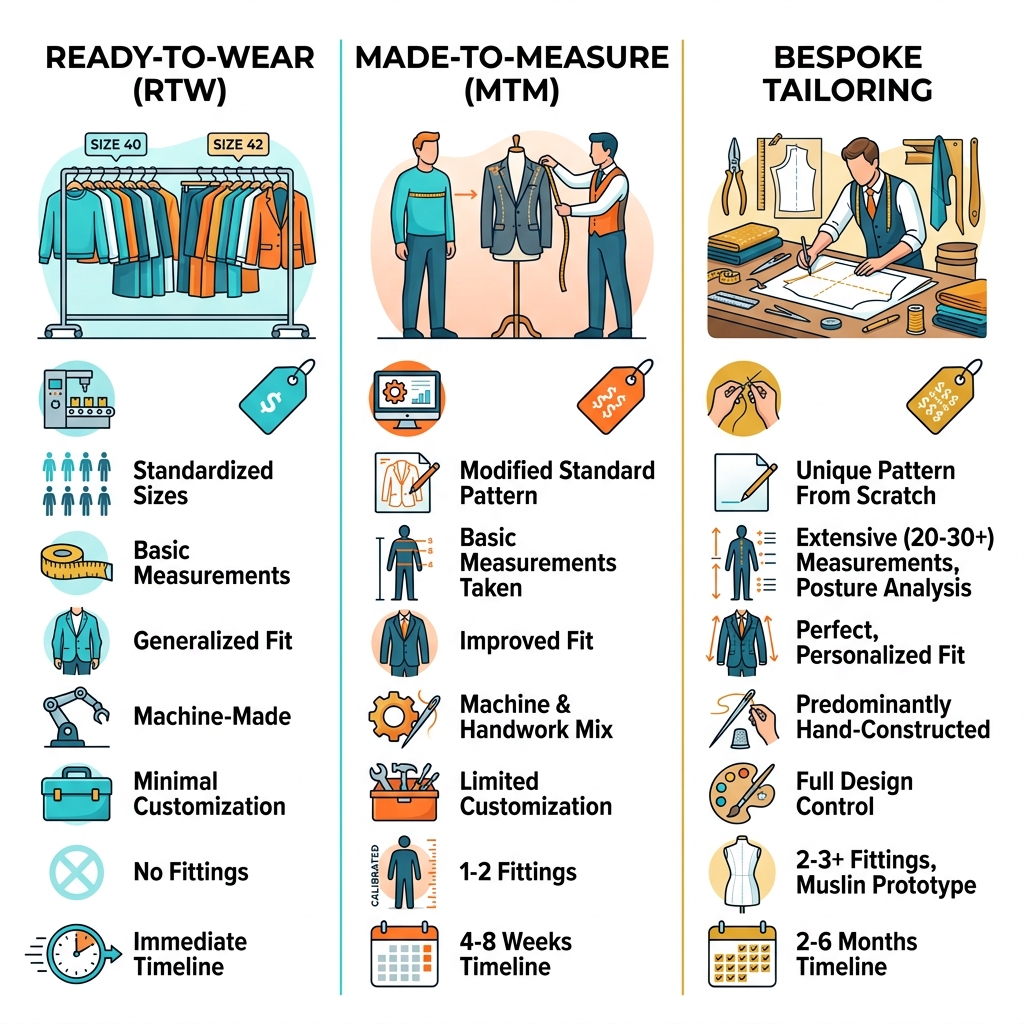
The Evolution of Custom Bespoke Fashion on Savile Row
Savile Row in London stands as the undisputed “Golden Mile” of tailoring, a name synonymous with the highest standards of bespoke craftsmanship. Its history stretches back to the 16th century, where the concept of “bespeaking” a cloth evolved into a formalized system of creating garments tailored precisely to the individual. This tradition was cemented by master tailors who established their ateliers on the Row, honing techniques passed down through generations via rigorous apprenticeships.
For centuries, Savile Row was the exclusive domain of men’s tailoring, dressing royalty, politicians, and cultural icons. The process involved meticulous hand-executed couture, where every stitch and seam was a testament to the tailor’s skill. While deeply rooted in tradition, Savile Row has not remained static. In April 2026, we see a fascinating blend of heritage and modernity. Tailors on the Row continue to uphold their historic standards, creating unique garments that can take approximately fifty person-hours to complete. However, they are also adapting to global influences and evolving client demands, offering a more contemporary approach while preserving the essence of their craft. This includes expanding services to a broader clientele and incorporating subtle innovations without compromising the bespoke ethos.
The term “bespoke” has itself come under scrutiny over the years. In 2008, the UK’s Advertising Standards Authority (ASA) ruled that the term could be used for garments with machine-made elements, sparking debate among traditionalists. However, the core principle of a unique pattern drafted from scratch for each client, combined with multiple fittings and extensive handwork, remains the hallmark of true bespoke tailoring, particularly on Savile Row.
Technical Superiority in Custom Bespoke Fashion
The technical superiority of bespoke tailoring is what truly sets it apart. It’s not just about a garment that fits; it’s about a garment engineered for optimal comfort, drape, and longevity. This is achieved through an unparalleled level of detail and hand craftsmanship.
Consider the intricate construction of a bespoke suit. A single lapel, for instance, can involve over 1,000 hand stitches. This extensive hand-stitching allows the fabric to roll and drape naturally, creating a soft, three-dimensional effect that machine stitching cannot replicate. The internal structure of a bespoke jacket typically features full-canvas construction, in which layers of horsehair canvas, wool, and linen are hand-stitched together. This canvas molds to the wearer’s body over time, providing a natural, breathable foundation that ensures the jacket maintains its shape and elegance for decades. In contrast, fused construction (common in RTW and some MTM) uses glue to bond interlinings, which can stiffen the fabric and bubble over time.
The precision begins with an exhaustive measurement process. Tailors often take up to 28 unique measurements, but equally important is their keen observation of the client’s posture, shoulder slope, and natural stance. This holistic approach allows the cutter to draft a pattern that not only accommodates the body’s dimensions but also corrects for any perceived imbalances, creating an optical illusion of perfect symmetry and proportion. This level of personalized patternmaking is crucial for achieving a perfect fit, especially for unique body types.
The labor involved is substantial. For example, some Savile Row houses dedicate up to 80 hours of handwork by skilled cutters and tailors to each bespoke garment. This investment of time and expertise results in a garment that is not only aesthetically superior but also remarkably durable, designed to last for 20 years or more with proper care. This longevity underscores the investment value of bespoke fashion, making it a sustainable choice in the long run.
The Anatomy of the Bespoke Commissioning Process
Commissioning a bespoke garment is a deeply personal and collaborative journey, a true experience in co-creation. It begins with an initial consultation and typically unfolds over several months, culminating in a garment that is uniquely yours.
The process kicks off with an initial consultation, which is far more than just a measurement session. This is where you meet your tailor or stylist, discuss your lifestyle, preferences, and the specific purpose of the garment. Do you need a suit for daily business, a special occasion, or something more casual? The tailor serves as a guide, offering expert advice on style, cut, and fabric choices that suit your physique and needs.
Next comes the exciting part: fabric selection. Bespoke tailors offer an unparalleled selection of luxurious cloths from the world’s most renowned mills. You might choose from the exquisite wools and cashmeres of Loro Piana, the sophisticated blends of Zegna, the classic British textiles of Holland & Sherry, or the innovative designs from Scabal. The choice isn’t just aesthetic; it involves considering seasonality, weight, texture, and durability. A winter suit might call for a heavier flannel, while a summer jacket would benefit from a lightweight linen or fresco wool. The tailor will guide you through swatches, explaining how each fabric will drape and wear.
Once the design and fabric are chosen, the tailor takes an extensive series of measurements. This is a meticulous process that captures not just standard dimensions but also subtle nuances such as shoulder slope, arm length, neck height, and even the natural curve of your spine. These measurements are then translated into a unique paper pattern, drafted entirely from scratch for you. This pattern is the blueprint for your garment, ensuring every curve and angle is accounted for.
For a truly bespoke experience, particularly with complex garments like suits, a muslin prototype (or “toile”) is often created. This mock-up garment, typically made from an inexpensive fabric, allows the tailor to assess the fit and drape on your body before cutting into the chosen luxury fabric. This crucial step ensures that any major adjustments can be made without risking the final material. It’s during this phase that the garment truly begins to take shape around your form, perfecting the lines and proportions. This meticulous process ensures that the finished garment, whether it’s a suit, a dress, or even a unique accessory like a piece of bespoke fashion and men’s rings, is perfectly aligned with your vision and body.
The Essential Role of Multiple Fittings
The cornerstone of bespoke tailoring, and what truly distinguishes it, is the series of fittings. These are not mere alterations but critical stages where the garment is sculpted to your body, ensuring an impeccable fit that off-the-rack or even made-to-measure options cannot achieve. Typically, a bespoke garment involves two to three fittings, though more may be necessary for new clients or particularly complex designs.
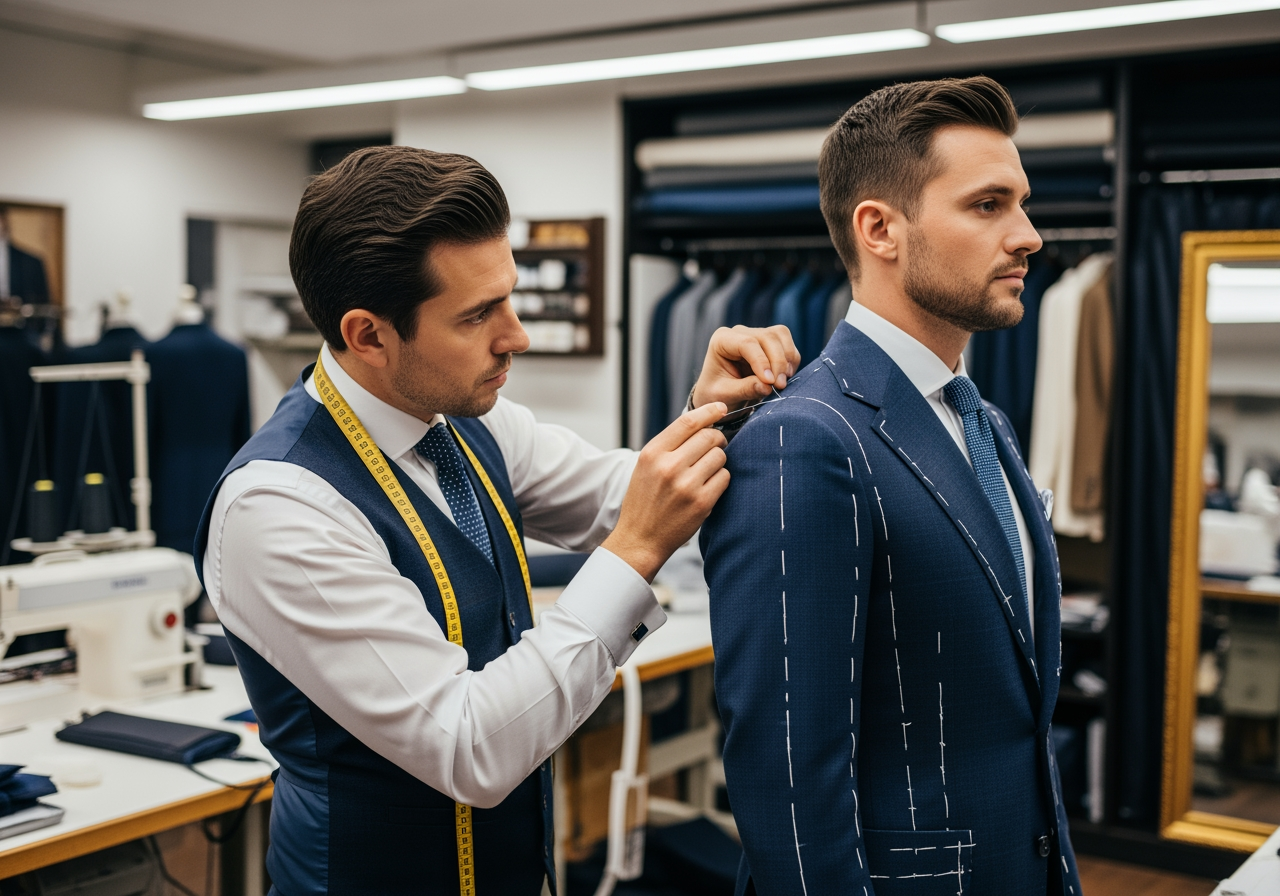
The baste fitting is usually the first time you see the garment taking shape. At this stage, the garment’s pieces are loosely basted (temporarily stitched) together, allowing the tailor to make significant adjustments. You’ll try on the garment, and the tailor will observe its drape, balance, and how it interacts with your body’s unique posture and movement. White thread markings are often used to indicate changes. After this fitting, the garment is “stripped down,” meaning the temporary stitches are removed, the pieces are re-marked according to the adjustments, and then re-sewn. This iterative process is vital for perfecting the silhouette.
A forward fitting (sometimes combined with the baste or final fitting) allows for further refinement once more of the garment’s internal structure and details are in place. Here, the focus is on finer adjustments to the shoulder slope, sleeve pitch, collar set, and the garment’s overall balance. The tailor ensures that the fabric flows smoothly without pulling or creasing, accommodating nuances like a high or low shoulder, or balancing for excess girth.
The final adjustments and collection fitting is the last step before you take your new garment home. At this stage, the garment is nearly complete, and only minor tweaks are typically needed, such as sleeve length, trouser break, or button placement. The tailor ensures every detail is perfect, from the lining to the buttonholes, making sure the garment hangs flawlessly and feels supremely comfortable. This meticulous, hands-on approach across multiple fittings is why bespoke garments achieve such exceptional fit and comfort.
Modern Technology in Traditional Tailoring
While bespoke tailoring is steeped in tradition and hand craftsmanship, the industry is not immune to technological advancements. In fact, many modern ateliers are finding innovative ways to integrate technology to enhance precision, efficiency, and the overall client experience, without compromising the artisanal core of bespoke.
Digital patterning software, for instance, allows tailors to store and manipulate client patterns with incredible accuracy. While the initial pattern is still drafted from scratch, digital tools can help scale, make minor adjustments, and ensure consistency across repeat orders. Some forward-thinking tailors are even experimenting with 3D body scanning, which can capture thousands of precise data points about a client’s physique in minutes. This supplementary information can aid the cutter in drafting the initial paper pattern, providing unprecedented detail on unique body contours and posture.
Lean manufacturing principles are also being applied in some bespoke workshops to streamline processes and reduce waste, aligning with the growing emphasis on sustainability. Virtual consultations have become more common, allowing clients from around the globe to begin their bespoke journey with a tailor, discussing designs and fabrics before in-person measurements and fittings.
However, it’s crucial to understand that these technologies serve as aids, not replacements, for the human element. The discerning eye of a master tailor, their understanding of fabric, drape, and the human form, along with the skill of their hands, remains irreplaceable. Modern bespoke is increasingly a hybrid practice, leveraging precision tools and proprietary measurement systems to augment, rather than diminish, the traditional art of tailoring.
Sustainability and the Investment Value of Handcrafted Apparel
In an era dominated by fast fashion’s relentless cycle of consumption and waste, bespoke fashion stands as a powerful antidote, embodying principles of sustainability and longevity. Investing in handcrafted apparel is not just a luxury; it’s a conscious choice that offers significant environmental and economic benefits.
Fast fashion relies on mass production, cheap materials, and planned obsolescence, leading to enormous textile waste and significant environmental impact. Bespoke, by contrast, operates on a zero-waste production model. Each garment is made to order, eliminating overproduction and the need to discard unsold inventory. Precise cutting of fabric according to an individual pattern minimizes material waste, and any remnants can often be repurposed.
Furthermore, bespoke tailors prioritize ethical sourcing of high-quality materials. They work with reputable mills known for their sustainable practices and commitment to animal welfare and fair labor. These superior fabrics—natural fibers like wool, cashmere, and silk—are chosen not only for their luxurious feel and aesthetic appeal but also for their inherent durability.
A well-made bespoke garment is designed to last. With proper care, a bespoke suit can easily have a 20-year lifespan, becoming an heirloom piece rather than a disposable item. This dramatically reduces its environmental footprint compared to multiple cheaper garments that wear out quickly. This longevity translates into a lower cost-per-wear over time, making the initial investment surprisingly economical in the long run. While bespoke suits from renowned Savile Row tailors might start at £7,000 (as of April 2026), and high-end US bespoke shops can range widely, the value derived from decades of wear, a perfect fit, and timeless style often outweighs the upfront cost. It’s an investment in quality, craftsmanship, and a more sustainable wardrobe.
Expanding the Horizon: Bespoke for Women and Accessories
Historically, bespoke tailoring was predominantly associated with men’s formal wear. However, in April 2026, the landscape has significantly broadened, with bespoke options becoming increasingly accessible and popular for women, and extending to a wider range of accessories.
Bespoke for women
Beyond traditional clothing, the bespoke philosophy is expanding into other areas of personal style. This includes hand-made shoes, where every aspect from the last (the foot mold) to the leather and detailing is customized. Similarly, leather goods such as bags, wallets, and belts can be commissioned bespoke, reflecting individual needs and aesthetic preferences.
The integration of artisanal jewelry further exemplifies the bespoke approach to personal adornment. Just as a tailor crafts a suit for a body, a jeweler can design and create a piece of jewelry that perfectly complements an individual’s style, occasion, or even a specific bespoke outfit. This holistic approach to wardrobe curation ensures that every element of one’s personal presentation is thoughtfully designed and perfectly executed.
Frequently Asked Questions about Custom Bespoke Fashion
We understand that venturing into bespoke fashion can bring many questions. Here, we address some of the most common inquiries to help you navigate this exciting journey.
How long does the bespoke process typically take?
The creation of a truly bespoke garment is a meticulous, time-intensive process that cannot be rushed. Generally, you should expect the entire process, from initial consultation to final collection, to take between 2 and 3 months. However, this can vary significantly depending on the tailor, the garment’s complexity, and the number of fittings required. Some high-end ateliers, such as Berluti, indicate a timeline of 4 to 6 months, reflecting the extensive handwork and ritualistic fittings involved. Factors influencing the timeline include:
- Tailor’s schedule: Reputable tailors often have waiting lists.
- Fabric availability: Special orders or rare fabrics can increase lead time.
- Number of fittings: New clients typically require more fittings than returning ones.
- Complexity of the garment: A simple shirt will take less time than a three-piece suit or an intricate evening gown.
- Handwork involved: As an example, some garments require up to 80 hours of handwork.
While some services offer “rush options” for made-to-measure, true bespoke prioritizes craftsmanship over speed. In April 2026, the industry standard remains that quality bespoke takes time.
What should I expect during my first consultation?
Your first bespoke consultation is a crucial step in laying the foundation for your unique garment. You can expect a personalized and unhurried experience that typically involves:
- Discussion of needs and style: The tailor will engage in a conversation about your lifestyle, preferred aesthetic, the garment’s purpose, and any specific requirements you may have. Bring inspiration photos if you have them!
- Fabric selection: You’ll be guided through a vast array of fabric swatches from top mills, discussing their characteristics, suitability for your climate and usage, and how they drape.
- Design details: This is where you personalize the garment’s features—lapel style, button configuration, pocket types, lining choices, and even monogramming.
- Measurement session: The tailor will take an extensive series of measurements (often 20-30 points) while observing your posture, stance, and subtle body movements.
- Deposit: Once the design and fabric are finalized, a deposit (typically 50%) is usually required to commence work.
It’s an opportunity to ask questions, voice concerns, and build a rapport with your tailor, ensuring a collaborative and satisfying experience.
Can bespoke tailoring accommodate unique body types?
Absolutely. One of the most significant advantages of bespoke tailoring is its unparalleled ability to accommodate and flatter unique body types, postures, and preferences. Unlike ready-to-wear, which struggles with anything outside a generalized norm, bespoke is designed precisely for individuality.
Tailors are adept at addressing a wide range of anatomical challenges, such as:
- Asymmetrical shoulders: Whether high/low or sloped differently, bespoke patterns can balance these variations.
- Unique posture: Accounting for a forward head, rounded back, or swayback to ensure the garment hangs perfectly without pulling.
- Proportion balancing: Creating visual harmony for individuals with longer torsos, shorter legs, or vice versa.
- Excess girth: Expertly cut and shaped to provide comfort and a flattering silhouette without bulk.
- Specific preferences: Whether you prefer a looser fit for comfort or a very close, sculpted look, the bespoke process caters to your exact desires.
By drafting a pattern from scratch and making precise adjustments during multiple fittings, bespoke tailoring ensures a perfect fit that enhances your natural physique, boosts confidence, and provides unmatched comfort.
Conclusion
In a world increasingly driven by mass production, custom bespoke fashion stands as a testament to enduring artistry and the profound value of individuality. It is a realm where garments are not merely manufactured but meticulously crafted, where the human touch and an unwavering commitment to perfection define every stitch.
We’ve explored how bespoke differs fundamentally from its ready-to-wear and made-to-measure counterparts, emphasizing the unique pattern, extensive measurements, and multiple fittings that sculpt a garment precisely to your form. We’ve journeyed through the hallowed traditions of Savile Row, acknowledging its evolution while celebrating its unwavering dedication to hand craftsmanship. The technical superiority, from 1,000 hand stitches in a lapel to full canvas construction, underscores the longevity and unparalleled drape of bespoke attire.
Beyond the aesthetic, bespoke fashion champions sustainability, offering a powerful alternative to the disposable culture of fast fashion. It’s an investment in quality, ethical production, and a garment designed to last for decades, becoming a cherished part of your personal legacy. And as we’ve seen, the bespoke horizon is ever-expanding, embracing women’s unique forms and extending to a broader array of accessories, ensuring that every element of your personal style can be as unique as you are.
Commissioning a bespoke garment is more than a transaction; it’s an experience, a collaboration, and a celebration of self. It’s about owning a piece of clothing that tells your story, fits your body flawlessly, and reflects your distinct personality. In April 2026, as the pursuit of authentic self-expression continues to define our choices, bespoke craftsmanship remains the pinnacle of style, offering not just a garment but a masterpiece designed exclusively for you.
