

The Problem with Needles
We all want skin that looks its best. Smooth, firm, and radiant skin is a common goal. Many of us have heard about microneedling. It’s a popular way to boost collagen and improve skin texture.
However, traditional DIY microneedling involves actual needles. This can be intimidating. It often brings concerns about pain, infection, and long recovery times. We understand these worries.
What if there was a different way? A method that offers similar benefits without the typical risks of metal needles? This article will explore a approach. It’s called Spongilla microneedling. This natural method uses microscopic spicules from freshwater sponges. It’s a key part of modern solutions like PureRiot Spongilla DIY microneedling.
We’ll dive into the science behind this needle-free technique. We will show you how it works to renew your skin. Prepare to find a safer, smarter way to achieve your skincare goals at home.
Traditional microneedling, often performed with dermarollers or pens, involves puncturing the skin with tiny metal needles. The idea is to create controlled micro-injuries, which then trigger the body’s natural healing response, leading to increased collagen and elastin production. This process is known as collagen induction therapy. While effective in a professional setting, the DIY version comes with significant drawbacks.

One of the primary concerns for many contemplating at-home microneedling is pain. Depending on the needle length and individual pain tolerance, traditional microneedling can range from mildly uncomfortable to quite painful, often requiring numbing creams, especially for longer needles. Beyond the immediate discomfort, there’s the very real risk of infection. Our homes are not sterile environments, and introducing thousands of tiny punctures into the skin without proper aseptic technique can lead to bacterial infections, inflammation, and other complications. In fact, microneedling creates tiny open wounds that are highly susceptible to infection and irritation.
Downtime is another factor. Even with superficial at-home treatments, skin can be red, sensitive, and swollen for hours or even days. This can disrupt daily routines and social plans. Professional microneedling sessions often involve longer needles (up to 1.5 mm or more), which penetrate deeper into the skin to address concerns like deep acne scars or wrinkles. These treatments typically result in more significant downtime and are performed under strict clinical conditions. For instance, research indicates that significant improvements in acne scarring or wrinkles can be achieved after two to three sessions using 1.5 mm needles, but these are almost exclusively performed in an office setting due to the depth of penetration and associated risks.
Finally, there’s the cost. While at-home dermarollers are relatively inexpensive (often around $20), professional microneedling sessions can range from $200 to $700 per session, making the DIY route seem appealing on the surface. However, this cost saving often comes at the expense of safety and efficacy.
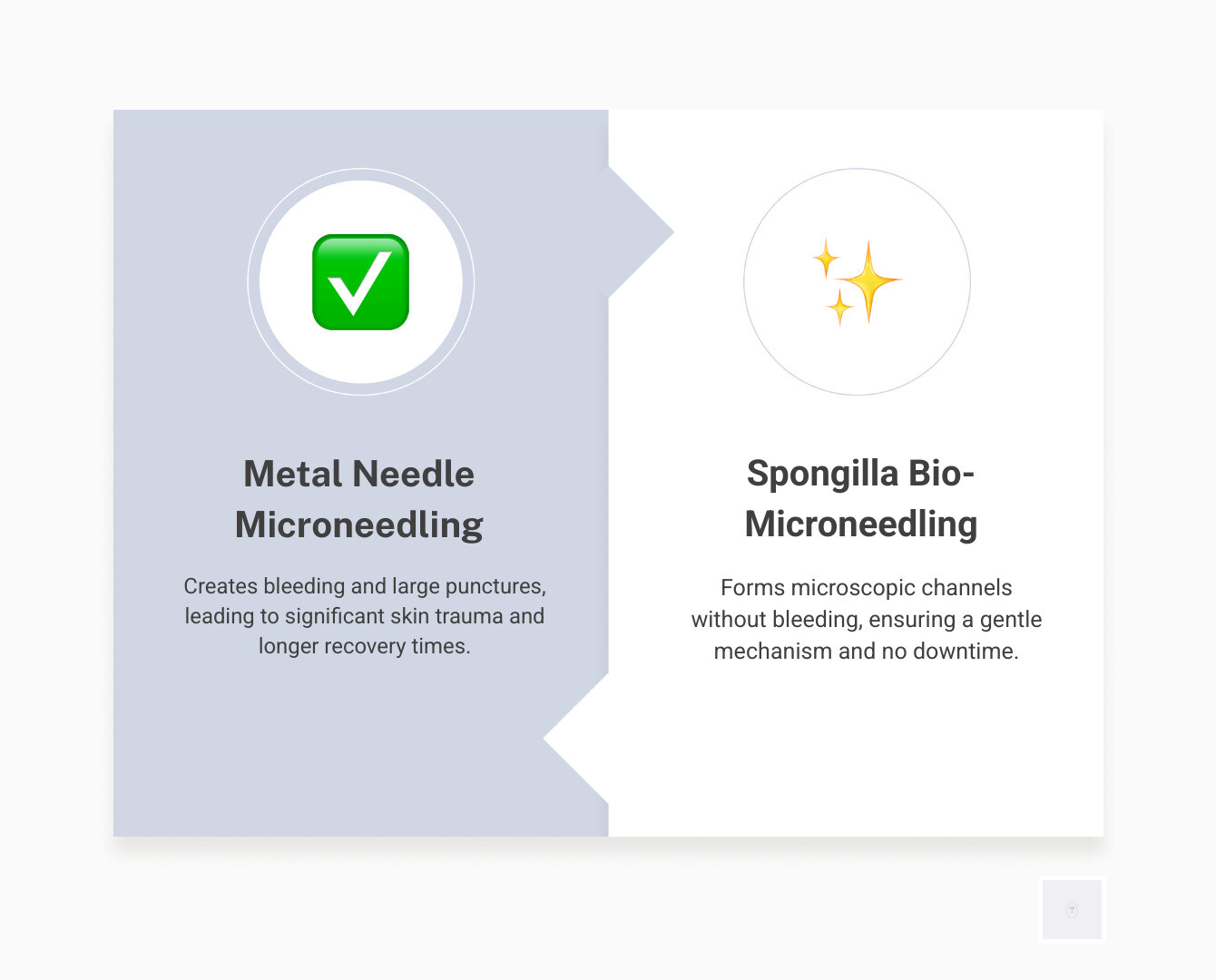
Comparing the trauma of metal needles (bleeding, large punctures, long recovery) to the gentle mechanism of Spongilla spicules (microscopic channels, no bleeding, no downtime).
Flaws of Traditional At-Home Microneedling
The allure of at-home microneedling with dermarollers is strong, promising professional results from the comfort of your bathroom. However, the reality often falls short, and the risks can outweigh the perceived benefits. While home treatments can improve exfoliation and product absorption, they rarely go deep enough to give dramatic results for more affected skin. Patients who are consistent with home treatments over a four to six-month period might see improvements, but these are typically subtle compared to in-office procedures.
The Food and Drug Administration (FDA) has not approved any microneedling instruments for sale over the counter, highlighting the regulatory body’s caution regarding these devices for home use. This lack of approval underscores the potential for misuse and harm.
The Risk of Self-Inflicted Damage
One of the most significant dangers of traditional at-home microneedling lies in the potential for self-inflicted damage. Dermarollers, especially cheaper models, can have needles that bend or dull quickly. A bent needle can cause micro-tears or drag across the skin rather than creating clean punctures, leading to scarring, hyperpigmentation, or even infection.
Uneven pressure during rolling is another common issue. Without professional training, it’s difficult to apply consistent pressure, which can result in some areas being over-treated and others under-treated. This can manifest as “tram track” scars, where lines of injury are visible on the skin. The general lack of sanitation in a home environment compared to a professional’s office significantly increases safety risks, such as infection. Improper sterilization of the device before and after use can introduce bacteria into the micro-wounds, leading to breakouts, inflammation, or more severe infections. Cross-contamination is also a concern if the device is not carefully cleaned or if it’s shared.
Furthermore, traditional microneedling should never be performed on active acne. Doing so can spread bacteria across the face, worsening breakouts and potentially leading to more severe scarring. This also applies to other skin conditions like rosacea, eczema, or cold sores, where the procedure can exacerbate inflammation and trigger flare-ups. The physical trauma can also compromise the skin barrier, making it more vulnerable to environmental aggressors and irritation.
Why Short Needles Fall Short
At-home microneedling devices typically feature much shorter needles than those used in professional settings. While professional treatments might use needles up to 2.5 mm, at-home devices usually range from 0.25 mm to 1.0 mm, with many experts recommending staying below 0.3 mm for safety. While these shorter needles are less likely to cause significant injury, they also limit the depth of collagen stimulation.
Collagen induction therapy works by stimulating fibroblasts in the dermis to produce new collagen. To reach these deeper layers effectively, needles need to penetrate beyond the epidermis, particularly the stratum corneum (the outermost layer of the skin). At-home versions will just get your skin a little pink; they aren’t deep enough where you’ll see blood droplets, which indicates a superficial treatment. If you see any pinpricks of blood, your device is going too deeply, and you should be using a tool with shallower needles, or ideally, stop the treatment in that area.
While short needles can improve product absorption and provide superficial exfoliation, they primarily offer temporary plumping due to mild inflammation and increased hydration. They are not deep enough to treat deep scars or deep wrinkles effectively, though they may improve skin texture and make those concerns look “a little better.” True dermal remodeling and significant improvement in issues like acne scars or deep lines often require deeper penetration to stimulate a more robust wound healing response, something that at-home devices with short needles simply cannot achieve.
How Your Skin Actually Heals and Rebuilds
To truly appreciate the benefits of any microneedling approach, we must first understand how our skin responds to controlled injury. The core principle behind microneedling is Collagen Induction Therapy (CIT). When the skin experiences a controlled injury, it initiates a complex and highly efficient wound healing cascade. This natural process is our body’s way of repairing damaged tissue and replacing it with new, healthy cells.
The micro-channels created by microneedling devices signal the skin to enter a repair mode. This involves the release of various growth factors and cytokines, which in turn attract specialized cells called fibroblasts. Fibroblasts are the architects of our skin’s structure, responsible for producing collagen and elastin—the proteins that provide firmness, elasticity, and a youthful appearance. The stimulation of these cells leads to neocollagenesis (new collagen formation) and neoelastogenesis (new elastin formation), resulting in skin remodeling. This process thickens the skin, improves its texture, and can reduce the appearance of scars and wrinkles. Histological examination of skin treated with microneedling has shown a significant increase in collagen and elastin deposition, highlighting the skin’s remarkable ability to rebuild itself.

The Biology of Bounce
The visible benefits of microneedling, such as improved skin firmness, elasticity, and the reduction of fine lines, stem directly from this biological repair process. As new collagen and elastin are laid down, the skin becomes denser and more resilient, literally regaining its “bounce.” This cellular repair mechanism also contributes to a more even skin tone and texture, as damaged cells are replaced and the skin’s surface becomes smoother. Growth factors released during the healing process are crucial; they are proteins that promote the production of healthy cells and tissues, binding to skin cells and signaling them to regenerate. This comprehensive cellular renewal leads to a revitalized and refreshd complexion.
Results Happen During Recovery
Rebuilding collagen is a slow process. New collagen synthesis can take three to six months to become fully apparent. This means that while some immediate improvements in skin texture and radiance might be noticed, the most significant and lasting results from microneedling unfold over several months as the skin continues its regeneration cycle and cellular turnover. Patience and consistency are key to achieving long-term benefits. Documented research has shown that results after three sessions can remain permanent even six months after the last treatment was concluded, underscoring the enduring nature of collagen remodeling.
Nature’s Answer: The Spongilla Spicule
Given the concerns surrounding traditional metal-needle microneedling, particularly for at-home use, we sought a solution that could harness the skin’s natural healing power without the associated risks. Our answer lies in nature: the Spongilla spicule.
Spongilla is a genus of freshwater sponges, and within its structure are microscopic, needle-like formations called spicules. These spicules are composed primarily of silica and have been used for centuries in traditional medicine for their unique skin-renewing properties. We call this approach bio-microneedling or needle-free microneedling. It represents nature’s neat technology for skin rejuvenation.
A Smarter Way to Create Micro-Channels
Unlike metal needles that puncture the skin, Spongilla spicules work by gently embedding themselves into the epidermal layer. These natural, microscopic needles create thousands of tiny, invisible micro-channels without causing bleeding or requiring anesthetic. The sensation is often described as a mild tingling, which is a sign that the spicules are actively stimulating the skin. This continuous, gentle stimulation triggers the skin’s regenerative processes, similar to traditional microneedling but without the trauma.
The beauty of this approach is the complete absence of downtime. You won’t experience the redness, swelling, or recovery period associated with metal needles. The micro-channels created by Spongilla spicules also significantly improve product delivery. By bypassing the stratum corneum, they allow active ingredients in your skincare products to penetrate more deeply and effectively, maximizing their benefits. This innovative method provides a safer, more comfortable, and equally effective alternative for collagen induction.
A Safer Approach to At-Home Microneedling
The advantages of Spongilla bio-microneedling for at-home use are numerous, primarily centered around safety and ease of use. First and foremost, there are zero metal needles involved. This eliminates the risks of bent needles, micro-tears, and the need for stringent sterilization protocols associated with traditional dermarollers. There’s no risk of cross-contamination from a reusable metal device, as the Spongilla spicules are typically delivered in a single-use, sterile formulation.
This needle-free approach is also safe on active acne, a significant contraindication for metal microneedling. Since the spicules do not cause deep punctures or bleeding, they won’t spread bacteria or exacerbate inflammation. The application is uniform, ensuring consistent treatment across the skin without the uneven pressure issues of a dermaroller. By effectively bypassing the stratum corneum, Spongilla spicules create pathways for improved product absorption, leading to improved skin texture and overall radiance without the risks of traditional DIY methods.
Supporting Your Skin’s Renewal Process
Regardless of the microneedling method you choose, proper post-treatment care is crucial for optimal results and to support your skin’s natural renewal process. The recovery phase is when your skin is most vulnerable and actively rebuilding itself, so treating it gently and providing the right nutrients is paramount.
What to Do After Treatment
Immediately after a microneedling session, whether traditional or Spongilla-based, your skin will be more receptive to topical products. We recommend focusing on ultra-gentle skincare products that support skin barrier health, recovery, and collagen production.
- Gentle Cleansers: Use a mild, pH-balanced cleanser to gently clean your skin without stripping its natural oils.
- Hydrating Serums: Hyaluronic acid is an excellent choice as it draws moisture into the skin, promoting hydration and plumping.
- Peptides: These short chains of amino acids are the building blocks of proteins like collagen and elastin. Applying peptide-rich serums can signal your skin to produce more of these vital proteins. Copper peptides, for instance, have been found to increase collagen production.
- Growth Factors: These proteins promote the production of healthy cells and tissues, aiding in accelerated healing and rejuvenation.
- Sun Protection: This is non-negotiable. Your skin will be more sensitive to UV radiation. Apply a broad-spectrum mineral sunscreen with at least SPF 30 daily, even indoors, and reapply frequently, especially if outdoors.
For deeper treatments, or if you’re using products that contain ingredients like snow mushroom, cica, or PDRN, these can further support skin barrier health and recovery. You can typically proceed with your usual skincare routine 72 hours post-microneedling, provided any redness, tenderness, and skin sensitivities have subsided.
What to Avoid After Treatment
Just as important as what you apply is what you avoid after microneedling. Because your skin’s barrier is temporarily compromised and more permeable, certain ingredients can cause irritation, inflammation, or even adverse reactions.
- Harsh Actives: Steer clear of retinoids (retinol, tretinoin), vitamin C serums (especially L-ascorbic acid, which can be irritating), and chemical exfoliants (AHAs like glycolic or lactic acid, and BHAs like salicylic acid) for at least 24-48 hours, or longer if your skin is still sensitive. While these are beneficial in a regular routine, their improved penetration post-microneedling can lead to excessive irritation.
- Physical Scrubs: Avoid any abrasive physical exfoliants or harsh scrubbing, as this can further irritate the skin and impede healing.
- Sun Exposure: Minimize direct sun exposure as much as possible. Even with sunscreen, seeking shade is crucial to prevent hyperpigmentation and sun damage to your newly exposed skin.
- Makeup: If possible, avoid applying makeup for at least 24 hours to allow your skin to breathe and recover. If makeup is necessary, opt for mineral-based, non-comedogenic formulas.
- Heat and Sweat: Excessive heat, hot showers, saunas, strenuous exercise, and anything that induces heavy sweating should be avoided for at least 24 hours to prevent irritation and potential bacterial growth in the micro-channels.
By following these guidelines, you can ensure your skin heals effectively, maximizes the benefits of your microneedling treatment, and maintains its newfound radiance.
