
Yes, but with real conditions attached. Smart water bottles reliably help people who already forget to drink water, mostly by combining tracking with gentle reminders that build a habit. Independent 60-day testing found hydration improvements of roughly 35 to 60% for top-performing models, though a peer-reviewed study found no such lift among college students. The benefits are real, just uneven across who uses them.
What Are the Real Smart Water Bottle Benefits?
The honest answer is that smart water bottle benefits cluster around three areas: hydration consistency, small health wins tied to avoiding dehydration, and a sustainability case that’s easy to overlook. None of these require blind faith in the tech. They come from a simple mechanism: a bottle that tracks intake and nudges you removes the guesswork of “have I had enough water today?”
For people who forget to drink, that nudge matters more than any app feature. A buzzing cap or a glowing base at the two-hour mark does what a sticky note on your desk never quite manages, because it happens exactly when you’re dehydrated enough to ignore your own thirst cues.
The health angle is grounded in something uncontroversial: mild dehydration is a well-documented trigger for headaches and reduced cognitive focus. Catch dehydration before it starts, and you sidestep the afternoon slump, the tension headache, and the sluggish digestion that often gets blamed on diet when the real culprit is just not enough water. Skin hydration follows the same logic, though it responds more slowly than focus or headache relief.

Productivity gains are more indirect but still tangible. A bottle that logs intake automatically removes one more thing to track manually, which matters if you’re already juggling a fitness app, a meal log, and a calendar. HidrateSpark’s own product guide frames hydration, sustainability, and productivity as the three pillars of the pitch, and while that’s a manufacturer’s framing, the productivity piece holds up: less mental overhead for one habit means more bandwidth for others.

The sustainability case is the most underrated benefit. A durable reusable bottle keeps hundreds of single-use plastic bottles out of landfills and waterways every year, and a smart bottle you actually use daily (because the tracking keeps you engaged) beats a regular bottle gathering dust in a cabinet.
The extras that separate a decent smart bottle from a forgettable one:
- Temperature-retention shells that keep water cold through a full workday
- UV-C self-cleaning cycles that cut down on the funky-bottle smell
- Find-my-bottle Bluetooth pinging for the chronically misplaced
- Automatic sync to Apple Health or Fitbit, so hydration sits next to steps and sleep
How Do Smart Water Bottles Actually Track Hydration?
Smart hydration features sound impressive until you break down what’s actually being measured. Most bottles use one of three sensor types, and each has a different failure mode worth knowing before you buy.
- Weight sensors sit in the base and measure how much liquid left the bottle between sips. They’re generally the most reliable for total volume, but they can misfire if you refill mid-day without resetting, or if you set the wrong bottle capacity in the app.
- Flow sensors track liquid moving through the straw or spout in real time. These catch sipping patterns well but can undercount if you drink straight from an open mouth rather than the sensor-lined opening.
- Cap sensors (used by brands like WATER.IO) detect when the cap opens and closes, estimating intake from drinking duration rather than direct volume. They’re the least precise of the three but require the least hardware, which keeps the bottle cheaper and lighter.
Connectivity splits the market too. Most bottles, including HidrateSpark’s PRO and PRO Lite lines, rely on Bluetooth Low Energy paired to a phone app, meaning tracking pauses if your phone is out of range or the app crashes. A smaller category, closer to smart coasters, works independently of a phone and displays intake directly on the bottle.
Self-cleaning tech is its own category. LARQ’s PureVis and PureVis 2 models use UV-C light cycles to reduce bacterial buildup inside the bottle, and Good Housekeeping’s testing confirms the feature works as a disinfecting method, though reviewers caution that manufacturer claims about eliminating specific pathogens should be checked against independent lab data rather than taken at face value.
The most common accuracy complaint across every sensor type: missed sips from drinking too fast, or forgetting to update the bottle size after switching containers.
Does the Research Actually Back Up Smart Hydration Claims?
The evidence is genuinely mixed, and that’s worth sitting with before you spend $60 to $100 on a bottle. A quasi-experimental study tracking college students found that smart bottles did not increase water intake or improve urinalysis hydration markers compared to a control group, which is a meaningful data point against the marketing hype. Young adults, it turns out, don’t necessarily change behavior just because a bottle is watching.
The numbers that matter: Independent 60-day testing of five smart bottles found hydration improvements of roughly 35 to 60% for top performers, with HidrateSpark-type bottles reporting tracking accuracy near the top end of the range in that specific test. Lower-tier models lagged well behind on both intake improvement and measurement accuracy.
That gap between the student study and the consumer test isn’t a contradiction; it’s a population difference. Clinical and field research on kidney stone patients and senior citizens has generally found smart bottles acceptable and useful for monitoring intake in those groups, where the motivation to hydrate is medically driven rather than habit-driven. Younger, healthier users without that motivation show smaller, less consistent results.
What actually changes in the studies that show benefit:
- Total daily intake volume, usually the first and most reliably measured outcome
- Self-reported adherence to hydration goals over multi-week periods
- In some clinical contexts, biomarkers like urine concentration, though this outcome is far less consistent than intake volume
The practical read: if you’re a senior, a patient managing a condition like kidney stones, or simply someone who has tried and failed to build a hydration habit on willpower alone, a smart bottle has a reasonable shot at working. If you already drink enough water and just want a fancier bottle, the tech won’t move the needle much.
What Should You Look for Before Buying One?
Six criteria separate a bottle you’ll use in six months from one that becomes a $90 paperweight.
- Tracking accuracy: ask whether the brand publishes a measured error rate, not just “smart sensor technology.”
- Reminder style: LED glow, gentle buzz, or push notification. Whichever style you’ll actually notice without wanting to throw the bottle across the room.
- Battery life: look for at least two to three weeks per charge; anything less becomes a chore.
- Cleaning and filtration: decide if you need UV-C self-cleaning or built-in filtration, or if a dishwasher-safe design is enough.
- App integrations: reviewers consistently find higher long-term adoption when a bottle syncs with Apple Health or Fitbit instead of living in an isolated app nobody opens twice.
- Insulation and size: match capacity to your actual daily goal, not an aspirational one.
Questions worth emailing support before you buy: What’s the measured accuracy rate in independent testing? Are replacement caps or filters sold separately, and at what cost? What’s the warranty period on the battery?
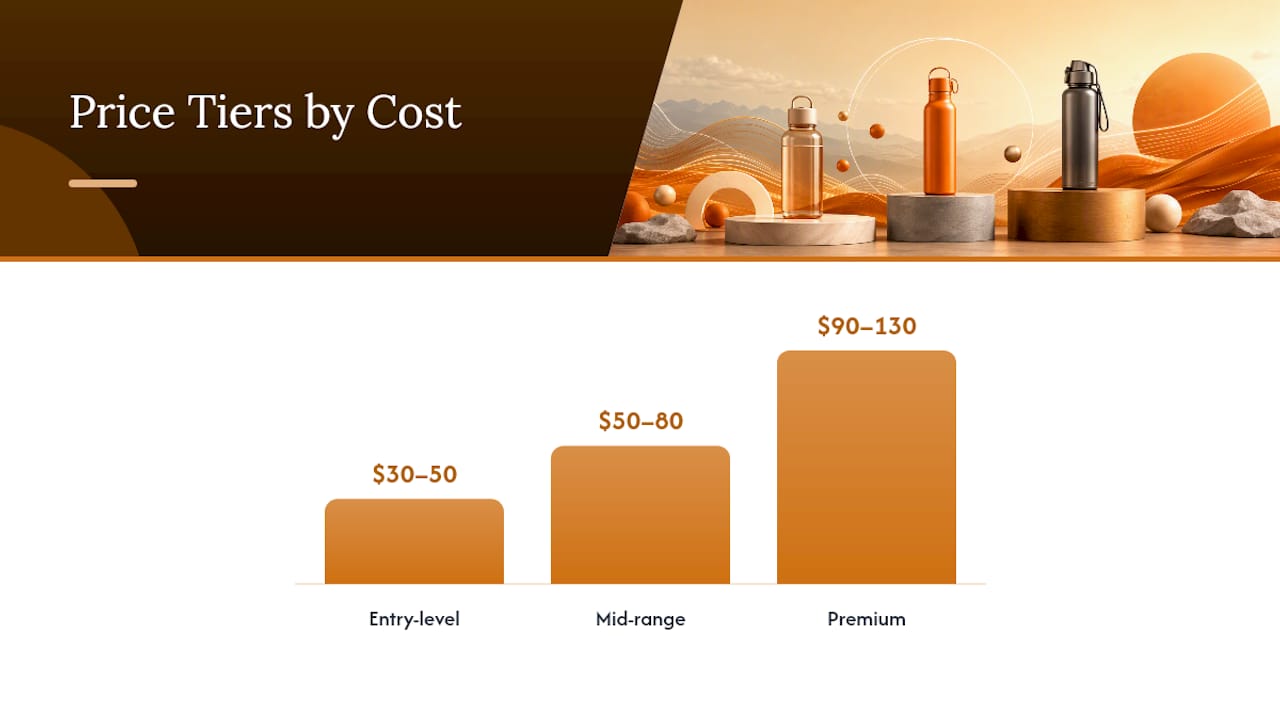
Budget tiers roughly track features. Entry-level cap-sensor bottles run $30 to $50 and suit habit building. Mid-range weight or flow-sensor bottles with app coaching land at $50 to $80 and suit general daily tracking. Premium UV-C filtration models like LARQ’s PureVis 2 run $90 to $130 and suit travelers or anyone uneasy about tap water quality.
Pro Tip: Pair your bottle’s reminder with an existing habit, like a sip every time you close a laptop tab or start a video call. Habit-stacking beats novelty; the buzz wears off, but the trigger doesn’t, and that’s what drives lasting behavior change more than any single feature.
When Is a Regular Bottle the Smarter Choice?
Smart bottles aren’t free of downsides. Batteries need charging every one to three weeks, and UV-C filters or replacement caps add $10 to $25 in recurring cost. App telemetry means your drinking habits live on a company’s server; if that bothers you, check the privacy policy for an opt-out or local-only data mode before buying.
- Skip the upgrade if you already hit your hydration goals consistently without help.
- Skip it if you rarely carry your phone, since most models depend on a paired app.
- Skip it if the idea of one more thing to charge feels like a chore rather than a convenience.
- Consider the environmental trade-off too: a smart bottle with a battery that dies in a year does less sustainability good than a $15 stainless bottle used for a decade.
StacyKnows’ Take: Making a Smart Bottle Work for Your Routine
We think the real win isn’t the gadget, it’s what the gadget nudges you toward. Pair sips with things you already do: a glass before your morning skincare routine, a refill between meetings, a bottle by the mat before you stretch. If your budget is tight, skip the $130 filtration model and put your money toward accuracy and battery life instead. Filtration matters most for travel or questionable tap water; for everyone else, a reliable reminder beats a fancy feature you’ll forget is there. And if a smart bottle isn’t in the cards right now, a $2 rubber band around a regular bottle, moved each time you refill, does surprisingly similar work.
— Stacy
Where to Read More on Smart Hydration Tech
For deeper reading: the college student hydration study for a clinical counterpoint to marketing claims, Good Housekeeping’s smart bottle reviews for feature breakdowns, and The Consumer’s Guide’s 60-day test for accuracy and hydration-improvement figures. For hydration habits beyond the gadget, Stacyknows’ practical wellness tips round out the picture.
If you’re building out a broader self-care routine alongside better hydration habits, Stacyknows’ beauty secret finds round up the products worth adding to your routine, smart bottle included.
Sources
- Effects of smart bottles on college students’ water consumption (DOI entry)
- Do Smart Water Bottles Actually Work? We Tested the Top 5
- Dehydration and headache (Cleveland Clinic)
- Best smart water bottles (Good Housekeeping)
Recommended
- Weight Loss Journey: A Practical Roadmap Made Sustainable
- Effective Strategies for Sustainable Weight Loss
- Experts say quitting Diet Coke can improve heart health and gut balance
- National Nutrition Month: Why GLP-1 Weight Loss Should Also Focus on Muscle, Metabolism, and Long-Term Health
