

A useful product review tells you three things up front: who the product is best for, what it actually does in everyday life, and whether the long-term value justifies the price. If you land on a review page and can’t answer those three questions within the first scroll, the review probably isn’t doing its job.
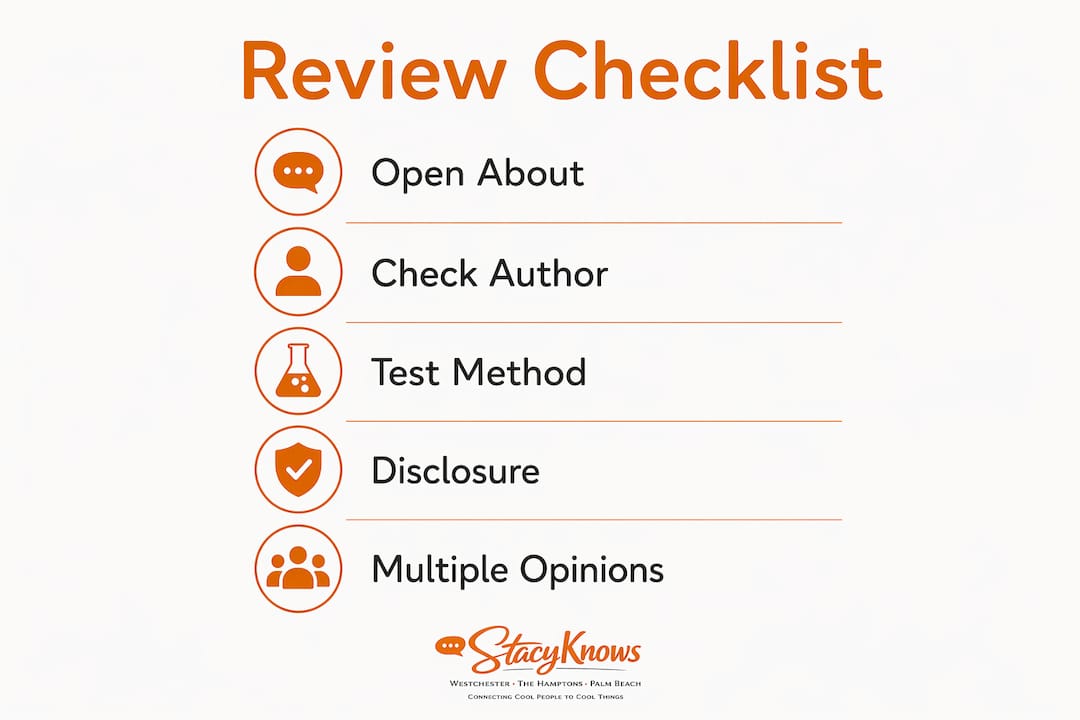
Before you read a word of the actual copy, scan the page for these quick trust signals:
- Author byline with a real bio — does the writer have relevant experience in beauty, wellness, or home?
- Testing or methodology note — did they actually use the product, or just restate the spec sheet?
- Sponsorship or affiliate disclosure — visible at the top, not buried in a footer
- Rating distribution, not just the average — a breakdown of 5-star vs. 1-star votes tells you far more than a single number
- “Best for” language — a specific use-case recommendation, not a generic “great for everyone”
Sites like RTINGS buy their own test units and run repeatable test benches, which is the gold standard for independence. BestReviews focuses on answering the questions that actually drive a buy decision. Stacyknows applies the same transparency principles to beauty, wellness, and home picks, with visible disclosures and context-specific guidance throughout.
Pro Tip: Before trusting any review, open the site’s “About” or “How We Test” page. If it doesn’t exist, treat every recommendation with extra skepticism.
What makes a product review worth trusting?
The single biggest dividing line between a useful review and marketing copy is whether the writer actually used the product. That sounds obvious, but a surprising number of reviews are assembled from press releases and manufacturer spec sheets, with no hands-on time at all.
Author credentials matter most in lifestyle categories. A skincare review written by someone with esthetics training or years of personal testing carries more weight than one written by a generalist. Look for a byline that links to a real author bio, not just a generic “staff writer” credit.
Testing methodology is the next filter. RTINGS purchases its own units and uses the same test bench across every product in a category, which eliminates cherry-picked samples. For beauty and wellness, the equivalent is a reviewer who tested a moisturizer across multiple skin types and climates, not just one afternoon. Long-term testing across 3–6 months is the gold standard for catching real degradation in performance, whether that’s a kitchen appliance losing its non-stick coating or a serum that stops working after the first jar.

Disclosure transparency is non-negotiable. Affiliate links are fine and common; what matters is whether the site tells you about them upfront and whether editorial control stays with the writer. Wirecutter-style separation between recommendations and brand influence is the benchmark to look for.
Finally, a single reviewer’s opinion is a starting point, not a verdict. BestReviews frames this well: the goal of a review is to answer the consumer’s most important questions, not to list every spec. When a review combines expert testing with aggregated user sentiment, you get a much fuller picture.
How do you interpret star ratings and review scores?
Start with the distribution, not the average. A product with a 4.2-star average can mean two very different things: either most people are genuinely happy, or it’s a polarizing product with a lot of 5s and 1s that average out to something misleadingly middle-of-the-road. Always look for the full breakdown.
| Signal | What to look for | Why it matters |
|---|---|---|
| Rating distribution | High 5s AND high 1s | Signals polarizing tradeoffs |
| Verified purchase tag | “Verified” badge on reviews | Filters out fake or incentivized posts |
| Review volume | More reviews = more reliable average | Small samples swing easily |
| Review recency | Recent reviews weighted more | Products change; older reviews may not apply |
| Spec-to-use-case match | Battery hours vs. your daily use | Converts a number into a real decision |
For beauty and wellness, the specs that matter most are ingredient lists, packaging size, and SPF rating (daily use vs. intense sun exposure are very different needs). For home products, focus on warranty length, measured durability data, and whether the reviewer tested under conditions similar to yours.
Worth noting: Test labs like RTINGS publish the number of products they’ve bought and tested, along with the size of their testing facility, as public proof of independence. That level of disclosure is what separates a credible lab from a site that just aggregates manufacturer data.
The Verge’s review approach illustrates this well: a flagship TV might score highest on paper, but a “best for you” pick for a bright living room could be a completely different model. Specs only matter when mapped to your actual situation.
A 10-point checklist to scan any review in under a minute
Run through these quickly before you commit time to reading the full piece:
- Byline and bio — is there a named author with relevant category experience?
- Publication date — is the review recent enough to reflect the current product version?
- Methodology statement — does the site explain how it tests?
- Product sourcing — was the unit purchased independently or supplied by the brand?
- Hands-on duration — how long did the reviewer actually use it?
- Sample size — one unit, or multiple units across different batches?
- Rating distribution — full breakdown visible, not just the average?
- Verified purchases — are user reviews tagged as verified?
- Sponsorship disclosure — is it at the top of the page, not hidden in a footer?
- “Best for” recommendation — does the review name a specific use case or audience?
Quick-pass: If a review clears points 1, 3, 9, and 10, it’s worth reading in full. Deep-pass: For a purchase over $50, check all ten and cross-reference at least one test-lab source alongside the user aggregation.
How do you spot a biased or unreliable review?
Some red flags are subtle; others are glaring. Here’s what to watch for:
- Sponsored language with no disclosure — phrases like “we partnered with” buried at the bottom, or no disclosure at all
- No hands-on details — the review describes the product exactly as the press release does, with no personal observations or friction points
- Manufacturer specs presented as real-world results — “up to 8 hours battery life” repeated without the reviewer actually testing it (Engadget’s Meta Glasses review is a good example of honest pushback: the reviewer found closer to 4.5 hours under real use)
- Rating clusters with identical phrasing — multiple 5-star reviews posted within days of each other using near-identical language are a strong signal of review farms
- Subscription-locked features not mentioned — a product review that doesn’t flag post-purchase paywalls is leaving out information that changes the value equation entirely
- Missing return and warranty information — a review that doesn’t mention what happens if the product fails isn’t giving you the full picture
Pro Tip: Copy a suspicious review’s exact phrasing into a search engine. If the same sentence appears across multiple unrelated products, it’s almost certainly fake.
How to use reviews to make a confident beauty, wellness, or home purchase
A clear decision process cuts through the noise fast.
- Define your non-negotiables first. Size constraints, ingredient restrictions (fragrance-free, vegan, etc.), and a firm price ceiling. Write them down before you open a single review.
- Run the 10-point checklist on two expert reviews and three user-aggregation sources. Prioritize sources that bought their own units and include long-term follow-up notes. The Verge’s use-case framing is a good model: the “best for you” pick often beats the flagship for real-life needs.
- Weigh trade-offs across four dimensions: cost, performance, durability, and ease of use. Assign each a rough priority for your situation. A travel moisturizer scores differently on “size” than a home-use treatment.
- Confirm the return policy and warranty before buying. Then recheck for any recent updates, formula changes, or — for tech products — firmware changes that may have altered features since the review was published.
Pro Tip: Cross-checking online purchasing behavior research shows that readers who verify reviews across at least two source types make fewer returns. Two minutes of cross-checking saves real money.
How Stacyknows evaluates and recommends products
Stacyknows publishes curated lifestyle content across beauty, wellness, and home categories with visible affiliate disclosures, named author bios, and context-specific “best for” guidance on every recommendation. Editorial picks are informed by hands-on testing where possible, aggregated user sentiment, and follow-up notes for long-term durability when relevant.
Every Stacyknows recommendation carries a byline linked to Stacy’s author bio, a clear disclosure of any affiliate relationship, and a specific use-case framing so you know whether a pick suits your situation. The site’s editorial transparency practices mirror the same methodology-first standards that credible test labs publish publicly.
Readers can find Stacyknows’ editorial policy and sponsorship rules on the site. Those documents matter because they tell you what the site will and won’t do when a brand relationship is involved. If a site doesn’t publish those policies, that absence is itself a signal.
Pro Tip: Look for a “corrections” or “updates” note on any review older than 12 months. Products change, and a site that updates its recommendations is one that takes accuracy seriously.
The honest truth about trusting reviews
There’s a version of review culture that has quietly become its own problem. Readers scroll past the disclosure, skip the methodology note, and go straight to the star average. That habit is exactly what review farms and sponsored content are designed to exploit.
The checklist in this article isn’t meant to make shopping harder. It’s meant to make the 30 seconds you spend scanning a review actually count. A review that clears those ten points isn’t just more trustworthy — it’s more useful, because it’s built around your real-world situation, not a brand’s best-case scenario.
Stacyknows approaches every recommendation with that same standard in mind. The goal isn’t to tell you what’s “best” in the abstract. It’s to help you find what’s best for you, with enough transparency that you can verify the reasoning yourself. That’s what ethical content practices look like in practice, and it’s the bar worth holding every review site to.
Helpful resources for going deeper on review quality
When you want to cross-check a recommendation or understand a site’s testing standards, these are worth bookmarking:
- Consumer Reports — subscription-based, independent testing across thousands of product categories; no advertising from tested brands
- RTINGS — rigorous, repeatable test benches for electronics; publishes full methodology and buys its own units
- Trustpilot — large-scale aggregated user reviews; useful for post-purchase service and brand reliability signals
- Stacyknows Beauty Secret Finds — curated beauty picks with editorial context and use-case framing for lifestyle shoppers
Cross-checking at least one test-lab source alongside a user-aggregation platform before any significant purchase is the single habit that most reliably separates confident buyers from regretful ones. Two source types, ten checklist points, and a clear sense of your own non-negotiables — that’s all it takes.
Recommended
- Best Shopping Finds in 2026: Your Curated Discovery Guide – Stacyknows
- Lifestyle Blog Topics That Resonate With Gen Z in 2026 – Stacyknows
- Elevate Your Lifestyle: Investing in Personal Wellness and Premium Experiences – Stacyknows
- New York Lifestyle Blogger: Who to Follow in 2026 – Stacyknows
