

Peptides are short chains of amino acids that act as biological messengers, signaling your body to produce collagen, repair tissue, and regulate cellular function. You have probably seen them listed on your favorite serum, in your protein powder, or trending across wellness feeds alongside terms like “bioactive peptides” and “collagen peptides.” The science behind them is genuinely exciting. But so is the hype, and those two things are not always the same. This article cuts through the noise with up-to-date 2026 clinical research so you can make smart, informed choices for your skin and your body.
What are the main types of peptides used in skincare and fitness?
Peptides fall into distinct categories, and knowing the difference matters more than most product labels let on. Each class works through a different mechanism, and matching the right type to your goal is the first step toward actually seeing results.
Here is a breakdown of the main types you will encounter:
- Collagen peptides (also called hydrolyzed collagen): These are broken-down fragments of collagen protein, typically taken orally as a supplement. They supply the amino acids glycine, proline, and hydroxyproline, which the body uses to rebuild skin structure and support joint health. Brands like Vital Proteins and Garden of Life have built entire product lines around this category.
- Signal peptides: Applied topically, these short sequences tell skin cells to ramp up collagen and elastin production. Matrixyl (palmitoyl pentapeptide-4) is the most studied example and appears in products from brands like The Ordinary and Paula’s Choice.
- Neurotransmitter-inhibiting peptides: These mimic the effect of Botox at a micro level by relaxing facial muscles to soften expression lines. Argireline (acetyl hexapeptide-3) is the most recognized name in this group.
- Carrier peptides: These deliver trace minerals like copper and manganese to the skin to support wound healing and enzyme activity. GHK-Cu (copper peptide) is the most widely researched carrier peptide in topical formulas.
- Injectable peptides: These include a growing list of compounds marketed for fat loss, muscle growth, and anti-aging. This category carries the most regulatory complexity, which is covered in detail below.
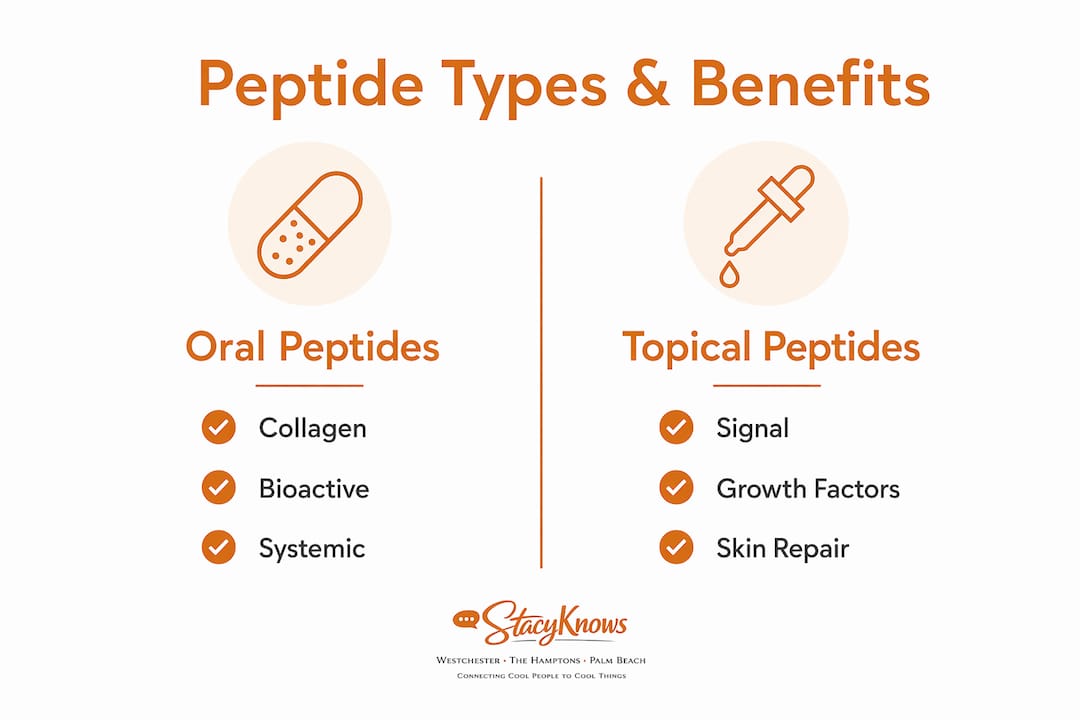
The route of administration shapes outcomes significantly. Oral peptides are digested and absorbed systemically, while topical peptides act locally but face absorption barriers through the skin’s outer layer. Injectables bypass both barriers entirely, which is why they carry the highest risk profile.
Pro Tip: When shopping for a peptide serum, look for the specific peptide name in the ingredient list, not just the word “peptides.” Products listing Matrixyl 3000, Argireline, or GHK-Cu give you something concrete to research.

What does the science actually say about peptide benefits?
The clinical evidence for peptides is stronger in some areas than others, and the distinction is worth understanding before you spend money.
A 2026 meta-analysis published in Frontiers in Medicine reviewed 19 randomized controlled trials covering 1,341 participants and found that oral and topical peptides significantly improved skin hydration and brightness, with a modest but statistically significant reduction in wrinkles (MD = 0.27, p = 0.04). Oral polypeptides showed stronger wrinkle-reducing effects (MD = 1.5, p = 0.01). This tells you that taking peptides by mouth may outperform putting them on your face, at least for wrinkle depth.
A separate 2026 randomized controlled trial tracked 119 middle-aged women taking 10 g/day of bioactive collagen peptides for 12 weeks. Wrinkle number improved with p < 0.0002, while skin elasticity and hydration reached significance at p < 0.0065 and p < 0.0037 respectively. Those are meaningful numbers. They suggest that consistent, adequately dosed supplementation over roughly three months produces measurable skin changes, not just marketing copy.
Here is a summary of what the evidence currently supports:
| Peptide type | Route | Evidence strength | Primary benefit |
|---|---|---|---|
| Collagen peptides | Oral | Strong (multiple RCTs) | Hydration, elasticity, wrinkle reduction |
| Signal peptides (Matrixyl) | Topical | Moderate | Collagen stimulation, fine lines |
| Neurotransmitter-inhibiting (Argireline) | Topical | Limited | Expression line softening |
| Carrier peptides (GHK-Cu) | Topical | Moderate | Wound healing, skin repair |
| BPC-157, TB-500 | Injectable | Very limited | Tissue repair (unconfirmed in humans) |
| GLP-1 peptide analogs | Injectable | Strong (approved versions) | Metabolic regulation, weight management |
The pattern is clear. Oral collagen peptides and a handful of well-studied topical signal peptides have the most clinical backing. Many other compounds marketed as peptides for muscle growth or anti-aging have trivial sample sizes and lack placebo controls. That gap between lab promise and human proof is where consumer confusion lives.
Pro Tip: Check whether a product references a specific clinical trial with a named peptide, dose, and duration. Vague claims like “clinically proven” without those details are not the same thing.
Are peptides safe, and what are the regulatory risks?
Safety for peptides depends almost entirely on which peptide you are using, how it is administered, and whether it has gone through proper regulatory review.
For oral collagen supplements and topical serums from established brands, the safety profile is generally favorable. Side effects in clinical trials are mild and infrequent, typically limited to minor digestive discomfort with oral supplementation. The therapeutic peptide review covering 106 articles noted that many novel peptides lack sufficient human research to confirm long-term safety, even when short-term studies look clean.
The picture changes sharply with injectable peptides. The American Medical Association has flagged that newer injectable peptides marketed by wellness influencers are often not FDA approved, with uncertain dosing and real contamination risk. These products circulate through grey-market channels, meaning no standardized manufacturing, no verified purity, and no confirmed ingredient identity. What is in the vial may not match what is on the label.
The FDA issued warnings in early 2026 about unapproved GLP-1 products used for weight loss, underscoring that the risks of unregulated peptide use extend beyond niche bodybuilding circles into mainstream wellness. This matters because GLP-1 receptor agonists like semaglutide are legitimate, FDA-approved medications. Their unregulated cousins are not.
Key risks to understand before considering any injectable peptide:
- Contamination: Grey-market peptides may contain bacterial endotoxins or undisclosed compounds.
- Dosing uncertainty: Without standardized manufacturing, the dose you receive can vary widely between batches.
- Lack of long-term data: Even peptides with promising short-term results may carry unknown risks over months or years.
- Legal status: Some injectable peptides occupy a legal grey area, making recourse difficult if something goes wrong.
“FDA approval implies oversight and clinical evidence, which newer wellness peptides often lack, increasing safety risks from unregulated products.” — American Medical Association, 2026
If you are curious about investigational drug programs and how regulatory pathways work, Stacyknows has covered that terrain in detail. The short version: approval exists for a reason, and skipping that process is a gamble with your health.
How to incorporate peptides into your beauty and fitness routine
Getting results from peptides comes down to matching the right compound to your goal, using a clinically relevant dose, and giving it enough time to work. Here is a practical framework.
-
Define your goal first. Skin hydration and elasticity? Oral collagen peptides at 10 g/day for at least 8 to 12 weeks is the most evidence-backed starting point. Fine lines and texture? A topical serum with Matrixyl or GHK-Cu applied consistently twice daily. Muscle recovery? Adequate dietary protein combined with collagen peptides post-workout has some support, though the evidence is less definitive than for skin.
-
Choose products with transparent labeling. Look for the specific peptide name, the concentration if listed, and ideally a reference to the clinical study behind the formula. Brands that name their peptide complexes (Matrixyl 3000, Leuphasyl, Syn-Ake) are giving you something you can actually verify.
-
Respect the timeline. Clinical studies commonly run 8 to 12 weeks before measuring outcomes. Expecting visible results in two weeks sets you up for disappointment and leads people to abandon products that would have worked with patience.
-
Support peptides with the basics. Peptides work better when your skin barrier is intact and your body has the raw materials it needs. That means daily SPF, adequate hydration, and a diet rich in natural peptide sources like fish, eggs, and legumes. You can also explore how oxidative stress undermines skin health and what to do about it.
-
Avoid unverified injectables. If a wellness influencer is selling you a peptide protocol that involves self-injection and ships from an overseas pharmacy, that is a hard pass. Consult a board-certified dermatologist or physician for any injectable peptide therapy applications.
Pro Tip: Not all peptides are interchangeable. Seek peptide-specific clinical evidence rather than relying on generic “peptides” claims on product packaging.
My honest read on the peptide moment we are in
The science on certain peptides is genuinely good. Oral collagen peptides have earned their place in a serious skincare and wellness routine. A handful of topical signal peptides have real clinical backing. That is worth celebrating, because it means this is not all smoke and mirrors.
What concerns me is the speed at which the word “peptides” has become a catch-all marketing term. I have seen serums with trace amounts of obscure peptides priced at three times the cost of products with far stronger evidence behind them. I have watched influencers on TikTok and Instagram promote injectable protocols with zero mention of FDA status or contamination risk, and I have seen the social media hype outrun the science by miles.
My honest take: treat peptides the way you would treat any supplement or skincare ingredient. Ask for the specific name, the dose, and the study. If a brand cannot give you those three things, the product is riding a trend, not delivering a result. The peptides that work are the ones with names, numbers, and peer-reviewed papers behind them. Everything else is a bet.
Peptides are one piece of a larger wellness picture. They do not replace sleep, nutrition, sun protection, or stress management. But when chosen carefully and used consistently, they are one of the more promising tools available right now.
— Stacy
Explore science-backed peptide picks on Stacyknows
If reading this has you ready to actually try peptides with confidence, Stacyknows has done the curation work for you.

The Stacyknows Beauty Secret Finds collection features products chosen for real ingredient transparency, not just trending labels. You will find peptide serums, collagen supplements, and complementary skincare picks that align with what the clinical research actually supports. And if you want to go deeper on anti-aging skin science or understand which treatments are worth your time and money, Stacyknows has the evidence-based coverage to help you decide. Smart beauty choices start with good information, and that is exactly what you will find here.
FAQ
What are peptides, exactly?
Peptides are short chains of amino acids, smaller than full proteins, that act as signaling molecules in the body. They direct processes like collagen production, tissue repair, and cellular communication.
How long does it take for collagen peptides to work?
Clinical studies using 10 g/day of bioactive collagen peptides show measurable improvements in skin elasticity, hydration, and wrinkle count after 12 weeks. Expect at least 8 to 12 weeks of consistent use before evaluating results.
Are injectable peptides safe to use?
Many injectable peptides marketed online are not FDA approved and carry real risks including contamination, inconsistent dosing, and unknown long-term effects. The AMA advises consulting a licensed physician before using any injectable peptide product.
Do topical peptides actually absorb into the skin?
Topical peptides face absorption challenges through the skin’s outer barrier, but formulations using smaller peptide fragments and penetration-enhancing delivery systems improve uptake. Signal peptides like Matrixyl have demonstrated measurable effects in controlled trials despite this limitation.
What is the difference between collagen peptides and signal peptides?
Collagen peptides are hydrolyzed collagen fragments taken orally to supply amino acid building blocks for skin and joints. Signal peptides are applied topically and work by triggering skin cells to increase collagen and elastin production directly at the site of application.
Recommended
- How To Combat Oxidative Stress for Youthful Skin
- Top 5 Benefits of Facial Plastics – Stacyknows
- National Nutrition Month: Why GLP-1 Weight Loss Should Also Focus on Muscle, Metabolism, and Long-Term Health – Stacyknows
- Skin Procedures For A Youthful Appearance in 2025 – Stacyknows
