

Mahjong is a four-player tile-based strategy game focused on drawing, discarding, and forming sets to complete a winning hand. Played by over 100 million people worldwide, it combines memory, probability, and sharp observation into one deeply social experience. Whether you are picking up a tile set for the first time or looking to sharpen your game, understanding the core rules and cultural roots makes every session richer. This guide covers everything from equipment and basic gameplay to strategy tips and the fascinating history behind one of the world’s most beloved games.
What equipment do you need to play Mahjong?
The first thing you need is the right tile set. Most versions of the game use either a Chinese traditional set of 144 tiles or an American set of 152 tiles that includes jokers. That difference matters more than it sounds. The jokers in American Mah Jongg open up entirely new hand patterns and change how you think about building your hand.
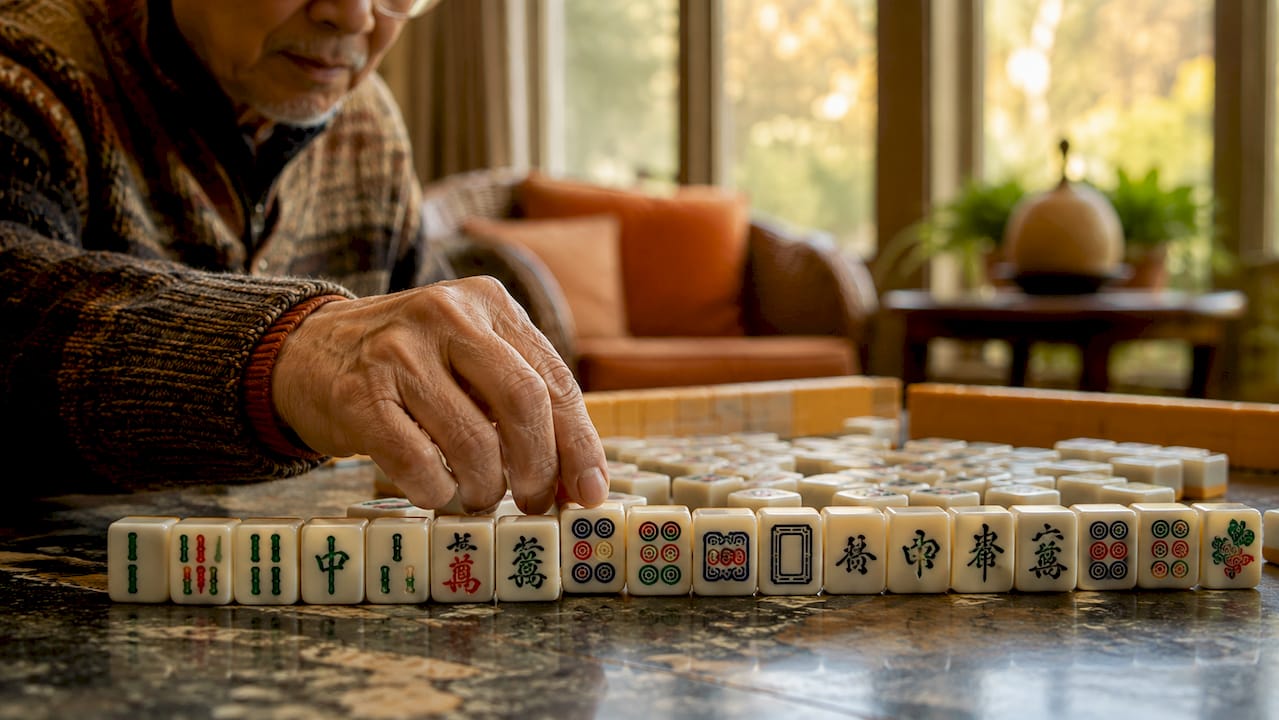
Tiles fall into three main categories: suited, honor, and bonus tiles.
| Category | Types | Quantity (144-tile set) |
|---|---|---|
| Suited tiles | Bamboo, Characters, Circles | 108 (36 per suit) |
| Honor tiles | Winds (East, West, North, South) | 16 |
| Honor tiles | Dragons (Red, Green, White) | 12 |
| Bonus tiles | Flowers and Seasons | 8 |
Once you have your set, four players sit around a square table and each takes a seat corresponding to a wind direction: East, South, West, and North. The East player is the dealer for the first round. All 144 tiles are shuffled face down and stacked into four walls, two tiles high, forming a square in the center of the table. Each player draws tiles from the wall to build their starting hand.
Pro Tip: If you are brand new to the game, start with a Chinese traditional 144-tile set before moving to the American version. Fewer tile types means fewer rules to absorb at once, and you will build a stronger foundation faster.
How do you play Mahjong step by step?
The goal of every round is to build a winning hand of 14 tiles: four melds (called sets) and one pair. The dealer starts with 14 tiles; all other players start with 13. That extra tile gives the dealer the first chance to win before even drawing.
The four meld types
- Chow: Three tiles in sequence from the same suit (e.g., 3, 4, 5 of Bamboo)
- Pung: Three identical tiles (e.g., three Red Dragons)
- Kong: Four identical tiles, which requires drawing a replacement tile from the wall
- Eyes (pair): Two identical tiles that complete the winning hand
How a turn works
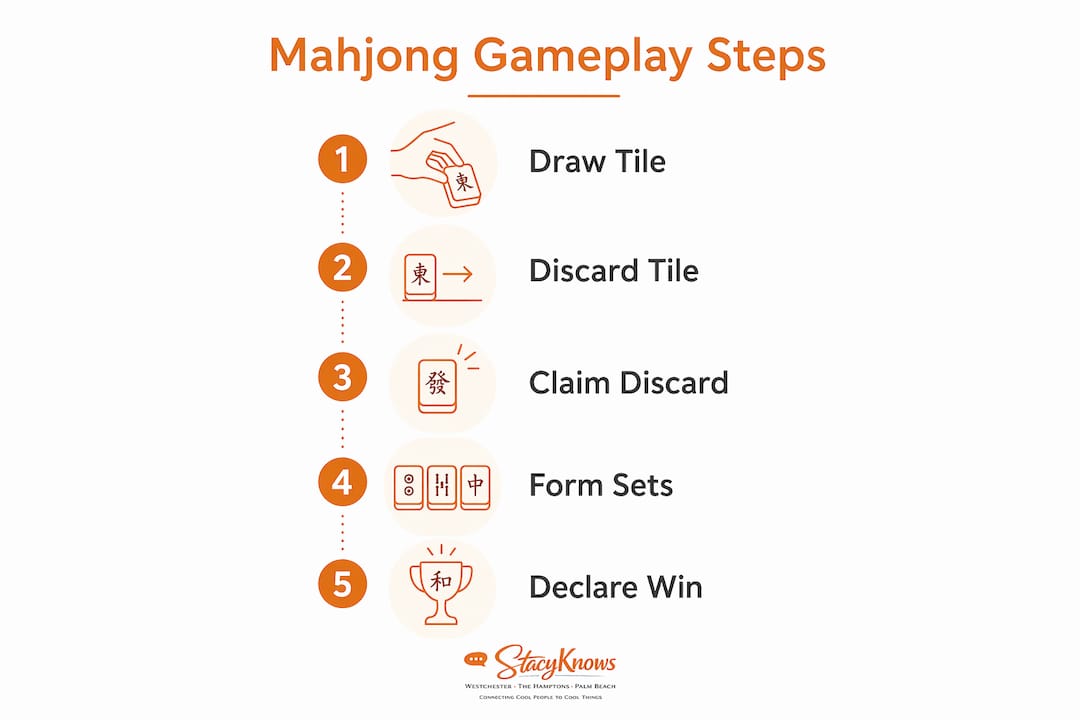
Each turn follows a clear sequence. Players draw one tile and discard one tile, keeping their hand at 13 tiles until they win. After any player discards, the other players may claim that tile to complete a meld, but strict priority rules apply.
Here is the standard sequence of play:
- The dealer draws a tile from the wall (or claims a discard).
- The dealer discards one tile face up in the center.
- The next player clockwise draws from the wall or claims the discard.
- A player who claims a discard must immediately reveal the completed meld.
- Play continues until one player completes four melds and one pair.
- The winning player calls “Mahjong” and reveals their full hand.
- Scoring is calculated based on the hand’s value and how the win was achieved.
Claiming discards and priority rules
Priority rules are where beginners most often get tripped up. A winning call always overrides any other claim on a discarded tile. If two players want the same tile for different reasons, the player who can use it to win takes it every time. After a winning call, the next priority goes to a player completing a kong or pung. A chow claim is lowest priority and can only be made by the player directly to the discard’s left.
Pro Tip: Watch the discard pile carefully before claiming a tile. If you see that other players have already discarded the same tile type you need, it is likely safe to build toward that meld. If no one has discarded it, be cautious. Someone else may be holding it.
What are the best Mahjong strategy tips for beginners?
Long-term success at Mahjong depends on memory, probability, and observation, not luck alone. Players who track which tiles have been discarded make far better decisions than those who focus only on their own hand. That shift in attention is the single biggest leap a beginner can make.
Here are the core strategies every new player should practice:
- Track discards actively. Observing opponents’ discards tells you which tiles are still live and which are dead. A tile no one has discarded is dangerous to discard yourself.
- Balance offense and defense. Building toward a high-scoring hand is tempting, but if another player is close to winning, switch to safe discards. Feeding someone else’s win costs you points.
- Keep your hand flexible early. Avoid locking into one specific hand pattern in the first few draws. Flexible hands adapt when the tiles you need do not appear.
- Protect concealed hands. A hand with no exposed melds earns bonus points in most scoring systems. Resist the urge to claim discards unless the meld significantly improves your position.
- Avoid common beginner mistakes. Discarding tiles that complete another player’s winning hand is called “dealing into” their hand. In many scoring systems, the player who discards the winning tile pays a penalty.
American Mah Jongg adds one more layer of strategy: the annual NMJL card redefines which hands are valid each year. Players who study the new card early in the season gain a real edge over those who rely on last year’s patterns. If you play the American version, treat the new card as required reading every spring.
Pro Tip: Build toward two or three possible winning hands simultaneously in the early game. As tiles come and go, one path will become clearer. Committing too early to one hand leaves you stuck when key tiles are gone.
How did Mahjong’s history shape its many variations?
Mahjong originated in China during the Qing dynasty, most likely in the mid-19th century, and spread rapidly across Asia before reaching Western countries in the early 20th century. That global spread produced distinct regional versions, each with its own rules, scoring, and cultural rituals.
The major variations you will encounter include:
- Chinese Classical Mahjong: The foundational version, with complex scoring based on hand value, seat winds, and round winds.
- Cantonese Mahjong: Popular in Hong Kong, with faster gameplay and specific bonus tile rules.
- Riichi Mahjong (Japanese): Features the “riichi” declaration, where a player announces they are one tile away from winning and locks their hand.
- American Mah Jongg: Uses the NMJL card, jokers, and a distinctly social playing culture that developed in the United States during the 1920s and 1930s.
One persistent source of confusion is Mahjong Solitaire, the single-player tile-matching puzzle found on most phones and computers. It shares the tile imagery but has nothing to do with the four-player strategy game. Knowing this distinction matters because players who learn Mahjong Solitaire first often arrive at the real game with the wrong mental model entirely.
The cultural rituals around the game are part of its appeal. Wind assignments, the direction of play, and even the way tiles are shuffled carry meaning in traditional settings. For many families, Mahjong is a living tradition passed down across generations, not just a game. If you want to read more about the worldwide rise of the game and its cultural significance, Stacyknows covers Mahjong’s global appeal in depth.
What I have learned from years at the Mahjong table
The biggest mistake I made as a beginner was trying to learn every variation at once. I bounced between Chinese Classical rules and American Mah Jongg, and I ended up confused about both. The moment I committed to one version and played it consistently, everything clicked. If you are just starting out, pick one style and stick with it until the rules feel automatic.
Playing with experienced players accelerated my progress more than any guide ever did. Watching how a skilled player handles a bad draw, or how they pivot their hand strategy mid-round, taught me things that are hard to put into words. If you can find a local group or a Mahjong community near you, join it. The social side of the game is genuinely one of its best features.
The mental shift that changed my game most was moving from “what do I need?” to “what does everyone else have?” Once I started reading the table instead of just managing my own tiles, my win rate improved noticeably. Mahjong rewards patience and attention. The complexity that feels intimidating at first becomes the very thing that keeps the game interesting for years.
— Stacy
More ways to enjoy your leisure time with Stacyknows
Mahjong is one of those rare games that rewards you the more you invest in it. Whether you are building your first tile set or refining a strategy that has taken years to develop, the learning never really stops.

At Stacyknows, the conversation goes well beyond the game table. If you love discovering things that genuinely improve your everyday life, the Stacyknows Beauty Secret Finds page is worth a look. It brings together the kind of lifestyle finds that feel like a tip from a well-traveled friend. And if you are curious about stylish Mahjong essentials that make game night feel a little more special, Stacyknows has that covered too.
FAQ
What is the goal of Mahjong?
The goal is to build a winning hand of 14 tiles consisting of four melds and one pair. The first player to complete that structure and call “Mahjong” wins the round.
How many tiles does a standard Mahjong set have?
A Chinese traditional set contains 144 tiles. The American Mah Jongg version uses 152 tiles, including jokers.
Is Mahjong Solitaire the same as real Mahjong?
No. Mahjong Solitaire is a single-player puzzle that uses tile imagery but has no connection to the four-player strategy game. They share a name and visuals, nothing more.
What is the NMJL card in American Mah Jongg?
The National Mah Jongg League publishes a new card each year that defines which hands are valid for that season. American players must study the updated card annually to stay competitive.
How do beginners get better at Mahjong faster?
Choosing one variant and practicing it consistently is the fastest path to improvement. Playing with experienced players and tracking discards actively will sharpen your skills more quickly than playing solo.
Recommended
- So You Want to Play Mah Jongg – Stacyknows
- ? Game Night Just Got Glam: Your Stylish Mahjong Essentials – Stacyknows
- Is the “Hot Wall” Even a Thing? The Mahjong Debate That Wouldn’t End – Stacyknows
- Staying in Westchester This Summer and Love Mahjong or Canasta? Here’s How to Fill Your Calendar – Stacyknows
