
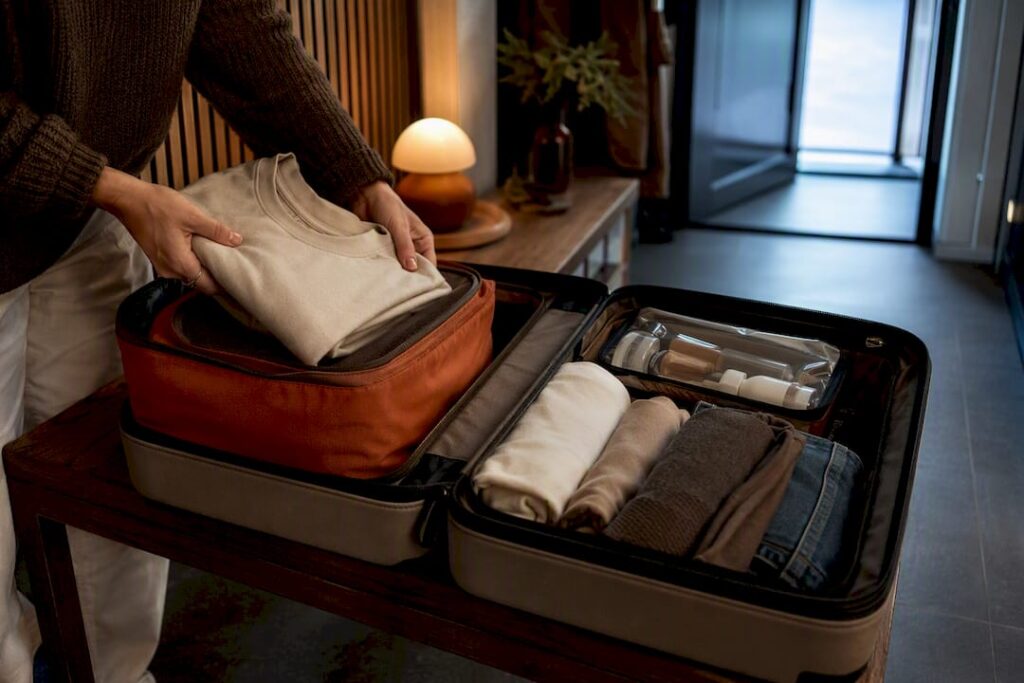
Pack one carry-on plus one personal item, build a small capsule wardrobe, use packing cubes to keep everything sorted, follow the TSA 3-1-1 liquids rule to the letter, and stash your power bank, meds, and documents where you can reach them fast. That combination is the whole system. Get those five pieces right and you can handle a weekend getaway or a two-week trip without ever touching a baggage carousel.
Carry On Packing List: The Complete Checklist By Category
A good carry-on packing list works like a kitchen mise en place: everything has a spot, and you’re not digging through a pile at security while a line forms behind you. Here’s the full breakdown, organized by function rather than dumped into one giant list.
Documents and money. Bring your passport or ID, a backup debit or credit card stored separately from your primary wallet, a slim travel wallet, and printed copies of your hotel and flight confirmations in case your phone dies at the worst possible moment.
Electronics and cables. Your phone, its charger, a power bank (it has to ride in your carry-on, never checked), a laptop or tablet if your trip needs one, exactly one cable per device, and a small tech pouch to keep the tangle contained.
Toiletries and meds. One quart-sized clear bag holding your 3.4-ounce containers, prescription medication left in its original labeled packaging, and solid swaps wherever you can manage them.
Clothing and footwear. A capsule wardrobe built around a few interchangeable pieces, plus a rule that saves real suitcase space: wear your bulkiest shoes and jacket on the plane instead of packing them.
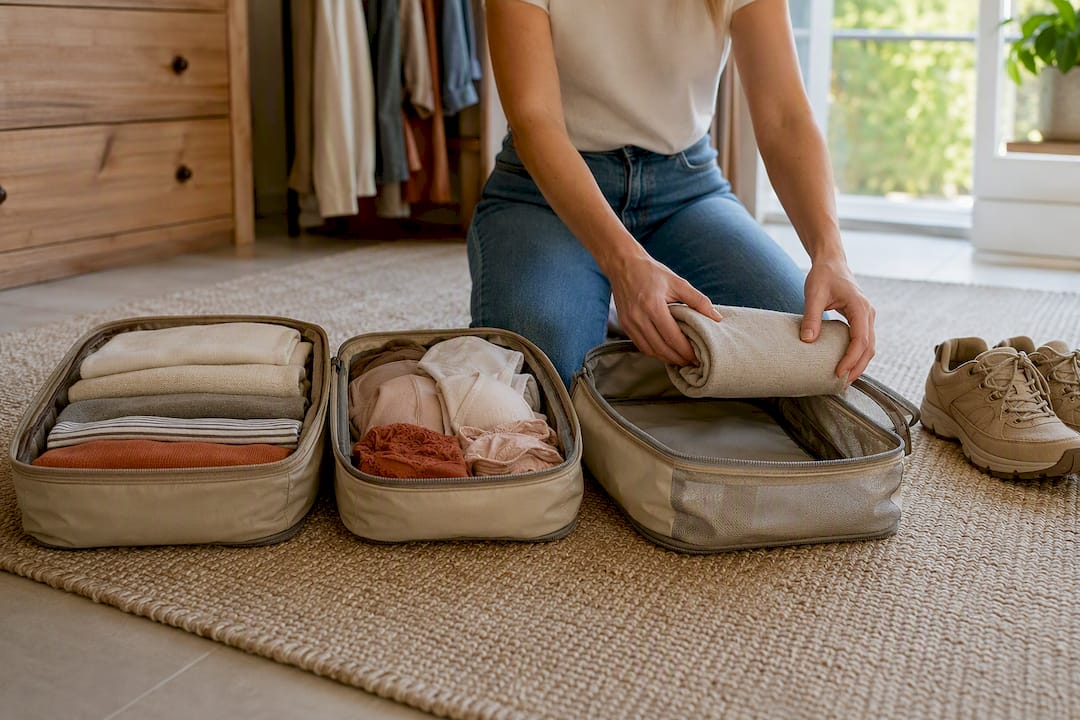
Organization. Packing cubes split by category, one for clean clothes, one for underwear and socks, and one left empty for dirty laundry on the way home. Compression cubes squeeze out a surprising amount of air and let you fit more without cramming.
Comfort and extras. A couple of snacks, a refillable water bottle you empty before security and fill on the other side, an eye mask, and earplugs or noise-canceling earbuds for whatever the middle seat throws at you.
Pro Tip: Leave roughly one-fifth of your bag empty when you pack it at home. That buffer is for the market finds, the souvenir, or the extra layer you didn’t know you’d need until you got there.
If you want a head start on the wardrobe piece specifically, Stacyknows has a breakdown of how to build a complete capsule wardrobe with just 22 pieces, which translates almost directly into carry-on math.
Choosing a Carry-On and Personal Item That Actually Fit
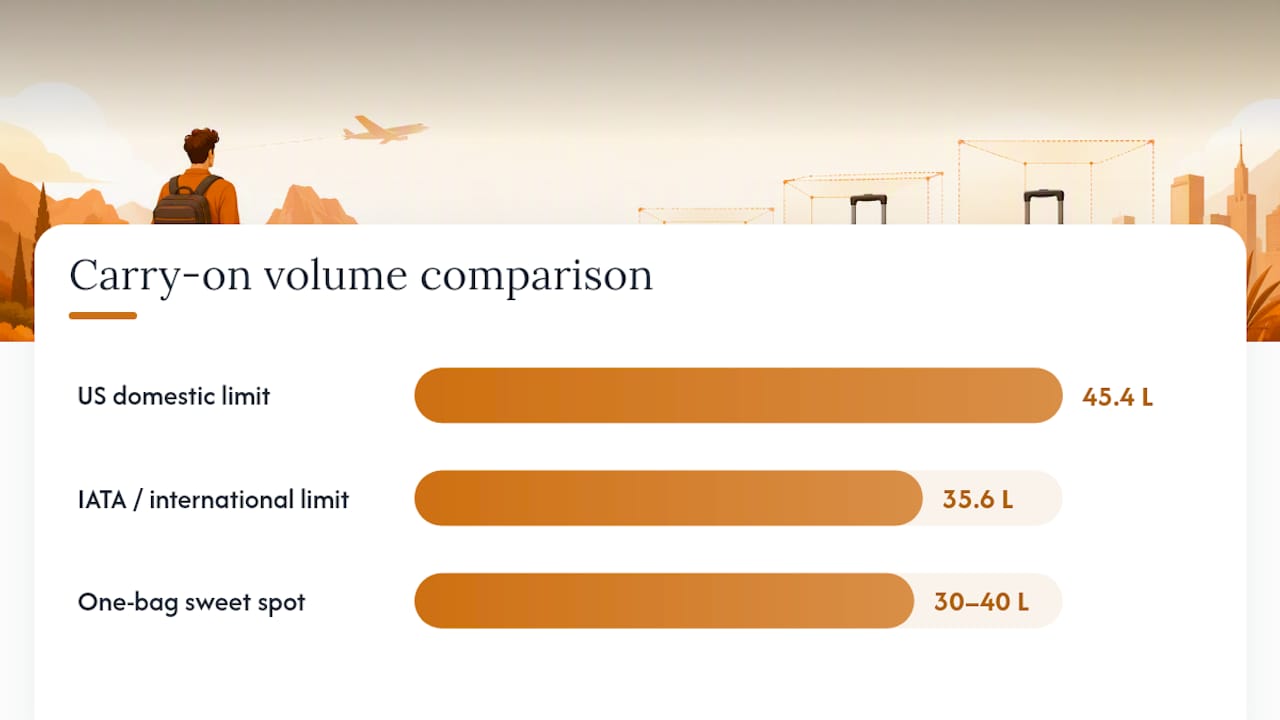
Most US domestic carriers cap carry-on bags around 22 x 14 x 9 inches, while international IATA-compliant sizing tends to run smaller, closer to 21.5 x 13.5 x 7.5 inches. Airlines enforce these numbers inconsistently, which is exactly why you should size your bag to the strictest carrier you fly, not the most generous one.
Soft-sided backpacks flex to squeeze under seats and absorb a little overpacking; hard-shell rollers protect fragile items better but won’t compress when a gate agent gives you the side-eye. Most one-bag travel guides land on a 30 to 40 liter volume as the sweet spot for trips running anywhere from a long weekend to two weeks.
Before you ever leave the house, pack the bag completely and test it against your tightest measurements, then practice pulling out your laptop and liquids bag until it takes under a minute. Your personal item isn’t just backup storage. Use it for the things you’ll touch mid-flight and at security screening, documents, power bank, headphones, snacks, while your carry-on holds the bulkier stuff you won’t need until you land. If your travel days sometimes involve a drive to the airport too, the same load-out logic applies to road trip prep.
Building a Clothing Capsule That Actually Works
Merino wool and other quick-dry synthetics are the backbone of any serious carry-on wardrobe. Merino resists odor and wicks moisture well enough that you can rewear the same top two or three days running without anyone standing near you noticing. Stick to a neutral palette, black, navy, gray, tan, so every top pairs with every bottom and you’re never stuck with an orphan piece.
A rough rule of thumb: pack one top per two days of travel, capped around seven, and two to three bottoms regardless of trip length, since pants and skirts hold up to rewearing far better than shirts do. Wear your bulkiest shoes and heaviest jacket on the plane rather than folding them into the bag. That single habit frees up more cube space than almost anything else you can do.
On technique: rolling clothes generally beats folding for cube-packed bags because it resists wrinkling and lets you see everything at a glance. Compression cubes take that a step further, squeezing garments down and freeing space for the return-trip souvenirs. The most repeatable layout experienced travelers use is three cubes: one for clean clothes, one for undergarments, and one left empty until day two, when it becomes the dirty-laundry cube.
Pro Tip: Sink-wash a shirt or two in the hotel bathroom with a dab of shampoo, wring hard, roll it in a towel to pull out extra moisture, then hang it near the AC vent or a fan overnight. It’s usually dry by morning, and it’s the trick that lets a five-shirt wardrobe cover a ten-day trip.
The TSA 3-1-1 Rule and What It Actually Means for Your Toiletries Bag
Every liquid, gel, aerosol, cream, and paste in your carry-on has to sit in a container of 3.4 ounces (100 milliliters) or less, and every one of those containers has to fit into a single quart-sized clear resealable bag. One bag, no exceptions, and it needs to come out for screening.
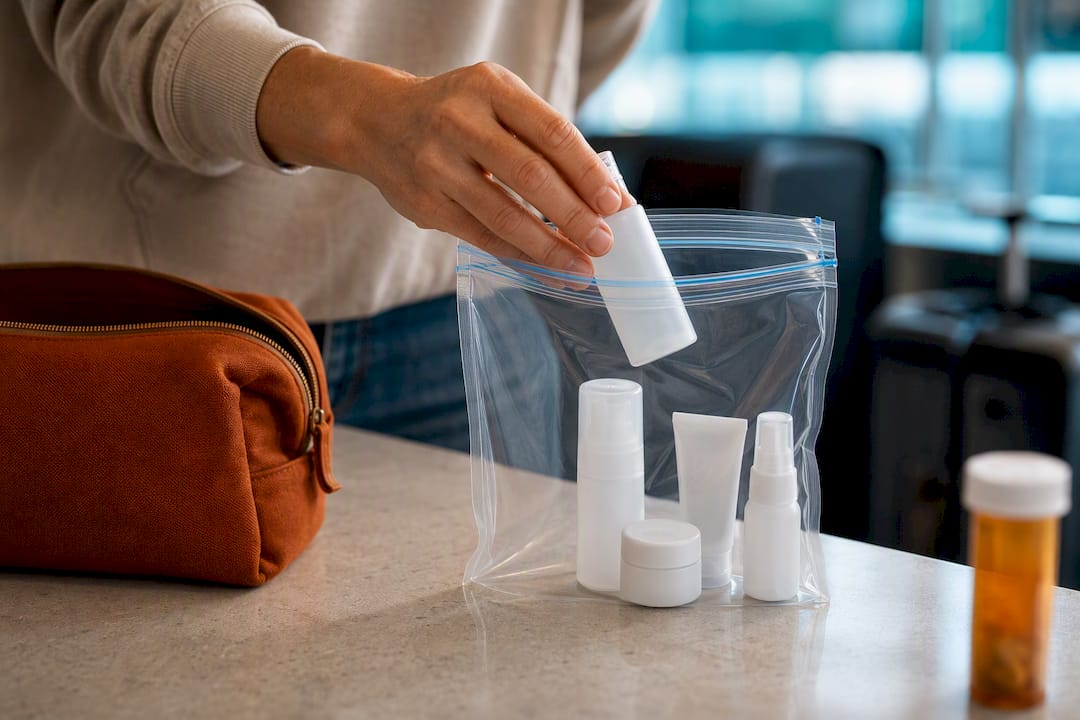
Prescription medications are exempt from the size cap and don’t have to squeeze into that quart bag, though keeping them in original, labeled packaging avoids questions at the checkpoint. Infant formula and baby food get the same exemption. Anything you’re carrying over 3.4 ounces belongs in checked luggage, not stuffed hopefully into a side pocket.
Duty-free liquids purchased past security are a partial exception: TSA generally permits them if they’re sealed in a secure, tamper-evident bag with the receipt attached, though connecting flights and international transfers can complicate things, so don’t count on it for anything you can’t live without.
The easiest way to sidestep the whole liquids puzzle is to go solid wherever you can: shampoo bars, solid perfume, stick sunscreen, solid deodorant. Fewer liquids means less risk of a leak ruining your capsule wardrobe and less time spent repacking that quart bag at 5 a.m.
Power Banks, Batteries, and Packing Your Tech Smart
The FAA is direct about this one: portable power banks and lithium-ion batteries have to travel in your carry-on, never in checked luggage, because of fire risk in the cargo hold. Most consumer power banks fall under the roughly 100 Wh threshold that doesn’t require airline approval, but if you’re traveling with an oversized battery pack, check with your carrier before you fly.
Pack one multi-port GaN charger instead of three separate bricks, keep exactly one cable per device, and corral all of it in a compact tech pouch you can pull out fast at the checkpoint.
- Keep your power bank and laptop near the top of your bag, not buried under clothes, since both typically need to come out for screening.
- Back up your phone photos before you leave, so a lost device doesn’t mean a lost trip.
- A small cable lock on your bag zipper deters casual tampering in shared spaces like hostels or overhead bins.
What to Keep on Your Person, Not in Your Bag
Some items belong on your body, not zipped into a cube where you’d have to dig for them at exactly the wrong moment.
- Passport or ID and your boarding pass, kept somewhere you can reach without opening the bag.
- A slim wallet with your primary card and a little cash, separate from any backup card stored deeper in your bag.
- Same-day medication doses, so a delayed bag never becomes a medical problem.
- Valuables like jewelry or a spare card tucked into an inner, zippered pocket rather than an outer one a stranger could brush against.
For comfort on longer legs, noise-canceling earbuds or simple foam earplugs, an eye mask, a light scarf that doubles as a blanket, and a couple of single-serving snacks cover most of what makes a flight bearable. If you want a broader safety net for the unexpected, from blister care to a phone charger cable you forgot, Stacyknows put together an emergency kit guide worth skimming before a longer trip.
Pack-By-Trip-Length Cheat Sheet
Trip length changes your counts more than anything else, so here’s how the math actually shifts.
- Weekend (1 to 2 days): Two tops, one bottom, two sets of underwear, two pairs of socks, and the shoes you’re wearing on the plane. Skip laundry planning entirely, you’ll be home before it matters.
- Short trip (3 to 7 days): Four to five tops, two bottoms, five sets of underwear, four pairs of socks, and one layer piece like a light sweater or packable jacket. If you’re gone the full week, plan one sink-wash around day four to stretch the tops further.
- Extended trip (8 to 14 days): Six to seven tops, three bottoms, seven sets of underwear, six pairs of socks, and two layers for temperature swings. This is where the laundry plan matters most: one sink-wash session around the midpoint, or a quick laundromat run if your lodging is near one, turns a two-week trip into the same bag you’d pack for one week.
For business trips layered on top of any of these lengths, swap one or two casual tops for wrinkle-resistant button-downs, add a slim garment folder to keep them crease-free, and bring one dressier shoe instead of doubling up on sneakers. That swap adds almost no bulk since you’re subtracting a casual item for each dressier one you add.
Why Stacyknows Trusts This System Over a Bigger Suitcase
We’ve watched enough friends drag oversized roller bags through cobblestone streets to know that more space just means more stuff you didn’t need. The carry-on-only system works because it forces the same decisions every time: what’s genuinely reusable, what can be washed once, and what belongs on your body instead of buried in a bag. Adapt the counts here to your own trip, your own climate, and your own tolerance for rewearing a shirt. The formula holds either way.
— Stacy
Quick Reference Links Worth Bookmarking
For the rules and the deeper methods behind this checklist, these are worth a direct look: TSA’s liquids and gels guidance, the FAA’s battery rules, and a solid youth travel packing list if you’re packing for a group that includes teens.
Once your bag is sorted, the next win is usually what’s in your dopp kit. Stacyknows rounds up beauty finds worth packing that hold up well in a quart-sized bag without weighing your carry-on down.
Sources
- What Can I Bring? | Transportation Security Administration
- Portable electronic devices with batteries | FAA
- Maximize space: how compression packing cubes work
Recommended
- Things to Handle Before a Long International Trip
- What Makes a Travel Bag Worth the Splurge
- A Taste of Piedmont: What To Pack for a Late Fall Trip
