
To repair a damaged skin barrier, stop all actives (retinoids, AHAs/BHAs, vitamin C) and harsh cleansers immediately. Switch to a gentle, low-pH cleanser, a ceramide-rich moisturizer twice daily, and a broad-spectrum mineral SPF every morning. Most people notice less stinging and redness within days, with clearer, more consistent improvement by two to four weeks of sticking to that simple routine.
What Skin Barrier Repair Actually Means
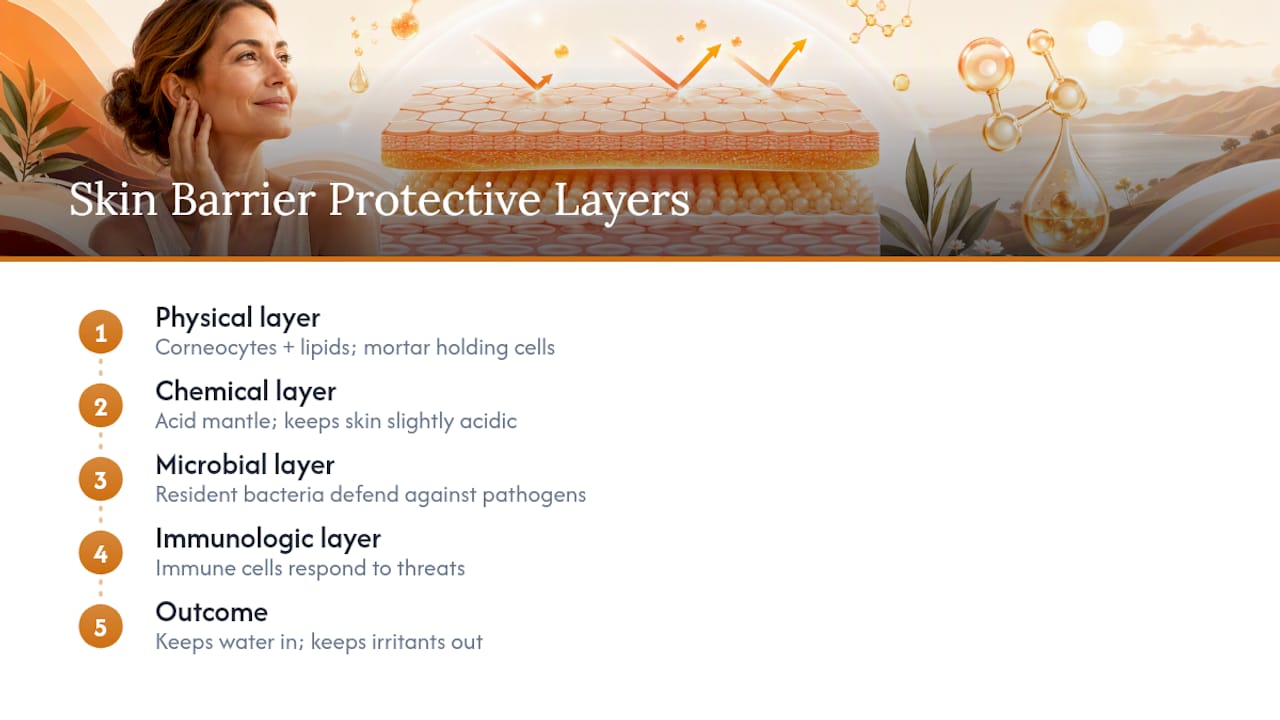
Your skin barrier is the outermost layer of the epidermis, called the stratum corneum, and it works like a brick wall. Dead skin cells, or corneocytes, are the bricks. A mix of intercellular lipids, mainly ceramides, cholesterol, and fatty acids, is the mortar holding everything together. When that structure stays intact, water stays in and irritants stay out.
Dermatologists actually think about the barrier in four layers doing different jobs at once: a physical layer (the bricks and mortar itself), a chemical layer (the acid mantle, which keeps skin slightly acidic), a microbiologic layer (your skin’s own bacteria acting as a defense system), and an immunologic layer that responds to threats.
When the mortar breaks down, moisture escapes faster than it should. Dermatologists measure this as transepidermal water loss, or TEWL, and it’s the clinical proxy for how compromised your barrier is. Your skin also relies on natural moisturizing factor, a blend of amino acids and salts inside skin cells that pulls in water. Skin barrier repair means rebuilding both the mortar and the moisture reserve, not just calming redness for a day.
What Are the Signs of a Damaged Skin Barrier?
Your skin usually tells you before you can see anything in the mirror. New stinging, burning, or tightness from products you’ve used for months without issue is one of the most reliable early signals that something has shifted, even before visible symptoms show up.
Common signs include:
- Stinging or burning when applying moisturizer, sunscreen, or even plain water
- Redness or a flushed appearance that doesn’t fade between applications
- Flaking, rough texture, or patches that feel tight after cleansing
- Sudden sensitivity to products you’ve tolerated for months
- Persistent dryness that heavier moisturizer doesn’t fix
Most of these respond well to the at-home routine below. But open cracks, a spreading rash, oozing or pus, or symptoms paired with fever or swelling are red flags that belong in a dermatologist’s office, not a skincare routine.
What Causes a Damaged Skin Barrier?
Barrier damage is almost never one single product. It’s usually a pile-up of small habits that each chip away at the lipid mortar until the wall gives out.
- Over-exfoliation from daily acids, physical scrubs, or exfoliating tools used too often
- Harsh, high-pH cleansers, especially bar soaps, combined with hot showers and long cleansing sessions
- Layering too many actives at once, like retinol plus vitamin C plus an acid toner in the same routine
- Products loaded with denatured alcohol or heavy fragrance, both known irritants for compromised skin
- Cold, dry air, indoor heating, and pollution, which strip lipids and increase TEWL independent of what you’re applying
Retinoids are effective ingredients but can thin the stratum corneum as part of their action, which can contribute to barrier breakdown if used too aggressively.
How Do You Stop the Damage Right Now?
Before any repair ingredient can do its job, you have to stop reinjuring the skin. This is the single most skipped step in barrier repair, and it’s the reason so many people stay stuck in a cycle of irritation for months.
- Stop every exfoliant and active. Retinoids, AHAs, BHAs, vitamin C, benzoyl peroxide, and physical scrubs or brushes all pause immediately, no exceptions.
- Simplify to three products. A gentle, low-pH cleanser, a fragrance-free ceramide moisturizer, and mineral sunscreen are the entire daytime routine.
- Moisturize morning and night. Apply the ceramide cream while skin is still damp to help lock in water.
- Wear mineral SPF every morning, even indoors near windows, since UV exposure accelerates lipid breakdown in already-compromised skin.
- Layer an occlusive at night on visibly dry, non-acne-prone areas to seal in moisture while you sleep.
- Watch the calendar. If there’s no improvement after two to four weeks, or you see signs of infection, escalate to a dermatologist.
Pro Tip: Keep a small notebook or phone note of exactly which products touch your face each day for the first week. When something goes sideways later, you’ll actually know what changed instead of guessing.
Which Ingredients Actually Repair the Skin Barrier?
Not all “barrier repair” labels are created equal, and this is where most people waste money. The clinical rationale matters more than the marketing.
- Ceramides, cholesterol, and fatty acids together. Formulations that combine all three lipids in roughly a 3:1:1 ratio outperform ceramide-only creams, because that ratio mirrors what’s naturally found in healthy stratum corneum.
- Humectants like glycerin and hyaluronic acid. Multi-weight hyaluronic acid pulls water into both surface and deeper skin layers, while glycerin is one of the most studied humectants for improving hydration.
- Niacinamide at 2% to 5%. This range supports your skin’s own ceramide production and reduces water loss. Very high concentrations, above that range, can actually irritate skin that’s already compromised, which defeats the purpose.
- Occlusives like petrolatum, dimethicone, and squalane. These sit on top of skin and dramatically cut water loss, but they don’t replace the structural lipid matrix, so they work best paired with a ceramide cream rather than instead of one.
Formulations built as lamellar creams, meaning they’re structured in layers that mimic your skin’s own lipid arrangement, tend to integrate into the stratum corneum more effectively than a basic oil-in-water lotion. Ingredient order on the label matters, too: look for ceramides and fatty acids listed within the first half of the ingredient list, not buried near the preservatives.
What Does a 4-Week Skin Barrier Repair Routine Look Like?
Recovery follows the skin’s own rhythm, so a week-by-week structure works better than “just wait and see.”
- Week 1, reset. Cleanse gently once daily (twice max), apply a ceramide moisturizer morning and night, and use mineral SPF every day. Sleep with an occlusive over any visibly dry patches.
- Week 2, maintain. Keep the same routine. If skin feels stable with no stinging, you can introduce a low-strength niacinamide serum, but resist adding anything new beyond that.
- Week 3, consolidate. If there’s been zero irritation for two weeks straight, a hydrating peptide serum or a lightweight hyaluronic acid layer can go in, always one product at a time.
- Week 4, evaluate. Assess overall texture, redness, and comfort. If things look steady, this is the window to patch test one active ingredient at the lowest available concentration.
Skipping steps to “speed things up” is the most common reason people end up back at week one.
How Long Does It Take to Repair the Skin Barrier?
Mild to moderate damage typically shows real progress within two to four weeks, which roughly lines up with the skin’s 28-day cell turnover cycle. Severe or chronic barrier dysfunction, especially with conditions like eczema or rosacea layered on top, can take six to eight weeks or longer and often needs dermatologic treatment.
Track progress with practical markers rather than the mirror alone: less stinging when you apply moisturizer, redness that fades faster, and skin that feels padded rather than tight by midday.
When Can You Safely Reintroduce Actives?
Adding actives back too soon is the single biggest reason people relapse into barrier damage. Patience here saves weeks later.
- Wait a minimum of two to four weeks after symptoms noticeably improve before adding anything back.
- Reintroduce one product at a time, at the lowest concentration available, and patch test on your inner arm or jawline first.
- Buffer retinol by applying moisturizer before or after it, start at one to two nights a week, and hold that frequency for two full weeks before increasing.
- If stinging, redness, or flaking returns at any point, stop that product and go back to the repair protocol for another one to two weeks.
Staged reintroduction, one new product per week with careful observation, meaningfully lowers the odds of retriggering the same damage.
Pro Tip: If you’re not sure whether a reaction is “purging” or genuine irritation, purging tends to show up as small breakouts in your usual trouble spots. True irritation shows up as stinging, tightness, or redness spreading beyond where you applied the product.
Does Diet and Hydration Affect Skin Barrier Repair?
What you eat and drink shows up on your skin, though it works on a slower timeline than topical care. Skin barrier lipids, the ceramides and fatty acids that make up your skin’s mortar, are built from dietary fats. Diets consistently low in essential fatty acids, found in foods like salmon, walnuts, and flaxseed, tend to correlate with drier, more reactive skin over time.
Hydration works a bit differently than most people assume. Drinking more water helps overall bodily function, but it’s not a fast fix for a barrier that’s already compromised. Skin pulls water from deeper tissue layers regardless of how much you drink; the real lever for surface hydration is the moisture you apply topically and how well your barrier holds onto it. That’s why a ceramide moisturizer matters more in an acute repair window than an extra glass of water does.
That said, chronic dehydration and very low-fat diets do make the repair process slower and less durable. Alcohol and high-sugar diets have also been linked to increased inflammation, which doesn’t help a barrier that’s already struggling. The practical takeaway is not to overhaul your entire diet mid-repair, but to make sure you’re getting enough healthy fats and staying reasonably hydrated while your topical routine does the heavier lifting.
Do Stress and Sleep Affect Skin Barrier Health?
Stress hormones and skin barrier function are more connected than most skincare routines account for. Elevated cortisol, your body’s primary stress hormone, has been associated with slower lipid synthesis and higher transepidermal water loss, meaning a stressful week can genuinely undo some of the progress your routine is making.
Sleep plays a similarly underrated role. Skin cell turnover and repair processes ramp up overnight, which is part of why dermatologists lean on that roughly 28-day renewal cycle when setting recovery expectations. Consistently cutting sleep short interrupts that overnight repair window, and people going through high-stress periods often report their “sensitive skin phase” flaring right alongside a rough week at work or poor sleep.
None of this means you need a total lifestyle overhaul to fix your skin. But if you’re doing everything right topically and still seeing slow progress, stress and sleep are worth a honest look before you blame your products. Small, sustainable changes, a consistent bedtime, a few minutes of decompression before bed, tend to support barrier recovery more than any single serum will. For a deeper look at how daily habits show up on your skin over time, the connection between lifestyle and skin health is worth a closer read.
How Do You Spot Skincare Allergens and Irritants?
The words “irritant” and “allergen” get used interchangeably, but they behave differently on skin. An irritant, like a high concentration of alcohol or a strong acid, causes a reaction in almost anyone if the concentration is high enough. An allergen triggers a reaction only in people who’ve developed a sensitivity to that specific ingredient, sometimes after years of using it with no issue.
Fragrance, both synthetic and “natural” essential oils, is the most common allergen in skincare, followed closely by certain preservatives and some botanical extracts marketed as soothing. Ironically, a lot of products labeled “sensitive skin friendly” still contain fragrance, just at lower concentrations, so the label alone isn’t a reliable filter.
A practical way to isolate the culprit: patch test any new product on your inner forearm for three to five days before applying it to your face, and introduce only one new product at a time. If you’re mid-repair and reacting to something you can’t identify, strip your routine back to the three-product basics (cleanser, ceramide moisturizer, mineral SPF) for a week, then reintroduce products one at a time, watching for the specific one that triggers the reaction. Keeping a simple list of what touched your face each day, mentioned earlier for tracking the repair process, does double duty here as an allergen log.

Does Skin Type Change How You Repair the Barrier?
The basics of skin barrier repair, stopping actives, simplifying, using ceramides, and wearing SPF, stay the same across skin types. What changes is texture and weight of the products, not the underlying strategy.
Oily and acne-prone skin often gets the worst advice during barrier repair, mainly “just strip it and dry it out.” That approach backfires because a damaged barrier on oily skin still needs lipid replacement; it just needs it in a lighter, often gel-cream texture rather than a thick balm. Occlusives like heavy petrolatum can clog pores in acne-prone areas, so a lighter ceramide lotion or a squalane serum is usually the better fit.
Dry skin tolerates and often needs the richest textures: cream-based cleansers, thicker ceramide creams, and an occlusive layer at night without much risk of breakouts. Recovery can also take longer here simply because dry skin starts with a thinner baseline lipid reserve.
Sensitive and reactive skin, including rosacea-prone skin, benefits most from fragrance-free everything and mineral over chemical sunscreen, since some chemical UV filters are more likely to trigger stinging on compromised skin. This is also the group that benefits most from extending the “wait” period before reintroducing actives, sometimes closer to four weeks than two.
Why This Approach Fits Readers Navigating Real Skin Concerns
Skincare advice aimed at women 35 and up tends to swing between two extremes: overcomplicated ten-step routines or oversimplified “just use sunscreen” advice that ignores real barrier damage. Neither respects how busy your actual mornings are or how much your skin has changed over the decades.
The article leans on dermatologist-sourced research and clinical reviews because a minimalist, evidence-first protocol holds up better long term than chasing every new ingredient trend. For readers focused on lasting skin health rather than quick fixes, that discipline pays off. For more on how skin needs shift with age, Beauty Over 50 digs into what actually changes and what doesn’t.
— Stacy Geisinger
Where to Find Trusted Products for Barrier Repair
Once your skin calms down, the real challenge becomes finding products that actually fit your skin type without falling for buzzwords like “clean” or “clinical” on a label that means nothing. Products are reviewed honestly, with an eye on formulation, not just packaging, like you’d want a friend to.

Our Beauty Reviews hub breaks down which moisturizers, cleansers, and sunscreens are actually worth your money, so you’re not guessing your way through a drugstore aisle mid-repair. For smaller, harder-to-find gems, Stacyknows Beauty Secret Finds rounds up the products our editors quietly rely on. This article is meant to inform, not replace medical care. If your skin isn’t improving after a few weeks, or symptoms feel severe, book time with a dermatologist rather than troubleshooting alone.
Key Clinical Reviews and Guidelines on Barrier Repair
- Fundamentals of skin barrier physiology
- Lipid replacement and barrier repair
- The Skin Barrier and Moisturization
- Clinical guidance on reintroducing actives
This article is general information, not a substitute for advice from a qualified doctor. Consult a qualified healthcare professional about your own circumstances before acting on anything here.
Sources
- Fundamentals of skin barrier physiology
- Lipid replacement and barrier repair (PMC article)
- The Skin Barrier and Moisturization: Function, Disruption, and Mechanisms of Repair
- Clinical guidance on barrier repair and reintroduction of actives (PMC article)
FAQ
What Is the Fastest Way to Repair a Damaged Skin Barrier?
Stop all actives and exfoliants right away, switch to a gentle low-pH cleanser and a ceramide-rich moisturizer, and wear mineral SPF daily. Most people see initial improvement within days, with clearer results by two to four weeks.
How Long Does It Take for the Skin Barrier to Repair Itself?
Mild to moderate damage usually improves within two to four weeks, tracking with the skin’s roughly 28-day turnover cycle. More severe or chronic barrier dysfunction can take six to eight weeks or longer and may need a dermatologist’s help.
Should You Moisturize a Damaged Skin Barrier?
Yes, moisturizing is one of the most essential steps in repair. A fragrance-free moisturizer containing ceramides, cholesterol, and fatty acids in balance helps rebuild the lipid matrix and reduces water loss far more effectively than a ceramide-only product.
Can You Still Wear Makeup While Repairing Your Skin Barrier?
Lightweight, fragrance-free makeup is generally fine, but skip long-wear or heavily matte formulas until irritation calms down, since many contain alcohol or drying agents that can slow recovery.
Is It Normal for Skin to Get Worse Before It Gets Better?
A brief adjustment period of a day or two is common when you strip a routine down, but genuine worsening, spreading redness or new stinging, means you should simplify further rather than wait it out.
Recommended
- How To Combat Oxidative Stress for Youthful Skin
- Skin Procedures For A Youthful Appearance in 2025
- Solve All Skin Problems with These Natural Ingredients
- Understanding The Link Between Your Lifestyle And Skin Health
