
Just when I thought I had finally figured out ghosting, apparently dating has developed an entirely new vocabulary.
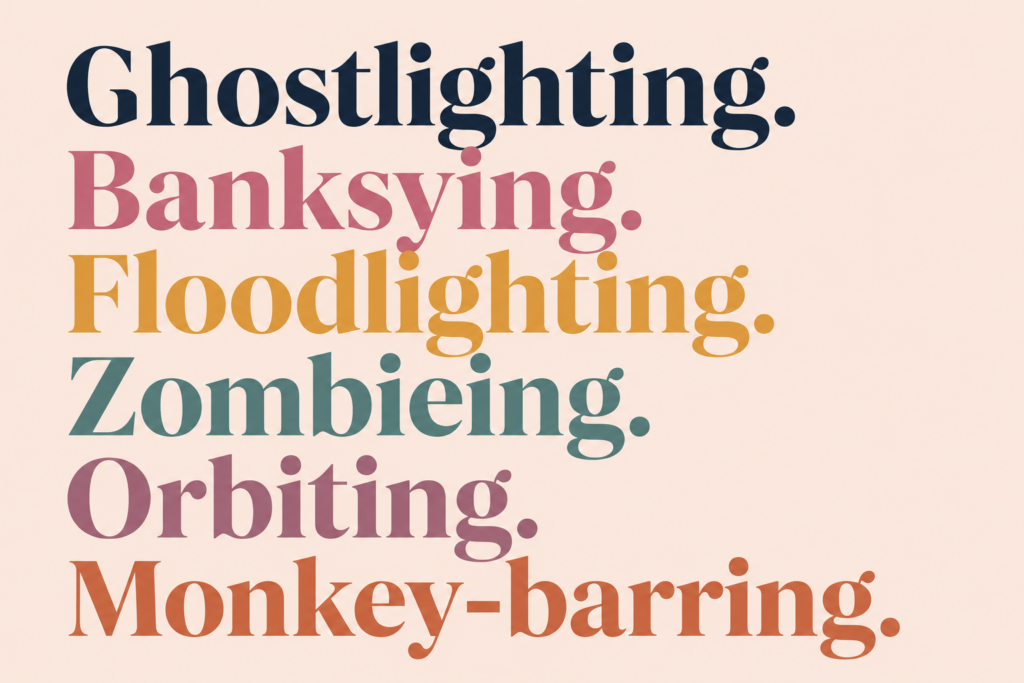
Ghostlighting. Banksying. Floodlighting. Zombieing. Orbiting. Monkey-barring.
Honestly, at this point, dating requires a dictionary.
And if you’re dating after 40, 50 or 60? You may be wondering when exactly you were supposed to take this course.
The funny thing is, while the terminology may be new—and very TikTok-friendly—the behavior behind most of it definitely isn’t.
Dr. Mindy DeSeta, a Doctor of Clinical Sexology, Board-Certified Sex Therapist and Licensed Mental Health Counselor, says putting names to these experiences can actually be helpful.
“Giving these experiences names can help people recognize patterns and realize they are not alone,” says Dr. DeSeta. “The danger is that a catchy term can sometimes replace a more important conversation about what actually happened, how it made someone feel and whether the behavior is acceptable in a healthy relationship.”
So, because apparently we all need continuing education in modern romance, here’s your cheat sheet.
Ghostlighting
Ghosting wasn’t bad enough?
Ghostlighting is ghosting combined with gaslighting.
Someone disappears and then resurfaces, only to deny that the disappearance was a big deal—or suggest that you’re overreacting for questioning it.
What do you mean I disappeared? I was busy.
Please.
Banksying
This one is particularly brutal.
Banksying happens when someone privately begins checking out of a relationship and preparing to leave while allowing their partner to believe everything is perfectly fine.
Then comes the “sudden” breakup.
Except it wasn’t sudden for the person doing the breaking up. They may have been planning their exit for weeks or even months.
Floodlighting
Vulnerability is supposed to build intimacy. But too much vulnerability too soon can create the illusion of intimacy before a relationship has actually earned it.
Floodlighting is sharing extremely personal information, trauma or emotional baggage very early in a new connection.
You know that instant OMG, I’ve never connected with anyone like this feeling?
Maybe you have.
Or maybe you’ve simply learned their entire life story before the appetizers arrived.
Dr. DeSeta points out that genuine intimacy develops with trust and emotional safety—and those things usually take time.
Stashing
You’re dating. You spend weekends together. Maybe you even think you’re in a serious relationship.
There’s just one small problem.
Nobody in their life knows you exist.
Stashing is when someone keeps the person they’re dating hidden from friends, family and social media.
Of course, not everyone needs to announce a relationship on Instagram.
But there’s a difference between private and secret.
The Avoidant Discard
This is when someone slowly withdraws communication, affection and effort without actually having the conversation that says the relationship is over.
But Dr. DeSeta raises an important point: We’ve gotten awfully comfortable diagnosing everyone as “avoidant.”
Sometimes people are emotionally immature. Sometimes they hate confrontation. Sometimes they’ve simply lost interest.
Not every disappointing dater needs an attachment-style diagnosis.
Sometimes a bad boyfriend is just a bad boyfriend.
Monkey-Barring
Picture a monkey swinging from one branch to another without letting go of the first branch until the next one is safely within reach.
You already know where this is going.
Monkey-barring is developing a new romantic connection before ending the relationship you’re already in.
Apparently being single for five minutes is simply too terrifying.
Zombieing
The ghost has risen from the dead.
Someone who disappeared suddenly resurfaces with a text, a reaction to your Instagram Story or the ever-popular:
Hey stranger. How have you been?
No acknowledgment that they vanished.
No explanation.
Just…hello!
That is zombieing.
Personally, I’d need a pretty good explanation before reopening that door.
Orbiting
They don’t call.
They don’t text.
They’re definitely not dating you.
Yet somehow they watch every single Instagram Story you post.
Welcome to orbiting.
Social media allows people to remain on the edges of our lives indefinitely. And that tiny bit of digital attention can keep us thinking about someone long after the actual relationship has ended.
Cushioning
Cushioning is essentially romantic insurance.
Someone maintains flirtations or possible romantic alternatives while still in a primary relationship so they have a soft place to land if things go south.
Old flame on standby?
Flirty coworker?
Someone who is just a friend but somehow texts every night?
You get the idea.
Chalance
Finally, a dating trend I can get behind.
Chalance is the opposite of calculated indifference.
You like someone?
You show it.
You text back.
You make plans.
You communicate.
You allow yourself to care without worrying that enthusiasm somehow makes you less desirable.
Imagine that.
After years of being told not to text too quickly, not to seem too eager and definitely not to let someone know you actually like them, perhaps we’re finally figuring out that emotional availability is attractive.
Micro-Mance
I like this one too.
Micro-mance is about small, consistent expressions of affection rather than over-the-top romantic gestures.
Sending someone a song because it reminded you of them.
Remembering how they take their coffee.
Checking in before an important appointment.
Picking up something they love because you happened to see it.
It’s not love bombing.
It’s paying attention.
And honestly, isn’t that what most of us really want?
Friendfluence
You go on a date.
Then immediately report everything to the group chat.
Within 20 minutes, six friends have analyzed his text punctuation, discussed what his choice of restaurant means and decided whether you should ever see him again.
That’s friendfluence.
Friends can absolutely spot things we miss. But Dr. DeSeta warns that excessive outside analysis can also make daters stop trusting their own experiences.
Sometimes you have to get out of the group chat and decide whether you actually like the person.
Have We Made Dating Too Complicated?
This may be the most interesting part of our ever-expanding dating dictionary.
Having language for confusing behavior can be incredibly useful. A name can help you recognize a pattern and realize you’re not the only person experiencing it.
But I also wonder if we’re in danger of turning every disappointing date or failed relationship into a psychological phenomenon.
Sometimes someone is ghosting.
Sometimes they’re orbiting, cushioning, floodlighting or Banksying.
Sometimes they have an avoidant attachment style.
And sometimes?
They’re just not that into you.
The vocabulary changes.
Human behavior? Not nearly as much.
Which is why my favorite new dating term might be chalance.
Care.
Show up.
Communicate.
If you like someone, let them know.
And at this stage of life, who has time for anything else?
After inventing an entire dictionary to describe all the ways people avoid one another, perhaps we’ve finally arrived at the most radical dating strategy of all:
Just say what you mean.
About Dr. Mindy DeSeta
Dr. Mindy DeSeta is a Doctor of Clinical Sexology, Board-Certified Sex Therapist, Licensed Mental Health Counselor and Board-Certified Hypnotherapist. She is the founder of Insight Counseling Center Miami, a private practice helping individuals and couples build healthier relationships and more fulfilling intimate lives.
