

Influencer marketing is a brand partnership model where companies collaborate with trusted creators to reach engaged audiences and drive measurable outcomes. The global influencer market exceeded $32.55 billion in 2025, and more than 80% of marketers surveyed say it benefits their brand. If you’re starting from scratch, pick one KPI first — say, cost per acquisition or engagement rate — then choose a creator tier to test against it. The FTC Endorsement Guides require clear disclosure on every paid partnership, so build that into your brief before anything goes live. Vetting creators through the 3 Rs — Relevance, Resonance, and Reach — keeps you from chasing follower counts that don’t convert.
Why does influencer marketing actually drive results?
The short answer: people trust people more than they trust ads. A creator who has spent years building an audience around a specific niche carries social proof that a banner ad simply cannot replicate. That trust translates into higher click-through rates, stronger purchase intent, and content that keeps working after the campaign ends.
Here’s what brands consistently gain from well-run influencer campaigns:
- Targeted reach — creators self-select audiences by interest, so your message lands with people already primed for your category.
- Creative assets — creator-produced content can be repurposed across paid social, email, and product pages, extending its value well beyond the original post.
- Scalable word-of-mouth — a cohort of micro-influencers can generate the kind of peer recommendation that feels organic at scale.
- Trust transfer — when a creator vouches for a product in their own voice, their credibility attaches to your brand.
- Conversion lift — affiliate links, promo codes, and shoppable posts create a direct path from content to checkout.
The use cases are wide. A beauty brand launching a new serum can seed product to 50 nano-creators for authentic unboxing content. A DTC food brand can run a seasonal recipe campaign with mid-tier food creators timed to a holiday. A B2B SaaS company can partner with LinkedIn thought leaders to drive demo sign-ups. Hootsuite notes that the industry nearly doubled between 2021 and 2025, and the platform-specific guidance they document shows that the channel works across verticals when strategy is tight. Sprout Social and Influencer Marketing Hub both track benchmark data that confirms awareness and conversion outcomes differ significantly by tier and platform — worth checking before you set budget expectations.
Which influencer tier is right for your campaign?
Choose your tier by campaign objective first, budget second. Nano and micro-creators tend to deliver stronger engagement rates and conversion signals for niche products. Macro and mega influencers scale awareness fast but cost more per post and often show lower engagement percentages.

| Tier | Follower Range | Best For | Typical Cost Range | Primary KPIs |
|---|---|---|---|---|
| Nano | 1K–10K | Hyper-local, niche conversion, UGC seeding | $10–$200/post | Engagement rate, conversions |
| Micro | 10K–100K | Community trust, affiliate sales, product launches | $100–$1,000/post | Engagement rate, CTR, CPA |
| Mid-tier | 100K–500K | Broad awareness + conversion hybrid | $1,000–$5,000/post | Reach, engagement, conversions |
| Macro | 500K–1M | Mass awareness, brand credibility | $5,000–$20,000/post | Reach, impressions, brand lift |
| Mega/Celebrity | 1M+ | Cultural moments, national launches | $20,000+/post | Impressions, share of voice |
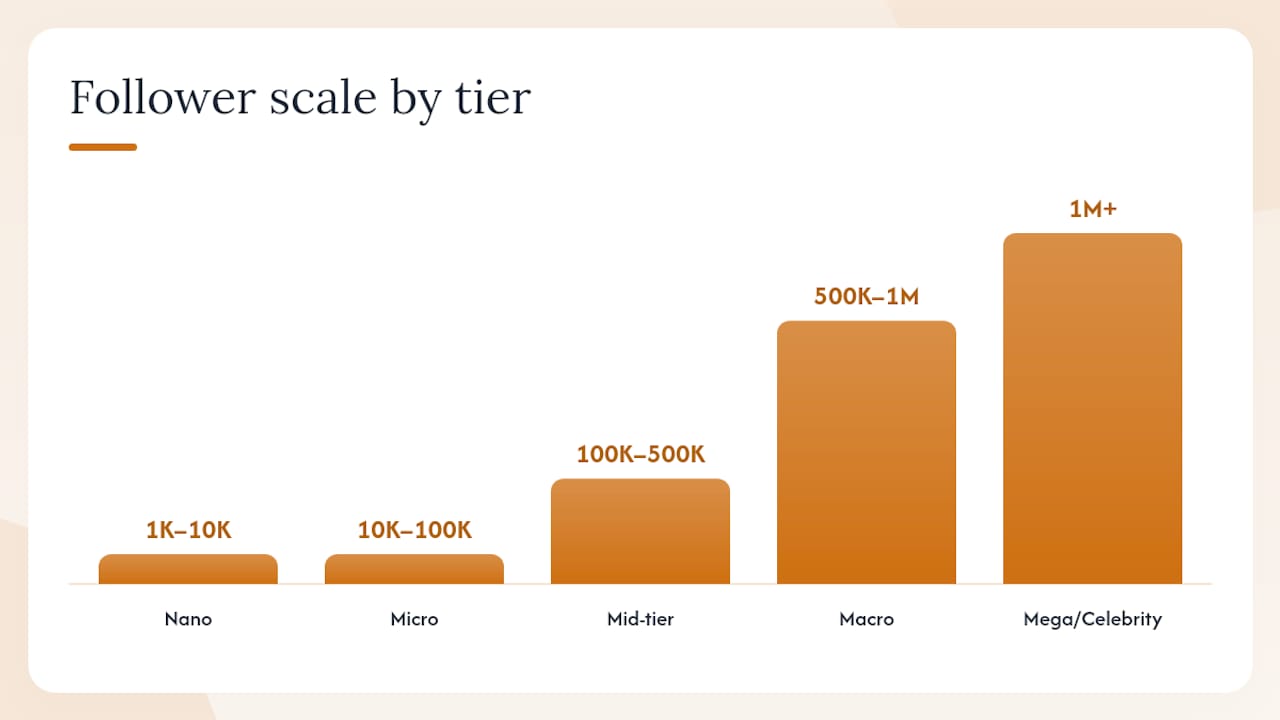
Beyond follower count, pay attention to emerging creator categories. Livestream hosts drive real-time purchase decisions. Subject-matter experts (dermatologists, registered dietitians, financial advisors) carry authority that lifestyle creators don’t. Community leaders — people who run active Discord servers or Facebook groups — often have smaller audiences with unusually high trust and response rates.
When Resonance and Reach conflict, prioritize Resonance. A creator whose audience actively comments, saves, and buys is worth more than one with three times the followers and half the engagement. Coursera’s overview of the 3 Rs frames this well: Relevance (does their content match your category?), Resonance (does their audience engage deeply?), and Reach (how many people will see it?) — in that priority order.
How do you build an influencer marketing strategy step by step?
A solid digital influencer strategy runs from goal-setting through optimization in seven steps. Skip any one of them and you’ll either overspend or under-measure.
- Set your goal and KPI. Awareness campaigns track reach and impressions. Conversion campaigns track CPA, ROAS, or affiliate revenue. Pick one primary KPI before you brief anyone.
- Map your audience and platform. Where does your customer spend time? TikTok skews younger and discovery-driven. LinkedIn suits B2B. Instagram still dominates beauty and lifestyle. Match the platform to the audience, not to your personal preference.
- Choose your creator tier and campaign type. Nano/micro for niche conversion and UGC. Macro/mega for awareness at scale. Gifting for low-cost seeding. Affiliate for performance-tied spend.
- Set budget and measurement infrastructure. Assign budget by tier, build UTM parameters, set up affiliate tracking or unique promo codes, and define your conversion window before outreach starts.
- Write the brief and collaborate creatively. A good brief includes: campaign objective, deliverables (format, quantity, posting schedule), mandatory brand points (product name, key claim, disclosure language), creative guardrails (what to avoid, not a script), and measurement requirements (UTM link, promo code, tagged handle).
- Launch and monitor. Watch engagement quality in the first 24–48 hours. Flag underperforming posts early and check whether the creator followed disclosure requirements.
- Optimize and scale. Double down on creators who hit KPI benchmarks. Negotiate longer-term agreements with top performers. Hootsuite’s strategy guidance consistently points to measurement and iteration as the difference between campaigns that grow and ones that plateau.
KPI mapping at a glance:
- Awareness goal → reach, impressions, share of voice, brand lift surveys
- Consideration goal → video views, saves, profile visits, story swipe-ups
- Conversion goal → affiliate revenue, promo code redemptions, CPA, ROAS
- Retention goal → repeat purchase rate, UGC volume, community growth
How do you find and vet the right creators?
Start with Resonance. A creator’s engagement quality — the ratio of genuine comments to follower count, the specificity of audience questions, the sentiment in replies — tells you more than their follower number ever will.
Discovery tools and methods:
- Platform search — native search on TikTok, Instagram, and YouTube using category hashtags and keywords
- Modash — filters by engagement rate, audience demographics, location, and niche; strong for fraud detection and audience overlap analysis
- Sprout Social — social listening features surface creators already talking about your brand or category
- Creator marketplaces — TikTok Creator Marketplace, Meta’s Brand Collabs Manager, and YouTube BrandConnect connect brands directly with opted-in creators
- Manual search — search your own branded hashtag and product tags; customers who already post about you are warm leads
Vetting checklist before outreach:
- Engagement rate relative to follower count (compare against tier benchmarks)
- Comment quality — are they substantive or generic (“great post!” spam)?
- Audience demographics — age, location, and gender match your customer profile
- Content cadence — are they posting consistently, or going dark for weeks?
- Sponsorship ratio — if more than 30–40% of recent posts are paid, organic trust may be diluted
- Past brand partnerships — any conflicts with competitors or brand-safety concerns?
- Fraud signals — sudden follower spikes, engagement pods, or suspiciously round numbers
Pro Tip: Before cold outreach, search your CRM and social mentions for existing customers who already create content about your product. Recruiting from that pool cuts onboarding time significantly and produces more authentic content — Modash practitioners consistently recommend this as a first step.
For a deeper look at what makes a creator credible beyond the numbers, Stacyknows covers the attributes and authenticity signals that separate genuine influence from manufactured reach.
What campaign models work best for different goals?
Pick your campaign model based on what you need to measure and how much attribution matters. Affiliate campaigns give you clean conversion data. Gifting campaigns generate awareness and UGC at low cost but make direct attribution harder.
Main campaign models:
- Paid post / sponsored content — flat fee for a defined deliverable; best for awareness, product launches, and brand credibility
- Affiliate / performance — creator earns a commission on tracked sales; best when direct conversion attribution is the primary goal
- Product gifting — no fee, just product; best for seeding new products, generating organic reviews, and building a UGC library
- Brand ambassador program — ongoing relationship with recurring deliverables; best for sustained trust-building and long-term ROI
- UGC campaigns — you pay for the content asset itself, not the posting; best for brands that need creative at scale for paid ads
- Co-creation / collaboration — creator co-develops a product, collection, or content series; best for cultural credibility and audience crossover
Modash’s campaign examples show that long-term ambassador programs consistently outperform one-off posts for sustained ROI. The trust a creator builds with their audience over time compounds — a creator who mentions your brand in month one and again in month six carries more weight than two separate creators doing it once each.
For creative briefs, the most common mistake is over-scripting. Give creators the mandatory points — product name, key claim, disclosure language, posting date — and then let them find their own voice.
Ulta Beauty’s TikTok Shop collaboration with Ice Spice is a useful real-world example: the campaign used shoppable livestream commerce to drive discovery and limited-time purchases, pairing creator-led content with a native shopping format that reduced friction between inspiration and purchase.
Contract clauses to include in every agreement:
- Deliverables (format, quantity, platform, posting schedule)
- Usage rights (how long and where the brand can repurpose the content)
- Disclosure obligation (FTC-compliant language required on every post)
- Exclusivity term (category exclusivity window and duration)
- Content approval window (how many days the brand has to review before posting)
- Payment terms (net-30, milestone-based, or performance-triggered)
- Morality clause (brand’s right to terminate if the creator’s conduct creates reputational risk)
How do you measure influencer ROI credibly?
Tie influencer activity to business outcomes, not just impressions. Reach and views tell you how many people saw the content. Conversions, CPA, and affiliate revenue tell you whether it worked.
| Campaign Goal | Primary KPIs | Tracking Method |
|---|---|---|
| Brand awareness | Reach, impressions, share of voice | UTM parameters, platform analytics |
| Consideration | Video views, saves, profile visits | UTM links, pixel events |
| Direct conversion | Affiliate revenue, promo code redemptions, CPA | Affiliate platform, unique codes, UTM |
| Sentiment / brand lift | Comment sentiment, survey data, NPS shift | YouScan, social listening tools |
| UGC / content volume | Number of posts, content quality score | Manual tracking, hashtag monitoring |
YouScan recommends measuring engagement quality and sentiment shifts alongside direct conversions — a campaign that moves brand perception without an immediate sale still has measurable value, especially for awareness-stage programs.
Tracking setup checklist:
- Define baseline metrics before the campaign launches (current CPA, engagement rate, brand search volume)
- Build UTM parameters for every link:
utm_source=influencer&utm_medium=social&utm_campaign=[campaign-name]&utm_content=[creator-handle] - Set up unique affiliate links or promo codes per creator so you can attribute revenue at the individual level
- Create dedicated landing pages for high-investment campaigns to isolate traffic
- Define your conversion window (7-day, 14-day, or 30-day click attribution) before the campaign starts, not after
Earned media value (EMV) is a useful supplementary metric — it estimates what the organic creator content would have cost as paid media. Use it directionally, not as a primary ROI figure, since EMV calculations vary widely by methodology.
What should you budget for influencer campaigns?
Budget to your KPI. If you’re optimizing for cost per engagement, your math looks different than if you’re optimizing for cost per acquisition. The two numbers rarely align, and conflating them is one of the most common budgeting mistakes.
Pricing models:
- Flat fee per post — most common for paid partnerships; negotiated per deliverable
- CPM-style pricing — some macro and mega creators price based on estimated impressions
- Affiliate revenue share — creator earns 10–20% commission on tracked sales; no upfront fee or a reduced one
- Performance bonus — base fee plus a bonus tied to hitting a conversion threshold
- Retainer / ambassador fee — monthly fee for ongoing content and exclusivity
Representative pricing ranges by tier (US market):
- Nano (1K–10K followers): $10–$200 per post; gifting-only arrangements are common
- Micro (10K–100K): $100–$1,000 per post depending on platform and niche
- Mid-tier (100K–500K): $1,000–$5,000 per post; YouTube and long-form content command the higher end
- Macro (500K–1M): $5,000–$20,000 per post
- Mega/Celebrity (1M+): $20,000 and up; celebrity rates can reach six figures for a single post
If you’re working with a managed influencer platform, factor in platform subscription costs as well.
Forecasting approach:
- Start with a small test cohort (5–10 creators across two tiers) before committing full budget.
- Calculate incremental CPA from the test: total spend divided by tracked conversions.
- Compare that CPA against your paid social benchmarks to assess relative efficiency.
- Scale spend toward the creators and tiers that beat your CPA target; pause or renegotiate with those that don’t.
For a broader look at how influencer campaigns fit into a brand’s organic growth strategy, this partner guide on organic growth via creators covers audience-first program planning in useful detail.
What are the FTC disclosure rules for sponsored content?
Disclosure is mandatory. The FTC Endorsement Guides require that any material connection between a brand and a creator — including free product, payment, or a family relationship — be clearly and conspicuously disclosed on every piece of sponsored content. “Clearly and conspicuously” means the disclosure must be hard to miss, not buried in a caption or hidden in a hashtag stack.
FTC disclosure best practices:
- Use plain language: “#ad,” “#sponsored,” or “Paid partnership with [Brand]” at the start of a caption, not the end
- On video content, include a verbal disclosure within the first 30 seconds and a visible on-screen label
- On Instagram, use the native “Paid Partnership” label in addition to a caption disclosure
- On TikTok, use the platform’s branded content toggle and add “#ad” or “#sponsored” in the caption
- Gifted product without payment still requires disclosure if the creator posts about it
- Disclosure must appear on every post in a series, not just the first one
Contract clauses that reduce compliance risk:
- Explicit disclosure obligation with approved language samples
- Brand approval window before posting (typically 48–72 hours)
- Creator representation that all content complies with FTC guidelines
- Indemnification clause covering regulatory fines tied to non-disclosure
- Recordkeeping requirement: creator retains proof of disclosure for a defined period
The FTC has increased enforcement activity in recent years, and brands — not just creators — can be held liable for non-compliant posts. Build disclosure review into your approval workflow, not as an afterthought.
Which platform should you prioritize for creator campaigns?
Optimize creative to platform format first. A 60-second TikTok and a 10-minute YouTube review are different products, not the same content repurposed. Here’s how each major platform behaves:
TikTok
- Best formats: short-form video (15–60 seconds), duets, stitches, shoppable livestreams
- Creative priority: hook in the first 2–3 seconds; native, lo-fi aesthetic outperforms polished production
- KPIs: views, engagement rate, TikTok Shop conversions, hashtag reach
- Measurement note: TikTok’s native analytics track video completion rate, which is a strong signal of content quality
- Best formats: Reels (15–90 seconds), Stories with swipe-up links, carousel posts for product detail
- Creative priority: visual quality matters more here than on TikTok; Stories drive direct link traffic
- KPIs: reach, saves, Story link clicks, affiliate conversions
- Measurement note: use UTM-tagged links in bio and Stories; track saves as a consideration signal
YouTube
- Best formats: dedicated reviews (8–15 minutes), sponsored segments within longer videos, YouTube Shorts
- Creative priority: longer-form content allows deeper product storytelling; search discoverability extends shelf life
- KPIs: views, watch time, click-through on description links, affiliate conversions
- Measurement note: YouTube content has a long tail — a video posted today may drive conversions 6–12 months later
- Best formats: thought leadership posts, short video, document carousels, newsletter mentions
- Creative priority: professional tone; data-backed claims and case studies perform well
- KPIs: impressions, engagement rate, profile visits, demo or lead form completions
- Measurement note: LinkedIn’s conversion tracking integrates with most CRM platforms for B2B attribution
- Best formats: idea pins, shoppable product pins, tutorial-style static images
- Creative priority: evergreen content; Pinterest has a much longer content lifespan than other platforms
- KPIs: saves, outbound clicks, Pinterest-driven revenue via affiliate or shoppable pins
Livestream and shoppable commerce
Structure offers around urgency: limited-time bundles, exclusive discount codes, and real-time Q&A drive the highest conversion rates in live formats. Ulta Beauty’s TikTok Shop livestream campaign with Ice Spice showed how pairing a culturally relevant creator with a shoppable native format can compress the path from discovery to purchase. Measure immediate add-to-cart and checkout events during the live window, then track post-live replay conversions separately.
For a broader read on where platform formats are heading, Stacyknows covers social media trends for 2026 with practical notes on format shifts marketers should watch.
What mistakes kill influencer campaigns before they start?
Most wasted influencer spend traces back to three problems: poor creator fit, weak measurement setup, and over-scripted briefs. Fix those three and you’ve eliminated the majority of campaign failures.
Red flags when vetting creators:
- Sudden follower spikes with no corresponding content moment — a classic sign of purchased followers
- High sponsorship-to-organic ratio (more than 40% of recent posts are paid partnerships)
- Generic engagement — comments like “nice!” or emoji-only responses with no substantive replies
- Audience location mismatch — a US-targeted campaign with a creator whose audience is 70% outside the US
- Competitor conflicts in recent posts — check the last 90 days of content
- Inconsistent posting cadence — long gaps suggest low platform priority or audience drift
Pre-launch checklist:
- Campaign KPI and measurement infrastructure confirmed (UTMs live, affiliate links tested, promo codes active)
- Creator contract signed with disclosure language, usage rights, and approval window defined
- FTC disclosure language approved and included in the brief
- Content reviewed and approved before posting date
- Baseline metrics captured (current CPA, engagement rate, brand search volume)
- Brand safety check completed on creator’s recent content and public statements
If a brand-safety incident happens after launch:
- Pause paid amplification of the creator’s content immediately
- Assess whether the incident is isolated or part of a pattern
- Invoke the morality clause in the contract if the situation warrants termination
- Prepare a brief internal statement for stakeholders; avoid public commentary unless the incident becomes widely covered
- Document the timeline for legal and compliance records
What do the numbers say about influencer marketing performance?
The benchmarks are clear: this channel is growing, and long-term programs outperform short-term ones. Statista’s global market-size data tracks the industry’s trajectory, and the numbers justify serious budget allocation for brands that measure correctly.
Key figures and benchmarks:
- The global influencer market exceeded $32.55 billion in 2025, reflecting sustained investment across verticals
- More than 80% of marketers report that influencer marketing benefits their brand
- Hootsuite documents that the industry nearly doubled between 2021 and 2025
The 3 Rs framework — Relevance, Resonance, Reach — is the most widely cited selection model in the industry, and Coursera’s foundational overview explains why prioritizing Resonance over raw Reach tends to produce higher conversion rates. A creator with 20,000 highly engaged followers in your exact niche will often outperform one with 500,000 passive ones.
YouScan’s analysis notes a clear industry shift from transactional one-off posts toward longer-term ambassador partnerships and co-created content. The brands seeing the best sustained ROI are the ones treating creators as ongoing collaborators, not ad placements.
Research-backed recommendations:
- Allocate at least 20–30% of your influencer budget to ambassador or retainer agreements rather than one-off posts
- Run hybrid campaigns that combine gifting for awareness with affiliate tracking for conversion, so you measure both ends of the funnel in the same program
- Test at least two creator tiers per campaign cycle to build comparative CPA data
- Review creator performance quarterly and reallocate budget toward top performers rather than spreading evenly
- Track sentiment alongside conversion metrics — a campaign that improves brand perception without an immediate sale still moves the funnel
For brands building ROI forecasts before pitching influencer budgets internally, this partner resource on boosting brand visibility and ROI offers tactical templates worth reviewing.
Stacy’s take: what actually works right now
The thing I keep coming back to is this: the brands winning at influencer marketing right now are not the ones with the biggest budgets. They’re the ones treating creators like partners instead of ad units.

The shift is real. YouScan’s trend data and Modash’s practitioner research both point in the same direction — long-term ambassador programs, co-created content, and hybrid measurement models are outperforming the old “pay for a post, count the likes” approach. And yet most brands are still running one-offs.
My practical recommendation right now: build a micro-ambassador cohort from your existing customers. Find 10–15 people who already mention your product organically, reach out personally, and offer them a simple ambassador structure — product access, a small fee or commission, and creative freedom. That last part matters more than most brands realize. The creator authenticity research Stacyknows has covered shows that over-scripted content consistently underperforms content where the creator speaks in their own voice.
At Stacyknows, we’ve seen this play out in the lifestyle and beauty space specifically. Brands that give creators room to be themselves — and pair that with clean affiliate tracking and FTC-compliant disclosures — get both authentic content and measurable results. That combination is harder to build than a one-off campaign, but it compounds over time in a way that single posts never do.
If you’re a brand manager reading this and wondering where to start, Stacy’s own story is rooted in exactly this kind of authentic, community-first approach to content. The principles translate directly to how you should be thinking about your creator relationships.
Sources
A compact reference list of the tools, reports, and regulatory resources worth bookmarking:
- Influencer marketing: Top strategies to maximize ROI in 2026
- Global influencer market size (Statista)
- What Is Influencer Marketing? How to Develop Your Strategy | Coursera
Recommended
- Local Influencer: Your 2026 Community Growth Guide – Stacyknows
- What Makes Someone An Influencer? I asked ChatGPT – Stacyknows
- Social Media Trends in 2026: What Marketers Need to Know – Stacyknows
- 7 Benefits Associated with Mastering Super Affiliate Marketing – Stacyknows
