

Understanding the Role of Mental Health Counseling
Every relationship thrives on connection, with effective communication at its heart. Yet, for many couples, truly connecting through dialogue can feel like a constant struggle. This often leads to misunderstandings, frustration, and emotional distance. Research indicates that a significant 65% of divorces stem from poor communication, underscoring the vital need for couples to develop stronger dialogue skills.
This extensive guide will explore how couples can overcome these hurdles. We will uncover the most common communication barriers and provide practical strategies to navigate them. From establishing clear ground rules to mastering active listening and assertive expression, we will equip couples with essential skills. We will also examine how professional support, such as Couples mental health counseling, offers a structured path to deeper understanding and emotional intimacy. Our aim is to help couples build stronger, more resilient bonds through improved dialogue.
Mental health counseling serves as a crucial resource for individuals navigating life’s challenges, offering a safe and confidential space to explore thoughts, feelings, and behaviors. It’s a journey of self-discovery and growth that can profoundly impact not only personal well-being but also the health of our relationships. By fostering emotional safety, individuals can develop a deeper sense of self-awareness, identifying patterns and triggers that might contribute to personal or relational distress. This process equips them with effective coping skills, enabling them to manage stress, anxiety, and other emotional responses more constructively. Mental health counseling supports positive behavioral change and personal growth, laying a solid foundation for healthier interactions with others.

The Core Goals of Mental Health Counseling
At its heart, mental health counseling aims to establish a strong therapeutic alliance between the client and the counselor. This partnership is built on trust and mutual respect, providing a secure environment for addressing sensitive issues. A primary goal is to assist clients in setting realistic and meaningful goals for their personal development and relational improvement. Through various therapeutic techniques, individuals learn emotional regulation, gaining the ability to understand and manage their emotional responses rather than being overwhelmed by them. This process often leads to enhanced self-esteem, as clients recognize their inherent worth and capabilities. Moreover, counseling cultivates resilience, empowering individuals to bounce back from adversity and navigate future challenges with greater strength and adaptability. These individual achievements collectively contribute to a more stable and emotionally intelligent partner, which is invaluable in any relationship.
When to Seek Professional Support
Recognizing when to seek professional support is a sign of strength, not weakness. Life inevitably presents stressors, but when these become overwhelming and persistent, they can significantly impact our mental and emotional well-being. Chronic stress, for instance, can manifest as physical symptoms, irritability, and difficulty concentrating, making it challenging to engage positively in a relationship. Similarly, persistent anxiety can create a constant state of worry, affecting sleep, decision-making, and emotional availability. Major life transitions, such as career changes, relocation, or the arrival of children, can also introduce unforeseen pressures that strain individual and relational coping mechanisms.
Relationship distress, characterized by frequent arguments, emotional distance, or a sense of being perpetually misunderstood, is a clear indicator that professional guidance might be beneficial. When couples find themselves stuck in repetitive negative patterns, or when communication breaks down entirely, an impartial third party can offer new perspectives and tools. Emotional exhaustion, a state of feeling completely drained and unable to cope with daily demands, can further exacerbate these issues, making it difficult to initiate positive change. Seeking counseling during these times can provide the necessary tools and strategies to navigate these challenges, preventing further deterioration and fostering a path towards healing and growth.
Rebuilding Connection: The Impact of Relationship Therapy
Relationship therapy, often referred to as couples counseling, is specifically designed to help partners improve their relationship satisfaction and deepen emotional intimacy. It provides a structured environment where couples can address underlying issues, learn new communication patterns, and strengthen their bond. The goal is not just to resolve conflicts but to build a more resilient and fulfilling partnership.
Central to relationship therapy is the development of effective conflict resolution strategies. Instead of avoiding disagreements or allowing them to escalate into damaging arguments, couples learn to approach differences constructively. This involves understanding each other’s perspectives, validating feelings, and working collaboratively towards solutions. A significant aspect of this process involves enhancing active listening skills, where partners learn to truly hear and comprehend what the other is communicating, rather than simply waiting for their turn to speak. This deepens mutual understanding and reduces misunderstandings.
Another key concept in relationship therapy is the “emotional bank account.” Just as a financial bank account requires deposits to grow, an emotional bank account thrives on positive interactions, gestures of affection, and expressions of appreciation. Regular “deposits” of kindness, understanding, and support build a reserve of goodwill that can buffer the relationship during times of stress or conflict. Conversely, “withdrawals” in the form of criticism, neglect, or defensiveness deplete this account, leading to emotional bankruptcy. Relationship therapy helps couples identify ways to make consistent deposits, fostering a richer, more secure emotional connection. Engaging in specialized support, such as professional couples mental health counseling, can provide targeted strategies and insights to navigate these complex dynamics and cultivate a thriving partnership.
Overcoming Common Communication Barriers
Many couples find themselves entangled in recurring communication barriers that erode connection and foster resentment. Recognizing these roadblocks is the first step toward dismantling them.
One prevalent barrier is defensive responses. When one partner feels attacked or blamed, their natural instinct is often to defend themselves, leading to arguments rather than resolutions. This can manifest as making excuses, counter-attacking, or denying responsibility.
Stonewalling occurs when one partner disengages from the conversation, often physically or emotionally withdrawing. This might involve giving silent treatment, changing the subject, or walking away. While often an attempt to self-soothe when feeling overwhelmed, it leaves the other partner feeling ignored, invalidated, and abandoned.
Criticism, distinct from expressing a complaint, involves attacking a partner’s character or personality rather than focusing on a specific behavior. Phrases like “You always…” or “You never…” are hallmarks of criticism and tend to trigger defensiveness.
Assumptions are another common pitfall. Partners often believe they know what the other is thinking or feeling without actually asking, leading to misunderstandings and resentment. These unverified beliefs can dictate reactions and responses, creating a cycle of misinterpretation.
Finally, emotional flooding describes a state where one or both partners become so overwhelmed by intense emotions (like anger, fear, or sadness) that their ability to process information and communicate rationally is severely impaired. During flooding, the body’s fight-or-flight response kicks in, making constructive dialogue nearly impossible. Recognizing the signs of flooding and taking a break is crucial for effective communication.
The Power of Active Listening and Validation
Active listening is a cornerstone of effective couples communication, moving beyond simply hearing words to truly understanding and empathizing with a partner’s message. It involves giving full attention, both verbally and nonverbally, and demonstrating that you are engaged and attempting to comprehend their perspective.
A key component of active listening is reflective dialogue, where the listener paraphrases or summarizes what they heard their partner say. This isn’t about agreeing, but about confirming understanding. For example, “So, what I hear you saying is that you feel frustrated when I don’t help with chores because it makes you feel unsupported, is that right?” This practice minimizes misunderstandings and ensures that the speaker feels heard.
Empathy is inextricably linked to active listening. It’s the ability to put yourself in your partner’s shoes and understand their feelings, even if you don’t share the same perspective or agree with their point of view. Expressing empathy, such as “I can see why that would make you feel overwhelmed,” validates their emotional experience and fosters emotional safety.
Nonverbal cues play a significant role. Maintaining eye contact, nodding, and having an open body posture signal attentiveness and receptiveness. Conversely, looking away, crossing arms, or fidgeting can convey disinterest or defensiveness, shutting down communication.
Active listening and validation build mutual understanding and strengthen the emotional connection between partners. When individuals feel genuinely heard and understood, trust deepens, and they are more likely to be open and vulnerable, creating a positive feedback loop for healthier communication. This skill is not innate; it requires conscious practice and commitment from both partners.
Practical Strategies for Healthy Relationship Dialogue
Effective communication is a skill set that can be learned and refined. By implementing practical strategies, couples can transform their interactions from conflict-ridden to constructive. Establishing clear communication ground rules is a foundational step, setting expectations for how discussions will unfold. These rules might include agreeing to no yelling, no interrupting, or taking breaks when emotions run high. Developing assertive communication skills allows partners to express their needs and feelings clearly and respectfully, without resorting to blame or aggression. The consistent use of ‘I’ statements is a powerful tool in this regard, shifting the focus from accusation to personal experience. Furthermore, learning conflict de-escalation techniques can prevent disagreements from spiraling out of control, ensuring that even heated discussions remain productive.

Structuring Assertive and Blameless Expression
Assertive communication is about expressing your thoughts, feelings, and needs directly and respectfully, without infringing on your partner’s rights or becoming aggressive. It stands in contrast to passive communication (where needs are suppressed) and aggressive communication (where needs are expressed at the expense of others). A key technique for assertive and blameless expression is the “soft start-up,” which focuses on the speaker’s feelings and needs rather than criticizing the partner’s behavior.
A classic formula for a soft start-up is: “I feel [emotion] when [describe specific situation/behavior without blame] and I need/would prefer [specific positive request].”
For example, instead of saying, “You never help with the dishes, you’re so lazy!” (criticism), an assertive soft start-up would be: “I feel overwhelmed when the dishes pile up in the sink, and I would really appreciate it if we could work together to keep the kitchen tidy.”
This approach emphasizes expressing needs clearly and uses positive language to frame requests. It avoids the accusatory “you” statements that often trigger defensiveness. By focusing on your own emotional experience and making a clear, actionable behavioral request, you invite your partner to respond constructively. This also involves cultivating vulnerability, sharing your inner experience rather than masking it with anger or blame. Practicing this method regularly, even for minor issues, can significantly improve the tone and outcome of your conversations.
Implementing the Speaker-Listener Technique
The Speaker-Listener Technique is a structured communication method designed to ensure that both partners feel heard and understood, particularly during difficult conversations. It establishes clear roles and rules to prevent common communication pitfalls like interrupting, mind-reading, and defensiveness.
Here’s how it works:
- Designate Roles: One partner is the “Speaker,” and the other is the “Listener.” A physical object, often referred to as a “talking stick” (or even a remote control), can be used to symbolize who has the floor. Only the person holding the object can speak.
- Speaker’s Role: The Speaker expresses their thoughts and feelings in short, digestible chunks, using “I” statements. They focus on one topic at a time and aim for clarity, describing their experience without criticism or blame. For example, “I feel frustrated when I come home and the house is messy.”
- Listener’s Role: The Listener’s sole job is to actively listen and then paraphrase what they heard the Speaker say. They do not offer their own opinion, agree, disagree, or problem-solve. Their response might be, “So, what I hear you saying is that you feel frustrated when you see the house messy after work.”
- Speaker’s Confirmation: The Speaker then confirms if the Listener’s paraphrase was accurate. If not, they rephrase their message until the Listener accurately reflects it.
- Switch Roles: Once the Speaker feels fully heard and understood on that point, the roles switch, and the Listener becomes the Speaker.
This technique is invaluable for separating discussion from solution. During the Speaker-Listener phase, the focus is purely on understanding each other’s perspectives and feelings. Problem-solving is deferred until both partners feel fully heard. This structured approach helps maintain emotional composure, as the rules prevent escalation and ensure that intense emotions are acknowledged rather than ignored or dismissed. Regular practice builds the muscle of active listening and empathetic understanding, even outside the formal structure.
The Value of Regular Relationship Check-Ins
In the hustle and bustle of daily life, it’s easy for couples to drift apart, allowing small issues to fester into larger problems. Regular relationship check-ins, often called “couples meetings” or “state of the union” talks, provide a dedicated, protected time for partners to connect, address concerns, and reinforce their bond. These aren’t impromptu arguments; they are scheduled, intentional conversations designed to strengthen the relationship.
A typical structure for a 30-minute check-in might include three main components:
- Appreciation (10 minutes): Begin by expressing genuine appreciation for each other. This could be acknowledging specific actions, qualities, or efforts. This positive start sets a constructive tone and builds the emotional bank account.
- Planning for Good Times (10 minutes): Discuss upcoming events, plan dates, vacations, or simply brainstorm fun activities to do together. This reinforces the idea of the couple as a team looking forward to shared experiences and strengthens their connection.
- Problem-Solving/Addressing Concerns (10 minutes): This is the time to gently bring up any issues or concerns that have arisen. The goal is not to solve everything in one session, but to acknowledge problems, understand each other’s perspectives, and perhaps schedule a longer discussion if needed. This prevents issues from accumulating and becoming overwhelming.
These meetings are crucial for aligning on shared values and goals, ensuring both partners feel their contributions are seen and that their future together is being actively shaped. The consistency of these check-ins normalizes healthy dialogue as a staple in the relationship, rather than something reserved only for crises.
Feature Unstructured Arguments Structured Couples Meetings Timing Spontaneous, often during high stress or fatigue Scheduled, dedicated time Focus Blame, past grievances, winning the argument Mutual understanding, appreciation, future planning, problem-solving Emotional Tone High defensiveness, criticism, emotional flooding Respectful, empathetic, focused on connection Outcome Unresolved issues, resentment, emotional distance Increased intimacy, clarity, proactive solutions, strengthened bond Rules Often none, leading to interruptions and escalation Clear ground rules (e.g., no yelling, active listening) 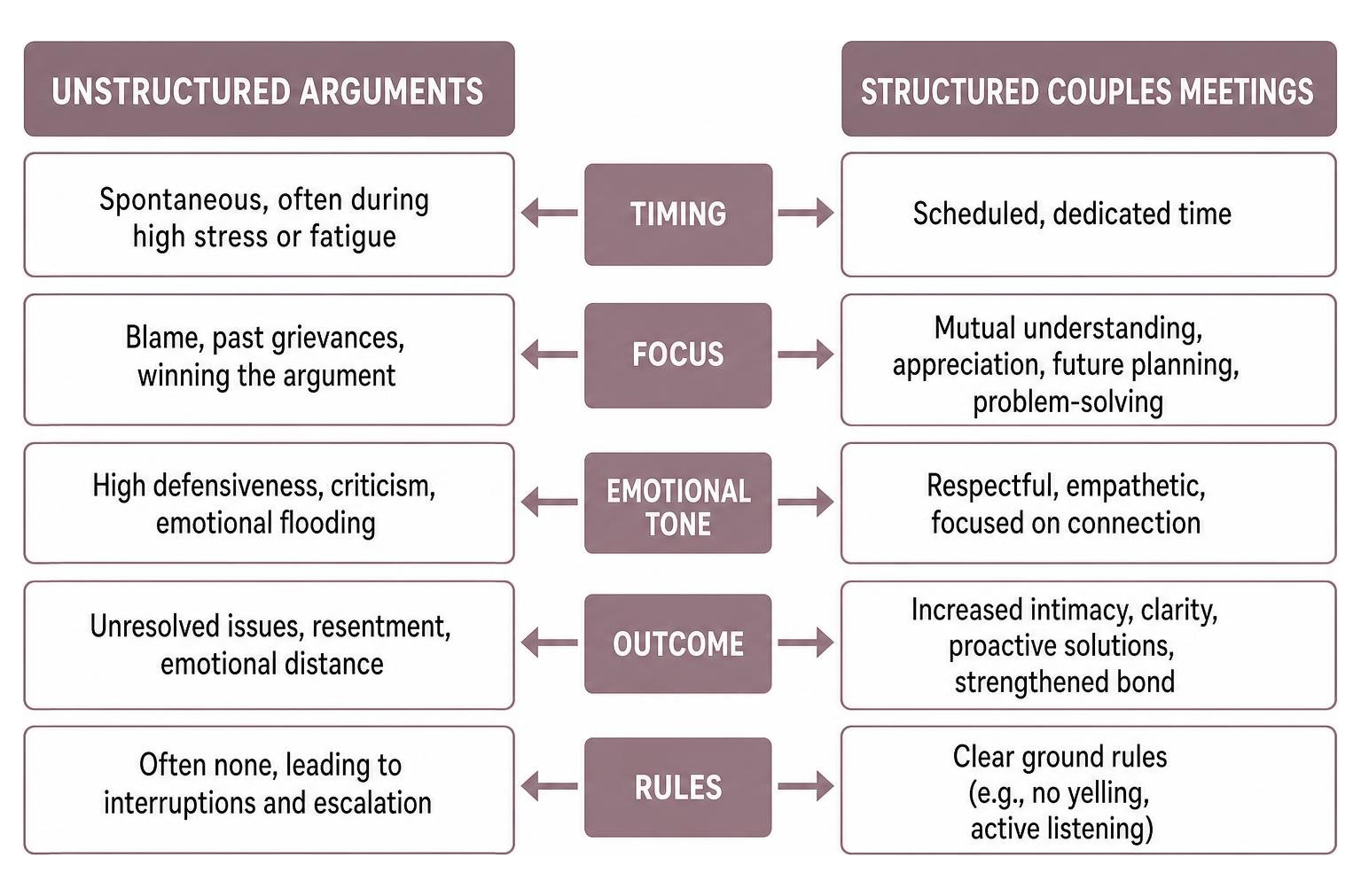
By committing to these regular check-ins, couples can proactively manage their relationship, ensuring that communication remains open, respectful, and supportive. This practice cultivates a “we-ness” mindset, fostering a team approach to both internal and external challenges.
Navigating Emotional Triggers and Conflict Resolution
Even with the best communication skills, emotional triggers and conflict are inevitable in any relationship. The way couples navigate these moments, however, can either strengthen their bond or cause significant damage. Emotional triggers are often deeply personal, stemming from past experiences or core insecurities, and can instantly shift a discussion into a heated argument. They can activate the body’s fight-or-flight response, making rational thought difficult. Learning to identify these triggers in oneself and one’s partner is crucial.
When a discussion escalates and emotions run high, a time-out strategy becomes invaluable. This involves one or both partners recognizing the signs of emotional flooding (e.g., racing heart, tension, anger) and agreeing to pause the conversation. The time-out is not an escape, but a commitment to self-soothing and returning to the discussion once calm. This might involve deep breathing, going for a walk, or engaging in a relaxing activity. The key is to re-engage within an agreed-upon timeframe, typically 20-30 minutes later, when both partners can approach the topic with greater composure.
Crucially, knowing how to make repair attempts is vital for effective conflict resolution. These are any statement or action that prevents negativity from escalating out of control. It could be a simple apology, a touch, a joke, or acknowledging your partner’s feelings. Repair attempts signal that the relationship is more important than the argument itself, helping to de-escalate tension and move towards resolution.
Managing Reactivity with Mental Health Counseling
Understanding and managing reactivity, especially during emotionally charged discussions, is a complex process often rooted in individual histories. Our responses in relationships are frequently shaped by childhood patterns and attachment styles developed early in life. For instance, someone with an anxious attachment style might react to perceived distance with pursuit and protest, while someone with an avoidant style might withdraw. These ingrained patterns can lead to automatic, often unhelpful, reactions to emotional triggers.
Mental health counseling provides a supportive environment to explore these deep-seated influences. Through therapy, individuals can gain insight into how their past experiences contribute to their current emotional regulation challenges. They learn to identify the origins of their reactivity, understanding why certain words or actions from a partner might trigger an intense emotional response.
A significant aspect of this work involves cultivating vulnerability. Many reactive behaviors are defensive mechanisms designed to protect us from perceived hurt or rejection. Counseling helps individuals safely explore and express their underlying vulnerabilities, fostering a deeper, more authentic connection with their partner. This process can also be instrumental in healing trauma, whether big or small, that might be contributing to hyper-reactivity or emotional shutdown in relationships. By addressing these individual psychological foundations, couples counseling can equip both partners with greater self-awareness and healthier emotional tools, allowing them to respond to each other with empathy and understanding rather than automatic, defensive reactions.
Rebuilding Trust and Repairing Breakdowns
Communication breakdowns inevitably occur, and when they do, the ability to repair the damage and rebuild trust is paramount for relationship longevity. Repair is not about erasing the past, but about acknowledging the hurt, taking responsibility, and making amends in a way that allows the relationship to move forward.
Central to this process are effective apologies. A genuine apology goes beyond simply saying “I’m sorry.” It involves:
- Acknowledging the hurt: “I’m sorry that my words made you feel dismissed.”
- Taking responsibility: “I realize that I was insensitive and I take full responsibility for that.”
- Expressing remorse: “I feel terrible that I caused you pain.”
- Stating intent for change: “I will work on being more mindful of how I phrase things in the future.”
- Asking for forgiveness: “Can you forgive me?”
This level of taking responsibility is crucial because it validates the other person’s experience and shows a commitment to growth. It moves away from blaming and towards accountability.
Furthermore, direct requests play a vital role in repair. Instead of expecting a partner to intuitively know what is needed, clearly articulating needs helps rebuild safety. For example, “I need some reassurance that you still value my opinions” is more effective than silent resentment.
Rebuilding trust and fostering emotional reconnection requires consistency. It’s not a one-time fix but an ongoing commitment to demonstrating changed behavior, maintaining open communication, and continuously making deposits into the emotional bank account. Over time, these consistent efforts demonstrate reliability and care, gradually repairing the fabric of trust that may have been frayed by communication breakdowns.
Frequently Asked Questions About Mental Health Counseling
Navigating professional therapy and relationship support can bring up many questions. Here, we address some common inquiries to help clarify the process and benefits of mental health counseling for individuals and couples.
What is the primary difference between individual therapy and couples counseling?
Individual therapy focuses on one person’s thoughts, feelings, behaviors, and personal history. The goal is to help that individual achieve personal growth, address mental health concerns, and develop coping strategies. While individual therapy can certainly impact relationships positively, the primary client is the individual. Couples counseling, on the other hand, involves both partners and focuses on the dynamics of the relationship itself. The “client” is the relationship, and the therapist helps the couple improve communication, resolve conflicts, and strengthen their bond as a unit. It addresses how two individuals interact and influence each other.
How does mental health counseling help couples break negative communication cycles?
Mental health counseling helps couples break negative communication cycles by first identifying these destructive patterns. A therapist acts as an impartial guide, observing the couple’s interactions and helping them recognize where and how their communication goes awry (e.g., one partner criticizes, the other stonewalls). The counselor then teaches specific, healthier communication skills, such as active listening, assertive expression (‘I’ statements), and conflict de-escalation techniques. They also help couples explore the underlying emotions and unmet needs that drive these cycles, fostering empathy and understanding. By practicing new ways of interacting in a safe, guided environment, couples can gradually replace old, unhelpful patterns with constructive, connecting ones.
When should a couple seek professional therapy instead of trying to resolve issues on their own?
Couples should consider seeking professional therapy when they find themselves stuck in recurring, unresolved conflicts, or when communication has broken down to the point where they feel distant, misunderstood, or resentful. Signs that professional help might be beneficial include constant arguments, emotional flooding, stonewalling, feeling like roommates rather than partners, infidelity, or if one or both partners are experiencing significant distress (e.g., anxiety, depression) that impacts the relationship. If self-help books, articles, or personal efforts haven’t led to lasting positive change, or if issues are escalating, a professional can provide the objective perspective, structured tools, and specialized expertise needed to navigate complex relational challenges effectively. It’s often more beneficial to seek help proactively rather than waiting until the relationship is in crisis.
Conclusion
Cultivating strong, resilient relationships is a continuous journey that demands conscious effort and effective communication. As we have explored, understanding and overcoming common communication barriers, embracing active listening, and mastering assertive expression are fundamental skills for any couple. From establishing clear ground rules and practicing the Speaker-Listener Technique to navigating emotional triggers and making genuine repair attempts, each strategy plays a vital role in fostering deeper connection and mutual understanding.
The path to emotional wellness and healthy relationships is not always easy, but couples do not have to walk it alone. Professional guidance offers invaluable support, providing structured frameworks, expert insights, and a safe space to learn and grow. By investing in communication skills training, couples can transform their interactions, build stronger bonds, and enjoy long-term stability and satisfaction. For those ready to embark on this transformative journey, seeking specialized support can be the most impactful step towards a more connected and fulfilling partnership.
