
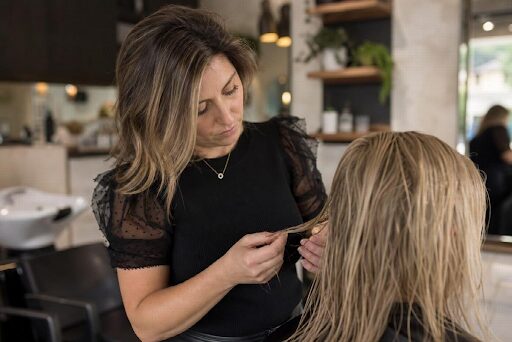
Fine or thinning hair requires a precise pre-extension assessment before any method is selected or applied, which is exactly why hair extensions for fine hair demand more planning than standard applications. Skipping that evaluation risks damage to fragile strands, visible attachment points, and results that fail within weeks. David Ryan Salon, serving clients throughout Flower Mound and the surrounding region, approaches every extension consultation with a thorough review of hair density, scalp condition, and strand integrity before recommending a single technique.
Fine and Thinning Hair Are Not the Same Condition
Fine hair and thinning hair describe two distinct biological conditions. Fine hair refers to individual strand diameter, generally classified as under 0.05 to 0.06 mm, and is largely genetic. Thinning hair describes reduced follicular density, which can result from androgenetic alopecia, postpartum hormonal shifts, telogen effluvium, or mechanical traction damage.
Conflating these two conditions produces incorrect method selection. A client with fine strands but full density requires a different protocol than a client with active follicular thinning. Applying the wrong method risks scalp stress, follicle damage, and premature extension failure. A structured pre-extension assessment covering strand diameter, tensile strength, scalp health, and density mapping is required before any recommendation for David Ryan Salon’s hair extensions can be made.
Evaluating Hair Strand Diameter and Tensile Strength
Strand diameter and tensile strength determine which attachment methods are safe and which will cause progressive damage at the attachment point.
How Stylists Measure Strand Diameter
Strand diameter is assessed through tactile evaluation and visual inspection, often cross-referenced against a strand comparison card. Fine hair in the lower diameter range lacks the structural mass to support a full weft without fracturing at the attachment point. Seasonal humidity across Denton County elevates strand porosity, which can further compromise adhesive performance, a factor stylists weigh when choosing bonded versus bead-based methods.
Areas of active thinning, follicular sensitivity, or visible scalp conditions are flagged during this phase. Compromised density zones contraindicate certain attachment methods entirely, and an honest density map prevents bonds from being placed over fragile areas.
Tensile Strength Testing
Tensile strength is evaluated through a gentle manual stretch test. Hair that snaps under minimal tension is not a candidate for any extension method until a conditioning protocol restores elasticity. David Ryan Salon’s hair extensions consultation includes this assessment to identify the best extension method for thin hair before any application begins.
Chemically processed hair, bleached, box-dyed, or relaxed, frequently presents with reduced tensile strength. Tape-in and micro-link extensions place the least mechanical load on fine strands by distributing weight across small subsections. Fusion or keratin-bond methods apply heat and bond weight that generate traction stress on structurally weakened hair. A stylist who skips this step risks strands that may already be near their breaking point.
Frequently Asked Questions
Can fine hair support the weight of extensions?
Fine hair can support extensions when attachment load is distributed across a properly sized subsection. Tape-in and nano-bead methods are preferred because they spread tension across a broader base rather than concentrating stress at a single point. The answer depends on strand diameter, density, and method selection rather than a blanket restriction.
Will extensions make thinning hair worse?
Extensions applied without a prior assessment can accelerate thinning by adding tension to follicles already in a weakened state. When the cause of thinning is identified first and the correct method is selected, extensions for thinning hair do not inherently worsen the condition. Attaching weight to a compromised scalp without addressing the underlying cause is what creates risk, not the extensions themselves.
How do stylists determine which extension method is right for fine hair?
A recommendation for the best extension method for thin hair is based on strand diameter, tensile strength, scalp health, density distribution, and the identified cause of thinning. No single method suits every presentation. David Ryan Salon’s hair extensions assessment covers each variable before any method is proposed.
Are there extension methods that do not require heat or adhesive?
Micro-link and nano-bead extensions attach using a small metal bead crimped around a natural hair subsection, with no heat or adhesive. This makes them a lower-chemical-stress option for previously processed or color-treated hair, particularly for clients in the 75022 and 75028 ZIP codes who have undergone prior chemical services.
How often do tape-in extensions need to be maintained for fine-haired clients?
Tape-in extensions typically require re-application every six to eight weeks. A six-week re-check is recommended for fine-haired clients specifically because thinner strands hold less adhesive contact area, so slippage appears sooner and the natural hair beneath the tape needs earlier inspection to confirm it is maintaining condition.
About David Ryan Salon
David Ryan Salon is a full-service hair salon located in Flower Mound, Texas, serving clients throughout Denton County and surrounding communities including Highland Village, Argyle, and the broader DFW region. The salon offers a structured consultation process covering hair extensions, color services, and scalp health assessments, with a focus on matching technical methods to each client’s specific hair profile.
Business Name: David Ryan Salon
Address: 4151 Cross Timbers Road Suite 150, Flower Mound, TX 75028
Phone Number: (972) 691-0022
